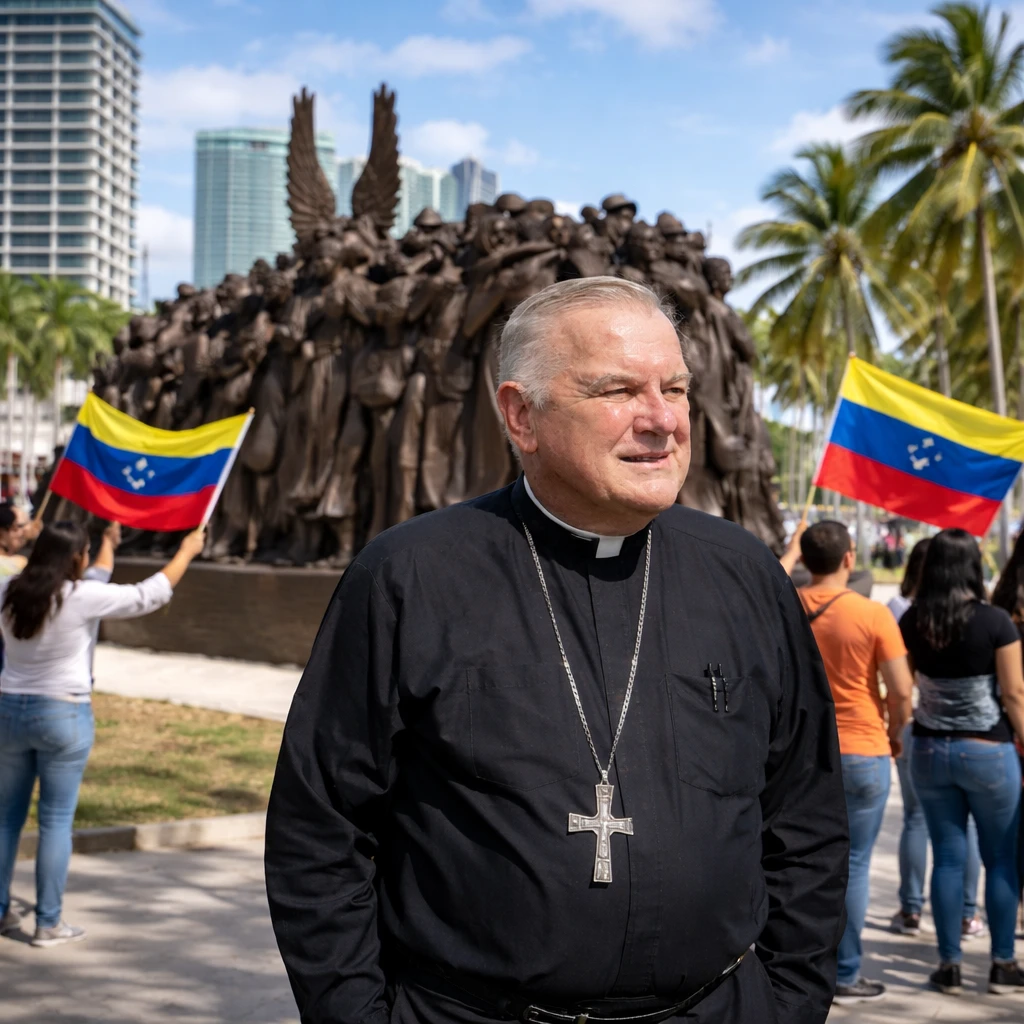
Within Venezuela itself, initial official reactions from the Catholic bishops’ conference and the Evangelical Council of Venezuela have been measured, each urging calmness and patience as the situation unfolds. Contrastingly, a number of pastoral figures serving Venezuelan diaspora congregations have expressed support for the removal of Maduro from power. The Catholic archbishop of Miami, overseeing a sizable Venezuelan population in the city, acknowledges widespread anxiety concerning the nation's future but underscores the important role the Church holds in aiding Venezuela's advancement as a country predominantly Catholic in faith.
Since 2014, an estimated 8 million Venezuelans have emigrated, initially to neighboring Latin American and Caribbean nations. More recently, post-pandemic migration patterns reveal an increasing number of Venezuelans undertaking arduous journeys such as trekking through jungles in Colombia and Panama or flying into the US under humanitarian parole sponsored by financial backers. Many have concentrated in South Florida, which today hosts the largest Venezuelan community in the United States. The area's residents publicly displayed their sentiments by taking to the streets waving national flags in joyous celebration after news of Maduro and his spouse’s capture surfaced.
Even so, the reaction is not universally celebratory. Miami Archbishop Thomas Wenski notes that despite relief regarding Maduro’s exit, uncertainty around future developments remains pervasive. Complications for Venezuelan migrants in the United States have been compounded by recent policy changes — since early February, two federal programs affording legal living and working status to over 700,000 Venezuelans were rescinded by the Trump administration. This revocation has led to fears among affected immigrants about returning to Venezuela unless significant political and social reforms are realized.
Wenski points to the hope that following Maduro's removal, conditions may improve for the Catholic Church within Venezuela. Historically, the Maduro and preceding Chavez administrations have had tense relations with the Church, which remains an institution independent of governmental influence and able to speak candidly about national affairs. Notably, Cardinal Baltazar Porras, renowned critic of Maduro's regime and archbishop emeritus of Caracas, was recently subjected to governmental restrictions including travel prohibitions and passport confiscation.
The archbishop advocates for the Church to maintain its voice in support of democracy while exercising patience and calm. The Church's mission includes fostering reconciliation amid the country's deep political polarization by encouraging dialogue between divergent factions and political parties within Venezuela.
In the Miami suburb of Doral, colloquially called “Little Venezuela” or “Doralzuela” due to its dense Venezuelan community of approximately 80,000 inhabitants, Sunday worship services became venues for collective prayer for their homeland's future following Maduro’s capture. The Rev. Israel Mago, pastor of Our Lady of Guadalupe in Doral and native Venezuelan, urged congregants to seek a just and peaceful transition allowing for peace and justice to prevail. He also invited participation in an afternoon vigil dedicated to justice particularly in countries including Venezuela, Cuba, and Nicaragua, reflecting concerns about governmental repression of religious freedoms noted in those countries.
Additionally, Rev. Frank López of Jesus Worship Center in Doral opened his sermon with expressions of gratitude towards the Venezuelan people, President Trump, and Secretary of State Marco Rubio. Emphasizing spiritual freedom, he expressed hopes for liberation manifested by faith to extend first in America and then to Venezuela and Cuba. His evangelical congregation boasts over 3,000 members representing more than 40 nationalities.
In Philadelphia, Venezuelan expatriates gathered at the Cathedral Basilica of Saints Peter and Paul for a special Sunday service organized by community groups including Casa de Venezuela. Attendees displayed Venezuelan flags, prayer beads, and national soccer team jerseys, creating a poignant environment focused on faith and hope.
Arianne Bracho, vice president of Casa de Venezuela Philadelphia, explained that holding the service at the church provided a sense of safety and reconciliation for participants. Although a baptized but nonpracticing Catholic herself, she conveyed the emotional resonance of the event and the collective yearning for hope, peace, and calm amid the ongoing crisis. Bracho described mixed emotions surrounding Venezuela's current state, acknowledging the difficult reality of witnessing conflict while recognizing the necessity of removing Maduro for his involvement in drug trafficking and human rights abuses.
She also emphasized the global dispersion of her family, reflecting the broader exodus caused by Venezuela’s political and economic turmoil. Despite personal turmoil, the faith-based gathering strengthened her conviction that the crisis will ultimately be resolved.
Thus, Venezuelan religious communities in both their home country and the diaspora continue to navigate an intricate landscape marked by political shifts, migration concerns, and the enduring role of faith institutions in promoting dialogue, reconciliation, and hope during a period of profound uncertainty. The Church’s involvement remains crucial as Venezuela and its people strive for a peaceful future and social justice amid evolving domestic and international dynamics.