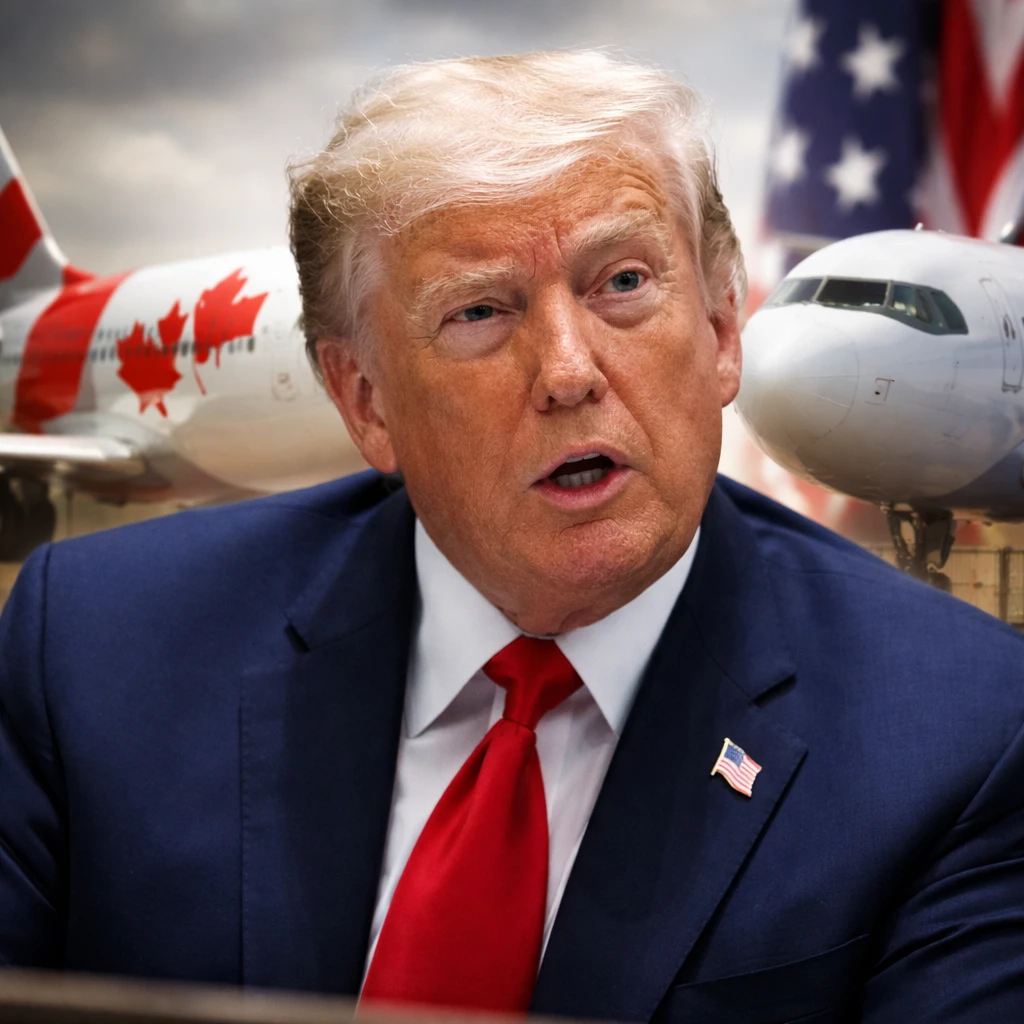

In a marked escalation of trade tensions, US President Donald Trump signaled on Thursday his intent to levy a 50% tariff on Canadian aircraft entering the US market. This announcement represents the latest development in the ongoing trade dispute between the two neighboring countries, intensifying a conflict that has seen various tariffs and threats exchanged recently.
The President's declaration, made via social media, comes on the heels of an earlier threat to apply a 100% tariff on Canadian imports should Canada proceed with a planned trade agreement with China. Despite Canada's completion of that trade arrangement, Trump did not specify a timeline for the implementation of the threatened tariffs.
Central to this new threat is the contention regarding certification of aircraft produced by Gulfstream Aerospace, based in Savannah, Georgia. Trump accused Canada of refusing to certify certain Gulfstream jets and, in retaliation, announced plans to decertify all Canadian aircraft models in the US—including those manufactured by leading Canadian producer Bombardier.
"If, for any reason, this situation is not immediately corrected, I am going to charge Canada a 50% tariff on any and all aircraft sold into the United States of America," Trump stated in his post. He further declared the decertification of the Bombardier Global Express business jets part of this measure.
Citing data from aviation analytics firm Cirium, there are currently 150 Bombardier Global Express aircraft registered in the US and operated by approximately 115 different entities.
The competitive dynamics between Bombardier and Gulfstream are significant, with both companies vying for share in the high-end business jet market through their respective Global and latest Gulfstream models.
Bombardier responded to the announcement by acknowledging the President's statement and indicating ongoing discussions with the Canadian government. The Montreal-based manufacturer emphasized that its aircraft meet all Federal Aviation Administration certification standards and noted expansion of its US operations. The company expressed hope for a swift resolution to prevent substantial disruption to air traffic and the broader flying public.
Requests for comment from Canadian government representatives were not returned by Thursday evening.
John Gradek, an aviation management professor at McGill University, addressed the certification issue by underscoring its foundational importance to aircraft safety. He characterized decertification for trade reasons as unprecedented. "Certification is not trivial. It is a very important step in getting planes to operate safely," Gradek stated. He added that many Gulfstream aircraft possess Canadian certification and viewed the US threats as a strategic ploy related to ongoing political disputes, describing it as "a new salvo in the trade war."
Historical context includes the 2017 US Commerce Department's imposition of duties on a Bombardier commercial passenger aircraft, accusing the company of selling below cost aided by unfair government subsidies. However, the US International Trade Commission subsequently concluded that Bombardier did not harm American industry through its sales practices.
Since then, Bombardier has concentrated on the business and private jet segment, with its Global and Challenger jet families serving individual owners, corporations, and fractional jet operators such as NetJets and Flexjet. A US market exclusion would significantly challenge Bombardier's Quebec-based operations.
Tensions have also been exacerbated by remarks from Canadian Treasury Secretary Scott Bessent and Canadian Prime Minister Mark Carney. Bessent warned Carney that his public criticism of US trade policy might negatively influence the ongoing review of the United States-Mexico-Canada Agreement (USMCA). Carney, however, maintained his position, affirming his comments at the World Economic Forum and underscoring Canada's intent to diversify trade through additional agreements.
At the recent World Economic Forum in Davos, Carney critiqued the use of economic coercion by major powers over smaller countries, without explicitly naming the US or President Trump. His comments received notable attention and were perceived as a counterpoint to US positions.
Aside from Bombardier, Canada hosts other key aviation manufacturers including De Havilland Aircraft of Canada, specializing in turboprop and maritime patrol aircraft, and Airbus, which produces the A220 single-aisle commercial planes and helicopters within the country.