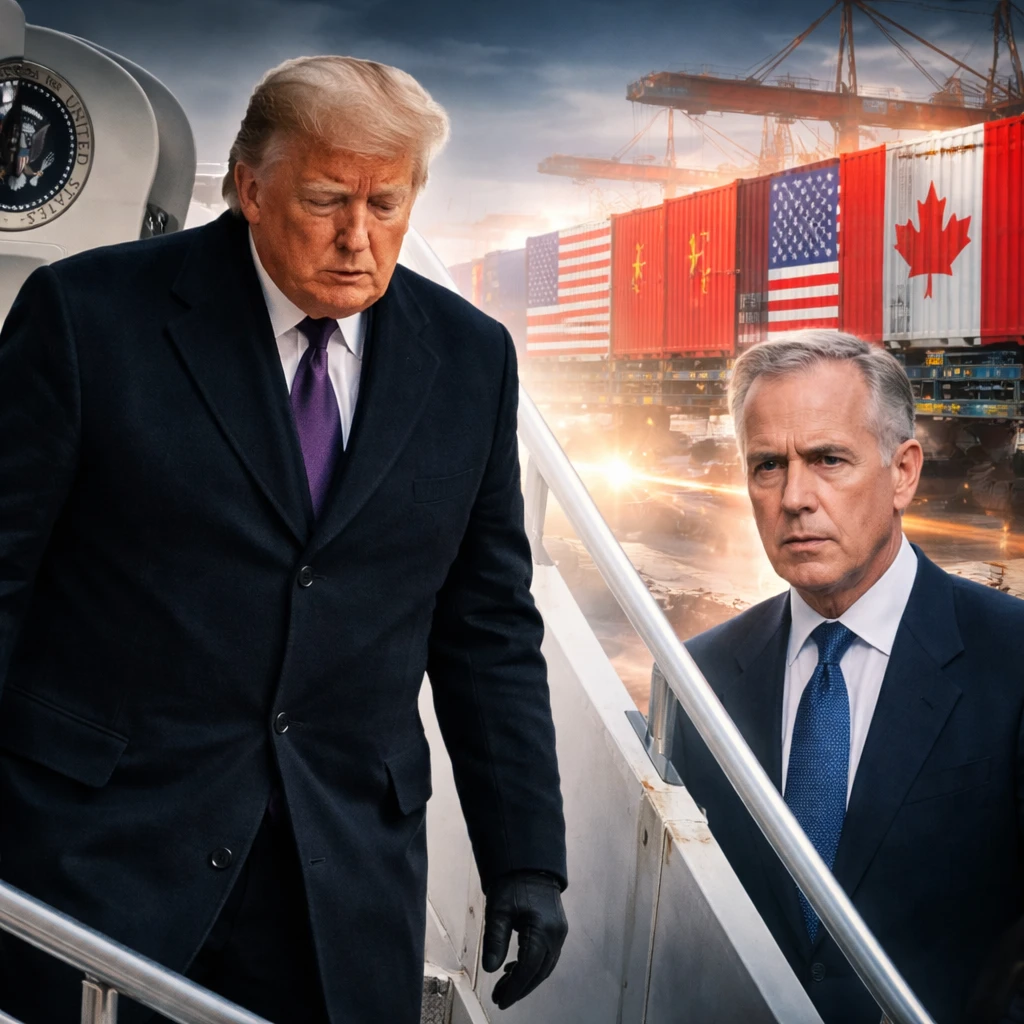

In a sharp development in international trade relations, President Donald Trump announced on Saturday his intention to impose a 100% tariff on imports from Canada should the country advance its trade agreement with China. The United States’ northern neighbor recently secured a deal aimed at reducing tariffs on Chinese electric vehicles in exchange for lowered import duties on Canadian agricultural products. This emerging partnership has provoked a stern response from Trump, who posted on social media that Prime Minister Mark Carney is mistaken if he believes Canada can serve as merely a "Drop Off Port" for China's goods entering the U.S.
Despite Trump's ongoing trade war campaigns, he had earlier expressed approval of Canada's agreement with China, initially describing it as a positive step. However, the relationship between the two leaders has soured notably in recent days. Carney, recognized as a leading figure in Western opposition to Trump's global approach, has been vocal in advocating for cooperation among middle powers to counter coercive tendencies by dominant nations, a stance underscored during his widely praised speech at the World Economic Forum in Davos.
The tensions between the two countries are further intensified by Trump's controversial moves regarding Greenland, attempting to purchase the territory, and his repeated provocations towards Canadian sovereignty. Trump has even publicized an altered map humorously depicting Canada, Greenland, Cuba, and Venezuela as extensions of the United States. Additionally, Trump's use of the moniker "Governor Carney," historically applied to Prime Minister Justin Trudeau, signals a deteriorating diplomatic rapport.
Amid these political challenges, Carney has withdrawn from Trump's "Board of Peace," an initiative aimed at resolving international conflicts. Public exchanges between the leaders have included Trump's assertion that "Canada lives because of the United States," a comment which was rebutted by Carney emphasizing Canada's independent prosperity and values, distinguishing it from autocratic tendencies.
Trade relations remain complicated by the existing tariffs imposed by the Trump administration, despite Canada’s protective positioning under the United States-Mexico-Canada Agreement, which shields it somewhat from the most severe impacts. The agreement is scheduled for review this year. The Canadian province of Ontario has engaged in a public relations effort in the U.S. opposing tariffs, which previously led to Trump threatening additional levies though not enforcing them.
Canada has initially mirrored U.S. tariffs on Chinese goods, imposing 100% tariffs on electric vehicles and 25% on steel and aluminum imports, to which China retaliated with tariffs on Canadian canola, pork, and seafood products. Nevertheless, Canada has articulated intent to cultivate a more autonomous foreign policy, fostering improved relations with China alongside cautious acknowledgment of disagreements on human rights issues.
Economically, the two nations are deeply intertwined. Canada absorbs goods and services valued near US$2.7 billion daily by U.S. businesses and is the primary source of U.S. crude oil imports, supplying approximately 60%, as well as 85% of U.S. electricity imports. Moreover, Canada remains the largest supplier of foreign steel, aluminum, and uranium to the U.S. and holds critical mineral and metal resources under Pentagon interest for national security considerations.
This complex milieu of political discord, trade realignment, and economic interdependence underscores the precarious position of U.S.-Canada relations amid shifting global power dynamics and the administration's protectionist policies.