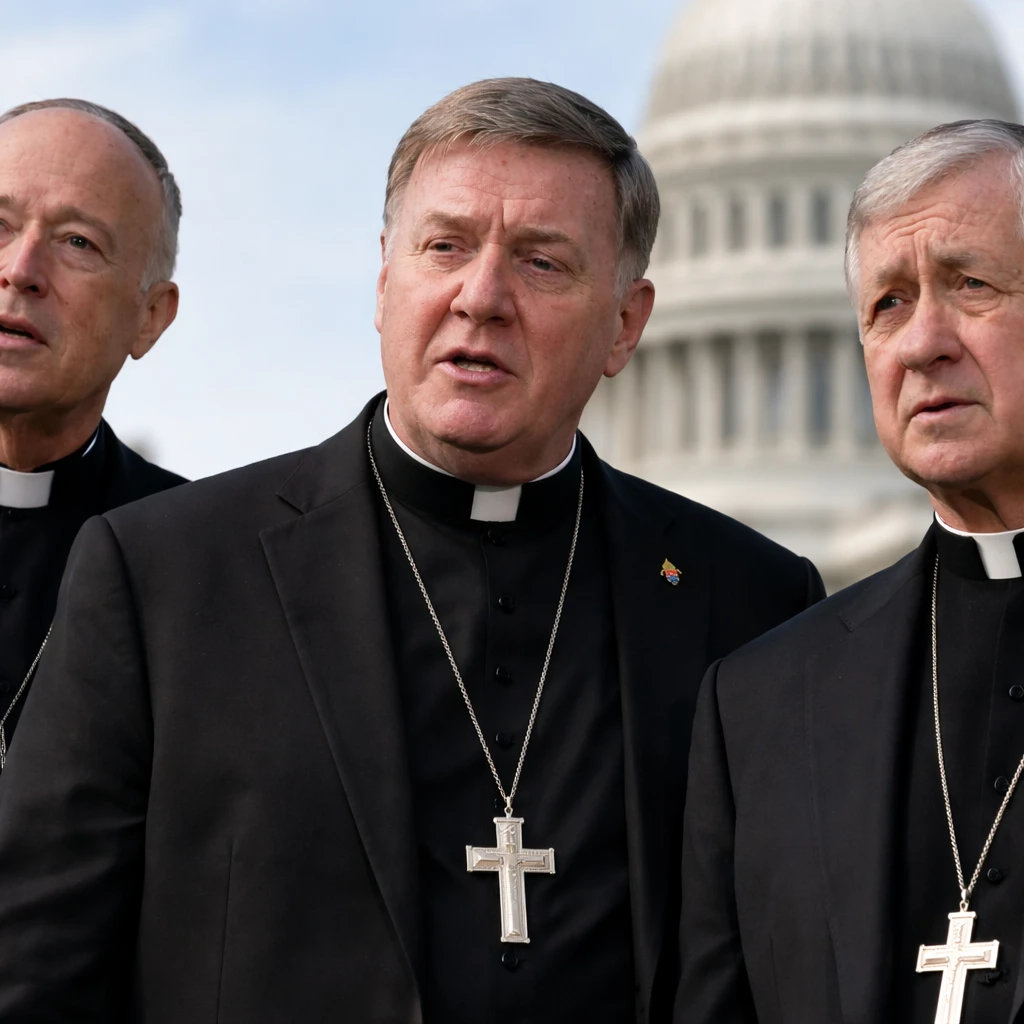

In a significant call for ethical foreign policy, three influential US Catholic cardinals have urged the Trump administration to reconsider its approach, emphasizing the necessity of a moral compass in global affairs. Cardinal Blase Cupich of Chicago, Cardinal Robert McElroy of Washington, and Cardinal Joseph Tobin of Newark, New Jersey, released a joint statement on Monday cautioning that recent US foreign policy initiatives might engender widespread hardship rather than contribute to peace.
The cardinals pointed to several recent US actions that have stirred debate, including military operations aimed at ousting Venezuelan President Nicolás Maduro, public threats to acquire Greenland, and pronounced cuts to foreign aid under the current administration. They argued that these actions raise profound questions about the appropriate use of military force and the broader concept of peace.
Cardinal McElroy remarked to the press, "Most of the United States and the world are adrift morally in terms of foreign policy," asserting, however, that the United States continues to exert a considerable impact worldwide. The statement reflects a growing unease within the US Catholic hierarchy regarding policies perceived to undermine universal human dignity.
This recent appeal marks the second time in just a few months that US Catholic leaders have voiced criticism of the administration's stance on issues involving migrants and humanitarian concerns. In a November address, the nationwide conference of Catholic bishops denounced mass deportations and the stigmatization of migrants in public discourse.
The framework for the cardinals’ concerns was notably influenced by Pope Leo XIV's January 9 address to ambassadors to the Holy See. Delivered almost entirely in English, the pope’s speech represented a significant critique of contemporary foreign policy tactics, particularly those involving the imposition of power and domination by nations. Without naming specific countries, the pope condemned actions undermining global peace and post-World War II international legal systems, implicitly referencing recent US operations in Venezuela, declarations concerning Greenland, and the ongoing conflict in Ukraine.
In their joint letter, the three cardinals emphasized their rejection of war as a tool driven by narrow national interests. They stated, "We renounce war as an instrument for narrow national interests and proclaim that military action must be seen only as a last resort in extreme situations, not a normal instrument of national policy." The statement underscores a vision of foreign policy grounded in respect for human life, religious freedom, and dignity, emphasizing the role of economic assistance in achieving these ends.
Cardinal Tobin articulated the underlying principle guiding their appeal, underscoring the necessity of prioritizing the common good over individual prosperity. He asserted, "It can’t be that my prosperity is predicated on inhuman treatment of others."
Interviews with Cardinals Cupich and McElroy revealed that the statement was a response to concerns voiced by fellow cardinals during a Vatican meeting on January 7-8. Many expressed unease regarding US military actions in Venezuela, reductions in foreign aid, and the dialogue around Greenland's status. The subsequent address by Pope Leo XIV provided a framework and impetus for their public statement.
While recognizing the legitimacy of holding Maduro accountable, Cardinal Cupich criticized the method employed, particularly the US military incursion into a sovereign nation. He cautioned against asserting might as a justification for action, highlighting the importance of adhering to the rule of law. The Trump administration maintains that the operation in Venezuela was lawful.
Regarding Greenland, President Trump has justified proposals to acquire the resource-rich autonomous region, citing national security needs. Concurrently, the administration has significantly reduced funding for the US Agency for International Development, citing inefficiencies and ideological concerns. Cardinal Tobin, drawing on his extensive ministerial experience in numerous countries, lamented these cutbacks, noting their adverse effects on global health and hunger alleviation.
The cardinals clarified that their intention is not to support any political party but to advocate for America's restoration of moral leadership through a foreign policy directed by ethical principles and the pursuit of the common good. Tobin emphasized the role of individuals of faith and people of goodwill in promoting basic human decency on the international stage.
Their coordinated statement and public engagement reflect an ongoing effort within the US Catholic Church's progressive leadership to influence foreign policy discussions toward greater alignment with human dignity and peaceful international relations.