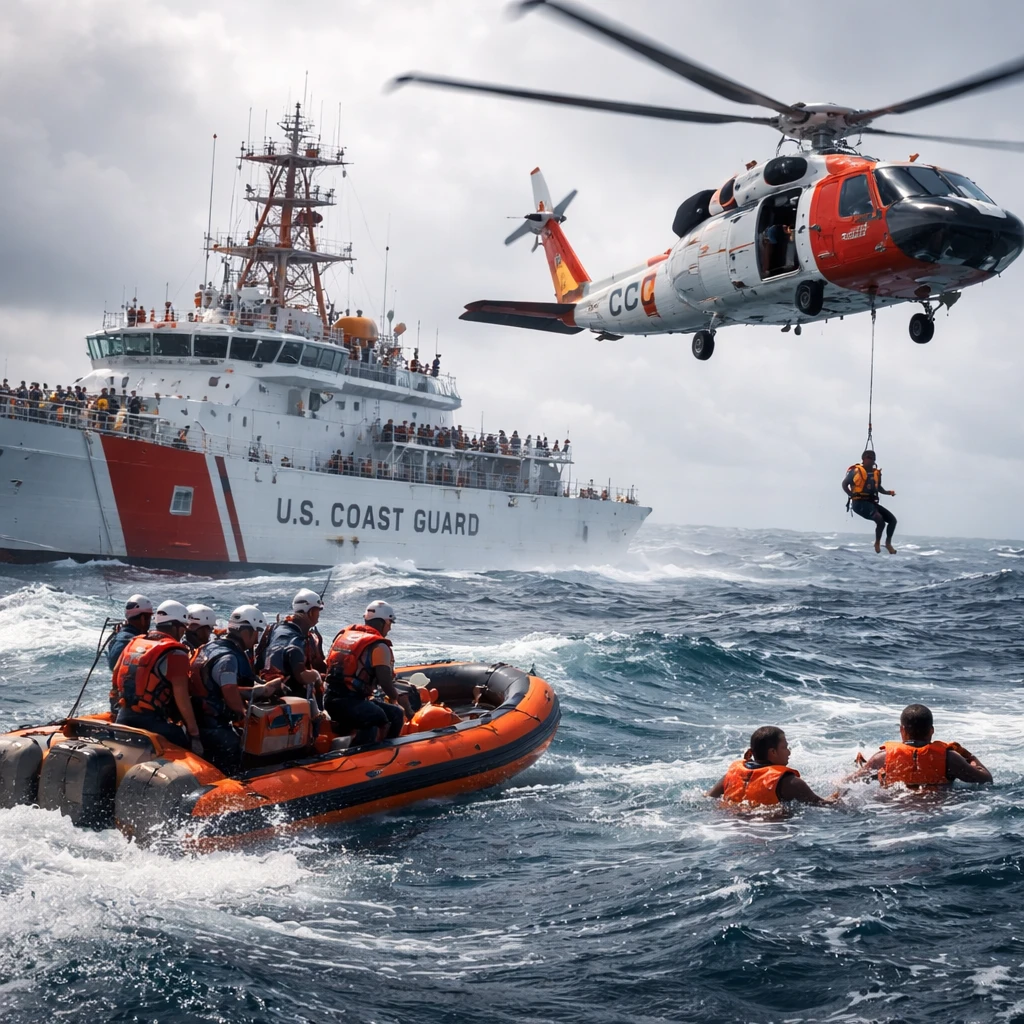

Officials from the U.S. Coast Guard reported ongoing search efforts as of Friday in the eastern Pacific Ocean to locate individuals who reportedly leapt from suspected drug trafficking vessels after U.S. military forces engaged those boats with strikes days earlier. These efforts take place approximately 400 miles southwest of the maritime boundary between Mexico and Guatemala.
The search operation commenced on Tuesday afternoon, initiated after the U.S. military alerted the Coast Guard that some survivors were in the water. Responses have included deployment of an aerial reconnaissance mission originating from Sacramento, covering a vast area north of 1,000 miles. Concurrently, alerts were issued to nearby maritime traffic to aid in the search. The coordinated endeavor has accumulated more than 65 hours of active searches involving international partners and civilian maritime units.
The environmental conditions in the search zone have posed considerable difficulties, with waves reaching nine feet and wind speeds of 40 knots reported. The U.S. authorities have withheld details concerning the exact number of people who abandoned the vessels, as well as the potential extent of mortalities resulting from this military campaign.
Earlier in the week, the U.S. military disclosed that operations targeted three boats that were navigating established narcotics trafficking corridors in the region. Statements indicated the vessels were engaged in drug transfer activities amongst themselves prior to being struck. However, no evidence supporting these assertions has been publicly provided.
The U.S. Southern Command, responsible for operational oversight in the area, confirmed that three casualties occurred on the first vessel that was attacked. On the following two boats, occupants escaped by jumping into the ocean before their vessels were hit, attempting to distance themselves from the target boats.
No naval vessels were concurrently operating in the eastern Pacific area at the time of these strikes, which precipitated immediate notification of the Coast Guard to commence search and rescue missions for persons overboard.
The involvement of the Coast Guard follows prior scrutiny of U.S. military conduct stemming from incidents earlier this year, where survivors of boat strikes were subjected to follow-up military actions. These actions prompted debate among lawmakers and legal analysts over their legality, with divisions along party lines and administration support for the operations.
Other survivors from similar operations include individuals found following military action in the Caribbean Sea, some of whom have been repatriated to their home countries. Subsequent investigations in these nations have not resulted in charges, reflecting complexities surrounding these interdictions.
Since early September, under presidential directive, the U.S. has escalated military targeting of maritime narcotics transport vessels in the Caribbean and eastern Pacific, tallying 35 known strikes and at least 115 fatalities associated with these engagements.
The administration characterizes these strikes as essential measures to curb drug influxes into the United States and frames the engagements within the context of an 'armed conflict' directed against drug cartels. These tactical operations run concurrently with an increased U.S. military presence in the region, signaling heightened pressures on regimes such as Venezuela's leadership, which has faced legal charges in the U.S. related to narcotics activities.