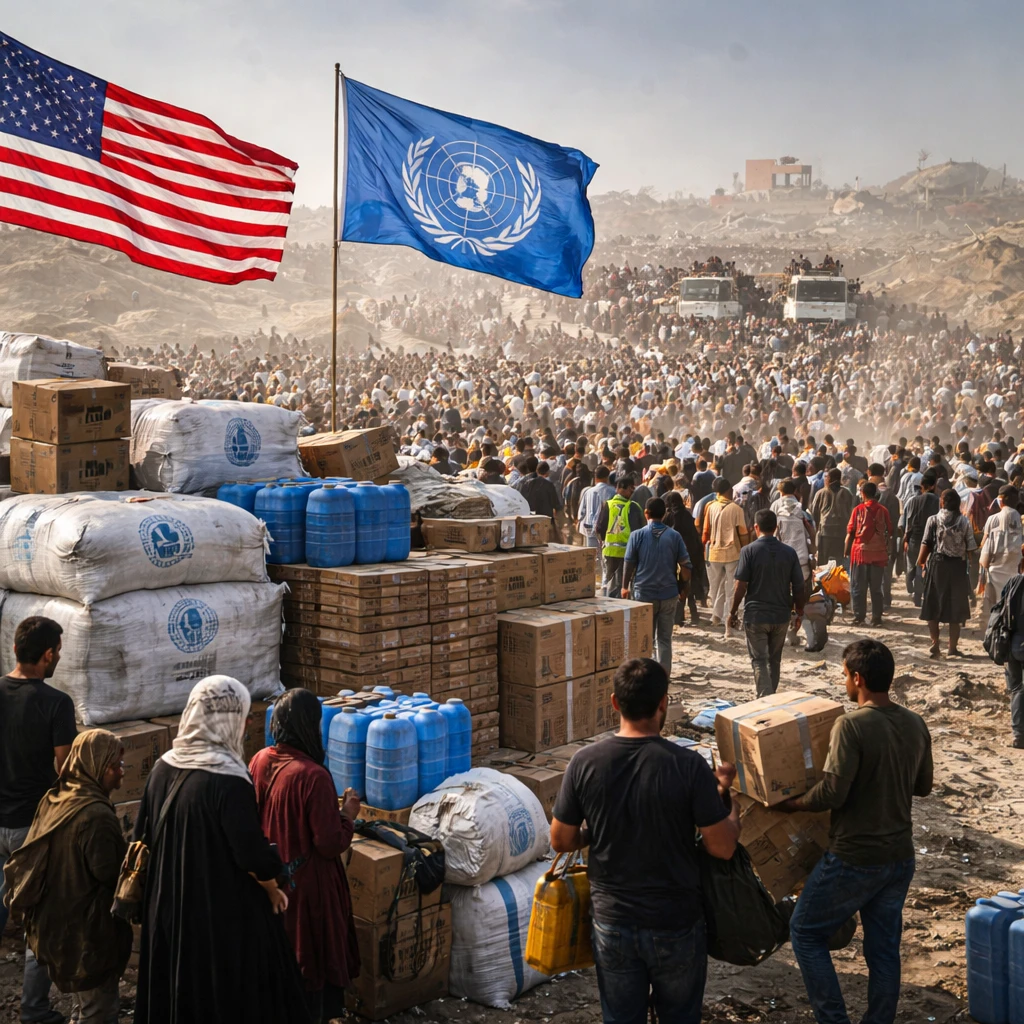

In Geneva on Monday, the United States declared a $2 billion pledge in support of humanitarian aid through the United Nations, a sum markedly smaller than historical levels but positioned to uphold America's role as the leading donor globally. This announcement arrives as the Trump administration continues to decrease foreign assistance funding, advocating for United Nations entities to "adapt, shrink or die" in response to evolving fiscal challenges.
The committed funds will be allocated via a consolidated umbrella fund designed to disburse resources to specific agencies and priority initiatives. This reflects a central US demand for sweeping reforms within the UN system, a move that has elicited concern from humanitarian workers who have witnessed significant trimming of programs and services. Historically, US contributions to UN-backed humanitarian programs have reached as high as $17 billion annually, though voluntary contributions averaged between $8 billion and $10 billion according to United Nations data. Beyond these voluntary payments, the US also remits substantial sums as mandatory dues for its UN membership.
Critics of the current trajectory argue that the reduction of Western aid commitments has been short-sighted, contributing to increased hunger, displacement, and disease globally, while simultaneously diminishing US soft power on the international stage.
Contextualizing a Year of Aid Challenges
These developments cap a difficult year for numerous United Nations organizations, including those managing refugees, migration, and food assistance. The Trump administration's drastic cuts to foreign aid have compelled these agencies to curtail spending, scale back aid initiatives, and eliminate thousands of jobs. Similarly, other traditional Western donors such as Britain, France, Germany, and Japan have decreased their aid allocations and advocated for reform within UN operations.
The US pledge is structured through a preliminary arrangement with the UN Office for the Coordination of Humanitarian Affairs (OCHA), led by Tom Fletcher, a former British diplomat. Fletcher's office, which has sought to implement a "humanitarian reset" aimed at enhancing efficiency, accountability, and impact, will now serve as the conduit for directing US and other donor funds to relevant UN agencies, replacing the previous model of scattered contributions targeting multiple appeals.
Consolidation and Reform Efforts
A senior US State Department official, speaking under condition of anonymity prior to the announcement, described the new plan as seeking "more consolidated leadership authority" over UN humanitarian aid delivery. Fletcher and OCHA will effectively control the distribution of funding, acting as a centralized mechanism for managing resources.
US Ambassador to the United Nations Michael Waltz emphasized that the "humanitarian reset at the United Nations should deliver more aid with fewer tax dollars," promoting assistance aligned with US foreign policy goals and measured on clear results.
The $2 billion is intended as an initial installment contributing to OCHA's recent annual appeal for funds. Responding to the altered aid environment, Fletcher has already reduced this year’s requested amount. The US initiative fits into a broader movement among traditional donors to decrease spending and introduce reforms aimed at eliminating redundancy, reducing bureaucratic burdens, and curtailing ideological interference. The State Department underscored that UN agencies must exhibit adaptability and efficiency to avoid obsolescence, stating, "Individual UN agencies will need to adapt, shrink, or die."
Humanitarian agencies are particularly stressed as focal points of reform, given their critical operational roles. According to the department, the newly reached agreement is pivotal for transforming funding, oversight, and integration practices of UN humanitarian efforts, balancing America's enduring commitment to generosity with the imperative for structural changes.
Targeted Aid and Exclusions
A core element of the reform is establishing pooled funding streams to be flexibly allocated to specific crises or countries in need. Initially, seventeen countries, including Bangladesh, Congo, Haiti, Syria, and Ukraine, will be the focus of this targeted funding approach.
Notably absent from this initial list are Afghanistan and the Palestinian territories. US officials indicated that the Palestinian regions will fall under financial arrangements linked to the Trump administration’s ongoing but incomplete Gaza peace plan.
Underlying Perspectives and Statements
The project stems from the Trump administration’s longstanding view that, despite the UN's potential, the organization has deviated from its foundational mission. Officials argue that it has occasionally undermined American interests, promoted radical ideologies, and engaged in inefficient, unaccountable spending. Fletcher acknowledged the gravity of current global strains but praised the agreement, asserting, "At a moment of immense global strain, the United States is demonstrating that it is a humanitarian superpower, offering hope to people who have lost everything."