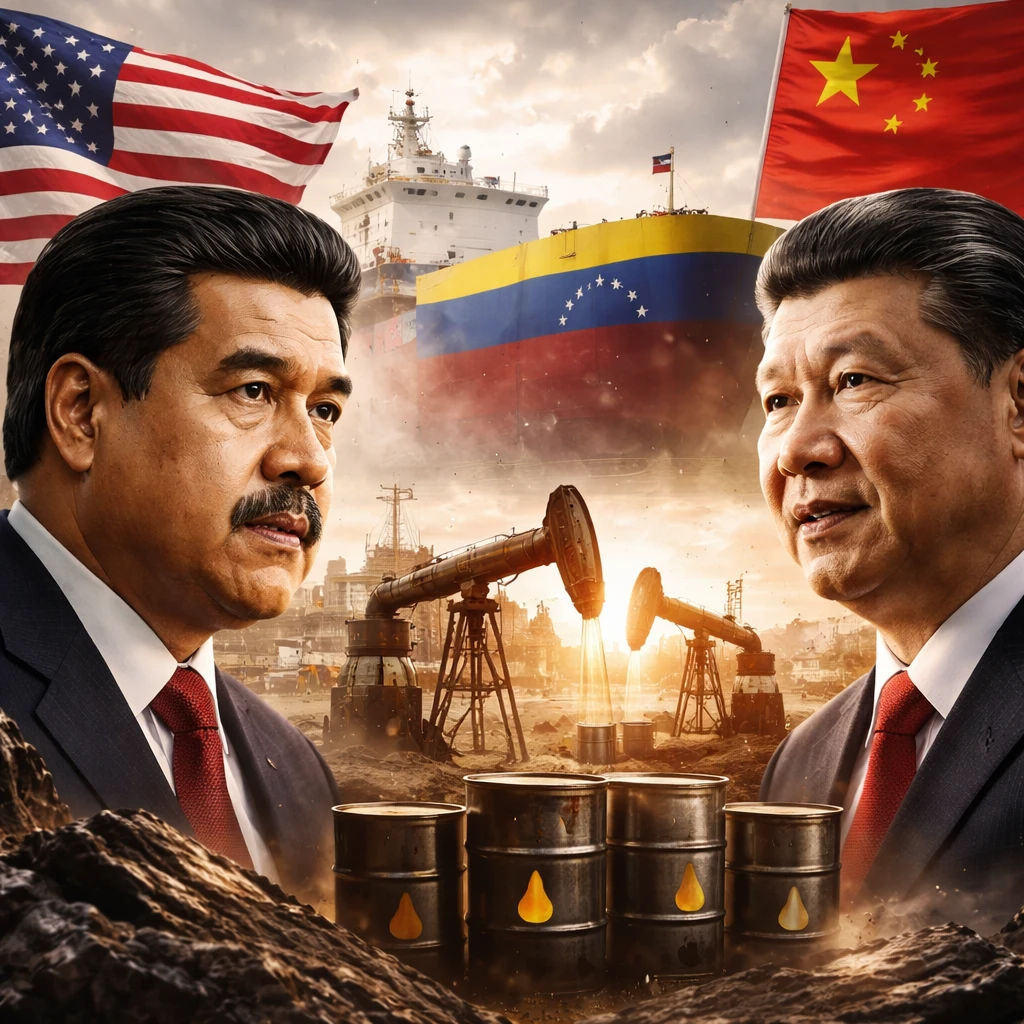

In recent developments, the United States has proclaimed authority over Venezuelan oil supplies, a bold assertion by President Donald Trump. However, a material segment of Venezuela's oil reserves remains under the financial influence of China, as a result of prior contracts made between Caracas and Beijing. This intertwining of energy resources and international finance creates a complex geopolitical scenario demanding careful diplomacy in the approaching weeks.
Experts surmise that the US administration might seek collaboration with China to preserve stable trade ties, particularly as President Trump is slated to visit Beijing in April. This visit aims to safeguard a tenuous trade truce brokered with Chinese President Xi Jinping toward the end of the previous year. Craig Singleton, senior director at the Foundation for Defense of Democracies' China program, noted that the administration appears intent on avoiding unnecessary tensions with China while maintaining strategic advantages on US terms. He expressed skepticism that Venezuela would become a contentious point jeopardizing these commercial and diplomatic engagements.
Estimates indicate that Venezuela owes China at least $10 billion, a debt accumulated over years of lending from Chinese authorities. Under contracts with former President Nicolás Maduro, Venezuela has been repaying this substantial loan by delivering oil shipments to China. However, the change in Venezuelan leadership aligned with Washington's demands might prompt a reassessment of these agreements' validity, potentially halting further payments.
Two principal Chinese state-owned energy companies, China National Petroleum Corp. and Sinopec, possess rights to an estimated 4.4 billion barrels of Venezuelan oil, the largest amount held by any foreign nation, as highlighted in research from investment bank Morgan Stanley.
Additionally, US corporations have pending claims amounting to tens of billions of dollars owing to oil industry nationalizations carried out by the Venezuelan government. The mechanisms by which these claims or debts will be reconciled remain uncertain.
This week, the US took control of two sanctioned oil tankers, signaling its intention to oversee Venezuela's oil exports directly. Energy Secretary Chris Wright confirmed that the US would manage oil sales "indefinitely," with proceeds held in accounts under US control intended to eventually benefit Venezuelans. The administration also announced plans to initiate sales extracting 30 million to 50 million barrels from Venezuelan storage.
An anonymous senior administration official elaborated, stating the US's agenda includes reducing "adversarial outside influence" within the Western Hemisphere. Employing control over a critical resource like petroleum underscores power dynamics reminiscent of China's previous tactics of exerting leverage. Last year, Beijing restricted supplies of essential rare-earth magnets and strategically limited soybean purchases from the US amid trade disputes. The October meeting between Trump and Xi in South Korea resulted in a mutual agreement to pause tariff escalations and export restrictions for a one-year period.
Throughout 2000 to 2023, Venezuela ranked as the fourth-largest recipient of official Chinese credit, absorbing loans exceeding $106 billion from China's public-sector financiers, per AidData—a research initiative based in Virginia's College of William & Mary tracking China's international lending. The exact repayment status of this debt is ambiguous, as Venezuelan authorities ceased sharing related data several years ago. AidData's executive director Brad Parks indicated that while $10 billion is commonly cited as outstanding debt, the actual figure may be larger, perhaps influenced by US sanctions disrupting loan repayments tied to Venezuelan oil exports.
The capture of Maduro stirred reflections within China of similar situations, notably the fall of Libya's Moammar Gadhafi, whose regime's demise left Chinese enterprises with substantial unrecoverable investments. Cui Shoujun, a professor of international studies at Beijing's Renmin University, suggested to Chinese media that Venezuela's interim government might declare previous deals invalid and China's loans unlawful.
Chinese investments in Venezuela extend beyond the oil sector, encompassing telecommunications infrastructure, railways, and port facilities. These projects face uncertainty amidst the current political upheaval, according to a report from financial services firm Jefferies, which also noted China's expected capability to withstand any resulting disruptions, partly because Venezuelan oil accounts for a relatively minor share of China's overall imports and due to China’s diversified energy portfolio and increasing commitments to electrification.
In a poignant moment prior to his capture, Maduro met with a senior Chinese diplomat at the presidential palace, praising the longstanding and prosperous ties between the two nations dating back to Hugo Chávez's tenure, which firmly entrenched China within America's geopolitical backyard.
Venezuela remains the only Latin American nation holding a high level strategic partnership with China, comparable with relationships China maintains with countries like Pakistan. Maduro's ouster is anticipated to diminish Chinese influence in the Western Hemisphere, aligning with objectives outlined in the Trump administration's National Security Strategy.
China's official reaction to Maduro’s apprehension included expressions of deep shock over the use of US force against a sovereign government and stern condemnation of the action taken against its leader. Beijing called for the immediate release of Maduro and his spouse, emphasizing that no external entity holds rights to interfere with economic or trade cooperation between China and Venezuela, which is protected under both international and domestic statutes. Chinese Ministry of Commerce spokesperson He Yadong affirmed that China’s interest in deepening bilateral economic relations remains unchanged regardless of Venezuela’s political developments.
Singleton emphasized that despite diplomatic protests from Beijing, the practical influence China wields in the Western Hemisphere remains limited. He asserted that China lacks the capacity to shield its partners or investments once the US opts for direct intervention.