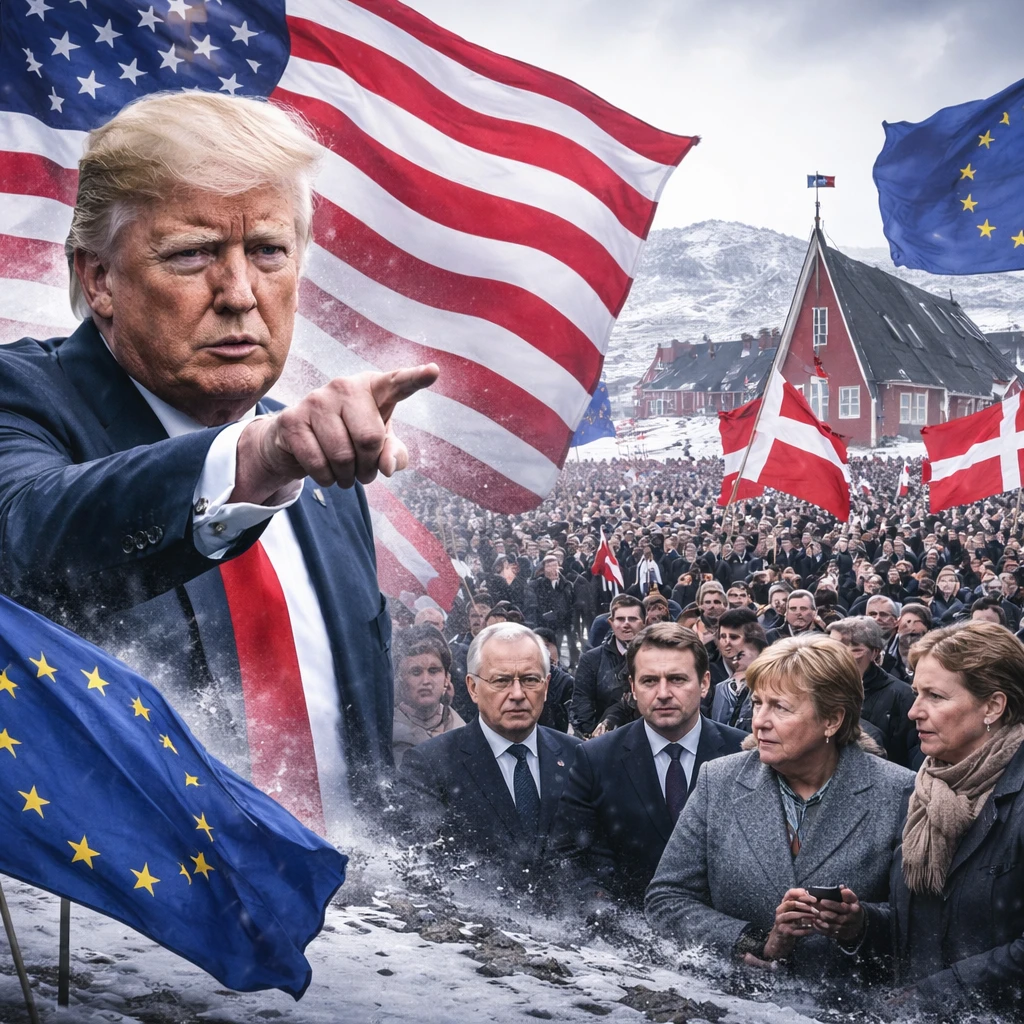

Washington's announcement of a 10% tariff on eight European countries due to their resistance to American attempts to assert control over Greenland has elicited strong condemnation from those nations. In a rare and forceful joint statement published on Sunday, Denmark, Norway, Sweden, France, Germany, the United Kingdom, the Netherlands, and Finland declared that their military personnel participating in the Danish-led exercise "Arctic Endurance" in Greenland represent "no threat to anyone."
The declaration comes amid escalating tensions following US President Donald Trump's Saturday proclamation, which appeared to use tariff measures as leverage to initiate negotiations regarding Greenland’s status. Greenland, a semi-autonomous territory within NATO ally Denmark, is viewed by Trump as strategically crucial to US national security.
Responding to the tariff threat, the eight European governments articulated their unified support for the Kingdom of Denmark and the Greenlandic people. They underscored a willingness to pursue dialogue grounded in respect for sovereignty and territorial integrity principles. The statement explicitly warned that such tariff threats jeopardize transatlantic relations and may instigate a harmful downward spiral in diplomatic ties.
The complexity of possible US implementation of these tariffs is compounded by the European Union’s status as a single economic zone for trade purposes. It remains unclear how this would apply across the bloc, especially legally within the US, where Trump might invoke emergency economic powers currently under Supreme Court scrutiny.
European Union foreign policy chief, Kaja Kallas, highlighted the negative geopolitical implications, stating that divisions between Europe and the US could advantage China and Russia. She posited that issues of Greenland’s security could be better addressed within NATO frameworks and cautioned that tariff measures risk undermining shared prosperity by making both Europe and the US poorer.
Domestically in the US, the tariff proposal also faced criticism. Senator Mark Kelly, a Democrat and former Navy pilot, argued the tariffs would unjustly burden Americans financially over an unnecessary territorial ambition. Kelly critiqued the irony of European troops arriving in Greenland purportedly to defend it from the US and stressed that the President’s actions are damaging the nation’s global reputation and alliances, potentially increasing vulnerabilities.
Among the targeted countries, six belong to the 27-member EU, which could complicate collective responses. EU envoys convened emergency talks to formulate potential countermeasures. Interestingly, the tariffs also drew disapproval from some of Trump's European ideological allies. Italy's Prime Minister Giorgia Meloni, regarded as a close Trump confidant, described the tariffs as "a mistake" following their discussion and clarified that European troop deployments were misunderstood by Washington, emphasizing their intent to safeguard against unspecified other actors rather than counter US interests.
French President Emmanuel Macron condemned the intimidation tactics on social media, reinforcing France’s position against coercion in matters concerning Ukraine, Greenland, or other global issues. He deemed the tariff threats as unacceptable and misplaced. Jordan Bardella, head of France's far-right National Rally, echoed concerns by advocating for suspension of the EU-US tariff deal from the prior year, labeling Trump's approach as "commercial blackmail."
In the UK, political consensus against the tariffs emerged across main parties including the hard-right Reform UK. Reform UK leader Nigel Farage, a longstanding Trump supporter, criticized the tariffs for potentially harming British interests, albeit stopping short of disputing US claims over Greenland. Conversely, Prime Minister Keir Starmer, from the Labour Party, declared the tariff decision “completely wrong” and committed to directly engaging the US administration over the issue.
In the wake of the unfolding situation, foreign ministers from Denmark and Norway were expected to address the crisis during a press conference in Oslo, reflecting the gravity and diplomatic urgency surrounding the dispute.