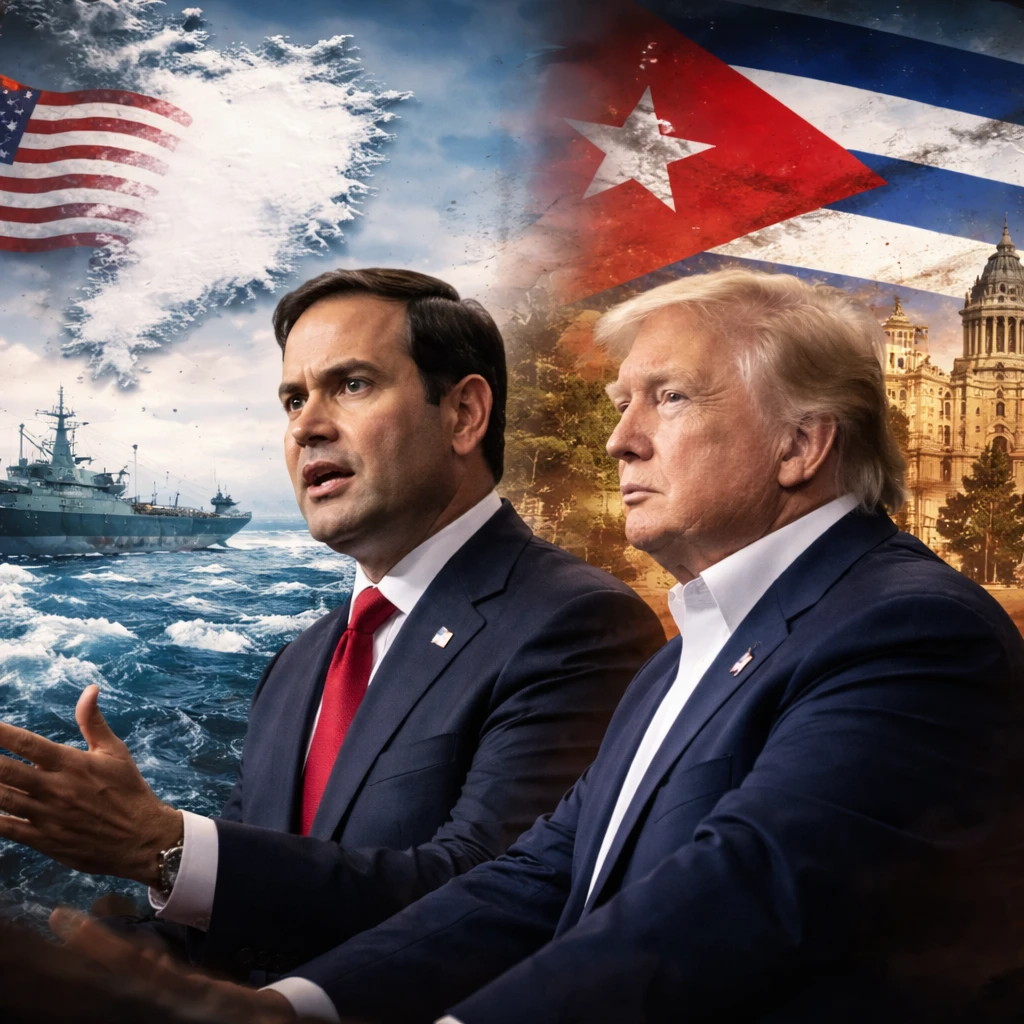

In an assertive display of U.S. foreign policy following the recent military operation targeting Venezuela, President Donald Trump reiterated his intention to annex Greenland, a Danish territory of strategic value, to secure American interests. This statement came shortly after Secretary of State Marco Rubio publicly described Cuba’s communist regime as facing significant challenges, indicating heightened U.S. scrutiny of the region. The remarks from both officials emphasize the current administration's commitment to expanding its influence in the Western Hemisphere.
Speaking in an interview with The Atlantic, Trump emphasized Greenland's importance, highlighting its strategic position amid activity by Russian and Chinese naval forces. "We do need Greenland, absolutely," he asserted, underscoring the island’s significance in geopolitical terms.
When questioned about the implications of the U.S. military intervention in Venezuela for potential actions in Greenland, Trump responded ambiguously, "They are going to have to view it themselves. I really don’t know." Despite requests, the White House refrained from offering further clarification.
As part of a broader strategic framework unveiled in the administration’s National Security Strategy, restoring "American preeminence in the Western Hemisphere" has been foregrounded as a vital objective heading into Trump's second term. This policy direction draws on historical doctrines such as the 19th century Monroe Doctrine, which opposes European colonialism, and the Roosevelt Corollary, which historically justified U.S. involvement in Panama's secession to facilitate control over the Panama Canal.
Trump has even colloquially referenced these traditional principles as the “Don-roe Doctrine,” signaling his intent to apply them assertively in contemporary contexts. This aggressive approach has drawn international attention, particularly following the covert U.S. operation in Caracas that contributed to the ousting of Venezuelan leader Nicolás Maduro.
Denmark, which governs Greenland, reacted sharply to renewed American acquisition ambitions. Danish Prime Minister Mette Frederiksen condemned Trump's statements, asserting that the United States has "no right to annex" Greenland. She reaffirmed Denmark’s commitment to NATO and its existing defense agreements that grant the U.S. broad access to Greenland's facilities.
Frederiksen urged America to cease threatening a longstanding ally, emphasizing that neither Denmark nor Greenland is "for sale." The Danish government further aligned with the European Union in endorsing the Venezuelan people’s right to self-determination, countering Trump's assertions about U.S. control over Venezuela and criticisms of the country's interim leadership.
The tension escalated on social media when former administration official turned podcaster Katie Miller posted an image depicting Greenland emblazoned with the American flag and the word "SOON," which was met with disapproval by Danish officials. Jesper Møller Sørensen, Denmark's chief diplomatic representative in Washington, called for full respect toward Denmark's territorial integrity in response.
Trump first raised the subject of Greenland during his presidential transition and early tenure, often hinting without exclusion the possibility of military measures to gain control over the mineral-rich Arctic island. While the topic waned briefly from public focus, Trump thrust it back into prominence by appointing Louisiana Governor Jeff Landry as a special envoy tasked with facilitating Greenland’s incorporation into the United States, a volunteer role Landry embraced with the aim to "make Greenland a part of the U.S."
Meanwhile, the administration's posture toward Cuba intensified. Rubio, appearing on NBC’s “Meet the Press,” highlighted Cuban involvement in Venezuela, stating that Cuban operatives were responsible for guarding Maduro and overseeing internal intelligence activities to monitor potential dissent within his regime.
Trump characterized Cuba as a failing state comparable to Venezuela, signaling the likelihood of future U.S. engagement aimed at assisting the Cuban population. In response, Cuban authorities organized demonstrations endorsing Venezuela's government and decrying the U.S. operation, cautioning regional nations about the widespread risks of external interference.
Rubio, with his Cuban heritage, has consistently portrayed Cuba as an authoritarian regime suppressing its citizens. He emphasized that the Western Hemisphere must remain free from the influence of adversaries and rivals to the United States, reflecting the administration's broader hemispheric security concerns.
Among Cuban citizens, apprehension regarding U.S. actions prevails. Bárbara Rodríguez, a biochemical laboratory technician, expressed fears about the aggression directed at Venezuela, warning that similar interventions might extend to Cuba, underscoring the pervasive unease about sovereignty and foreign involvement.
The evolving dynamics highlight the complexities and risks inherent in the U.S. administration’s strategy to assert greater influence over territories and governments within its hemisphere, reflecting a broader vision of American dominance in regional affairs.