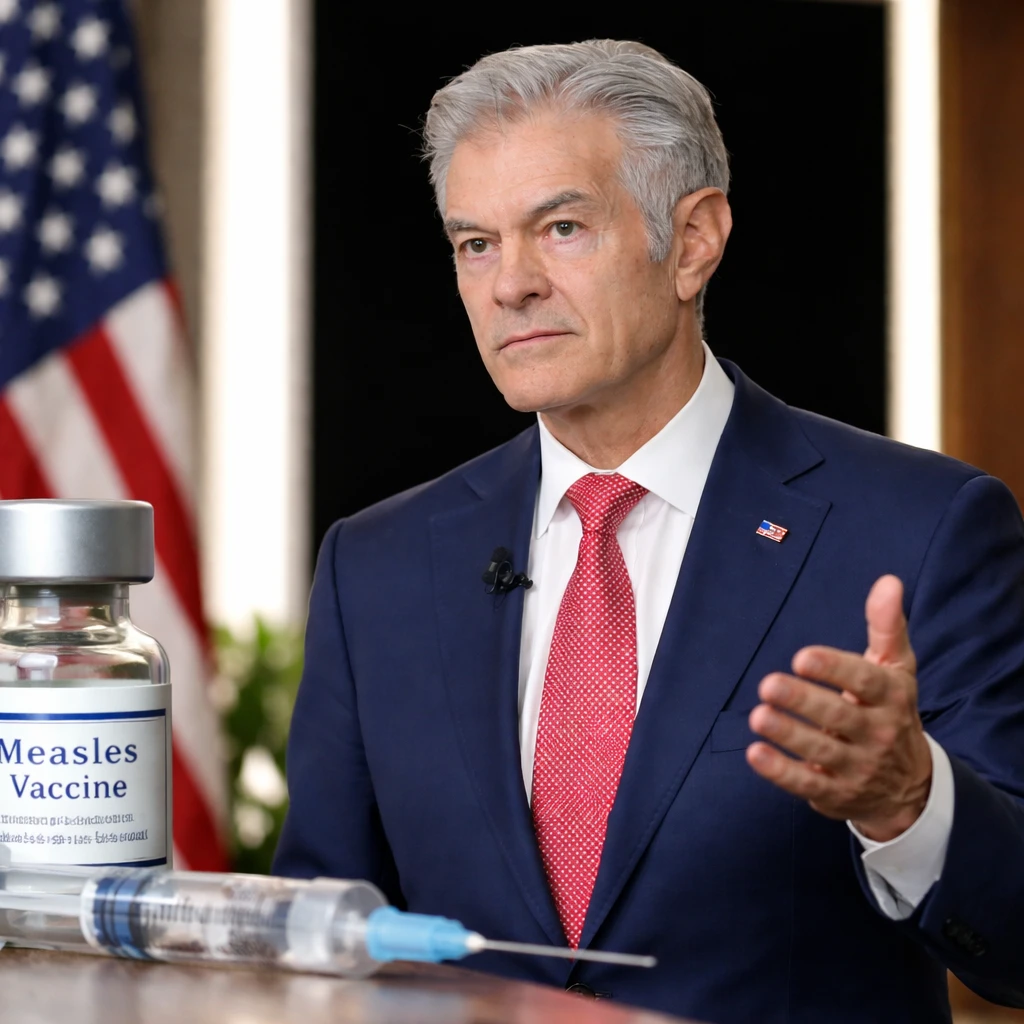
Dr. Mehmet Oz, the current head of the Centers for Medicare and Medicaid Services (CMS), issued a public call on Sunday urging Americans to receive the measles vaccine amid ongoing outbreaks affecting numerous states. His appeal comes at a critical moment, as public health officials warn that the United States may be on the verge of losing its officially recognized measles elimination status.
"Please take the vaccine," Dr. Oz implored during an interview on CNN's "State of the Union." Noting the severity of measles, he stated, "Not all illnesses pose the same level of danger nor affect each individual equally, but measles is one you should protect yourself from by vaccination." Oz, a practicing heart surgeon by training, also defended recent federal vaccine recommendations that have been revised under the current administration, as well as past remarks about vaccine efficacy from President Donald Trump and Health Secretary Robert F. Kennedy Jr., despite their history of expressing skepticism toward vaccines.
Significant outbreaks have emerged this year, including a notable surge in South Carolina, which has reported several hundred cases, surpassing the number seen in Texas during its 2025 outbreak. Additional flare-ups are occurring along the Utah-Arizona border. Confirmed cases have also been documented across multiple other states. These outbreaks predominantly affect children and come amid growing concerns from infectious disease experts that increasing public mistrust of vaccines is facilitating the resurgence of a disease previously declared eradicated by health authorities.
Addressing concerns about the severity of measles, Oz affirmed, "Absolutely, people should be concerned." He emphasized that measles vaccinations will continue to be covered benefits under Medicare and Medicaid programs. "There will never be a barrier to access for Americans seeking measles vaccination, as it remains a core component of the immunization schedule," he added.
Regarding Health Secretary Robert F. Kennedy Jr., who has publicly questioned some vaccine recommendations, Oz stated, "We have consistently advocated for measles vaccinations. Mr. Kennedy has also been at the forefront in advocating for measles vaccines." However, Kennedy’s stance has drawn criticism due to his broader skepticism surrounding vaccines and their safety, including his past promotion of unproven concerns about vaccine components and autism.
In a recent television appearance unrelated to vaccination topics, Kennedy appeared on Fox News Channel's "The Sunday Briefing," where vaccine issues were not raised. Instead, discussion centered around lighter subjects such as typical Super Bowl snacks and personal dietary habits.
Critics of Kennedy argue that his long-standing doubts about the safety and efficacy of vaccines, including sympathy for disproven theories linking vaccines to autism, may unduly influence public health policies under his leadership. Nonetheless, Oz highlighted that Kennedy has supported measles vaccination during specific outbreaks, referencing Kennedy’s urging for people in Texas to get vaccinated when that state first experienced an outbreak.
Last month, the administration initiated changes to the traditional childhood vaccine schedule, reducing some vaccine requirements. The Department of Health and Human Services reported that this revision was carried out at former President Trump's request, who directed a review comparing U.S. vaccine policies with those of peer nations, seeking to align U.S. guidance accordingly.
It is important to note that vaccination requirements for school attendance are established at the state level. While federal policies often shape state regulations, some individual states have formed coalitions to resist alterations in federal vaccine guidance under the current administration.
Federal data indicate a decline in vaccination rates nationally, coupled with a rise in exemptions for children, reaching historic highs. Concurrently, preventable diseases such as measles and whooping cough have seen an uptick across the country.
Kennedy’s history of vaccine skepticism has garnered scrutiny, particularly following his Senate confirmation hearings last year. He testified that a 2019 visit to Samoa—a nation later devastated by a significant measles outbreak—was unrelated to vaccines. However, emails obtained from U.S. Embassy and United Nations staff contradicted that claim, revealing Kennedy had sought meetings with high-ranking Samoan officials during his trip. Officials in Samoa have stated that Kennedy’s visit lent legitimacy to anti-vaccine activists prior to the outbreak that infected thousands and resulted in 83 deaths, mostly young children under five.
This context underlines the complex and sometimes contradictory messaging from administration officials regarding vaccines. Some have appeared to express doubts about vaccine safety or entertained unsupported theories, while simultaneously attempting not to stray markedly from established scientific consensus.
In parallel, Dr. Jay Bhattacharya, director of the National Institutes of Health, noted during a Senate hearing that no single vaccine causes autism, though he left open the possibility that certain combinations might have adverse health effects—a statement that diverges somewhat from traditional scientific quarters.
Kennedy has maintained that the link between vaccines and autism remains unproven, a stance inconsistent with the conclusions of medical research. He has also raised concerns about vaccine ingredients such as thimerosal, a mercury-containing preservative, which most measles-containing vaccines do not include. Last year, the vaccine advisory committee overseen by Kennedy voted to cease recommending thimerosal-containing vaccines.
Public health officials emphasize the need to rebuild trust in health institutions following the COVID-19 pandemic, during which vaccine policies became politically charged and controversial. Widespread misinformation and conspiracy theories flourished, boosting the profile of longstanding anti-vaccine groups. Kennedy, previously head of the anti-vaccine advocacy organization Children’s Health Defense, has been criticized for initiating reviews of vaccine policies and health guidelines that medical consensus regards as well-established.
The administration has faced additional criticism for unfounded claims made by top leaders, including President Trump, who suggested without scientific backing at a September Oval Office event that Tylenol and vaccines have contributed to an increase in autism rates in the United States.