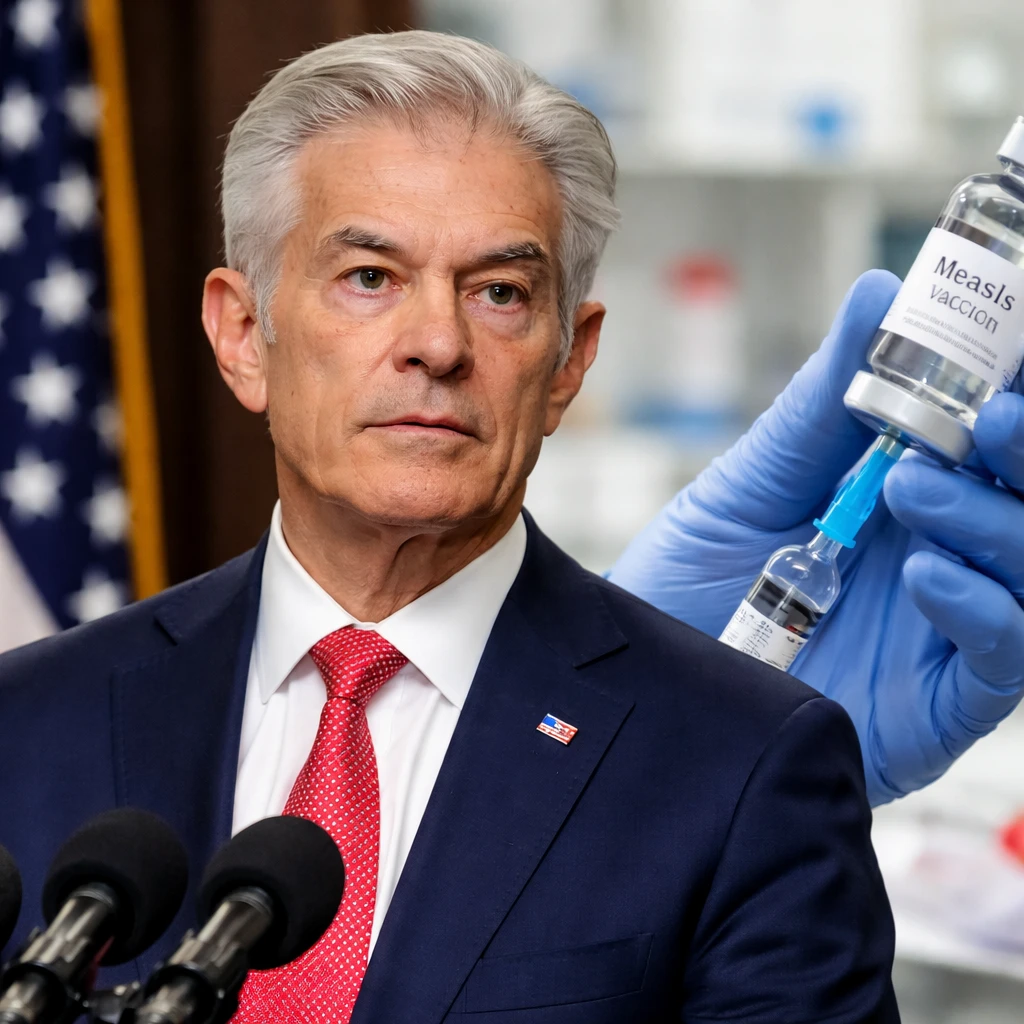
WASHINGTON - As multiple states across the United States confront active measles outbreaks, a prominent federal health official has urged the public to get vaccinated to curb the rising incidence. Dr. Mehmet Oz, the head of the Centers for Medicare and Medicaid Services, issued a direct appeal Sunday, advocating the vaccine as an effective solution to the current outbreaks threatening the nation’s measles elimination status.
Dr. Oz, known primarily as a cardiac surgeon, reaffirmed several recently revised federal vaccination guidelines covering the measles vaccine and touched upon prior statements made by President Donald Trump and HHS Secretary Robert F. Kennedy Jr., which had cast doubts on vaccine efficacy and safety in some quarters. On CNN’s "State of the Union," Oz underlined the seriousness of measles and the necessity of vaccination.
“Not all illnesses pose the same level of danger, and not everyone is equally vulnerable,” Oz stated. “However, measles is one illness for which vaccination is strongly recommended.”
Current outbreaks have notably intensified, with South Carolina reporting hundreds of cases surpassing the earlier 2025 Texas outbreak in scale. Additionally, an outbreak at the Utah-Arizona border area and confirmed cases in other states have been documented this year. The predominantly pediatric cases raise concerns amid increasing public skepticism towards vaccines—a trend experts warn could be fueling the disease’s resurgence after it was once declared eliminated in the US.
When asked directly if the public should fear measles during a television interview, Oz responded affirmatively, emphasizing the continuous coverage of the measles vaccine through Medicare and Medicaid programs. “No barriers exist for Americans in accessing the measles vaccine, which remains a core recommended immunization,” he said.
Oz also acknowledged that the administration has long supported measles vaccination efforts and noted that Secretary Kennedy has publicly encouraged vaccination against measles despite his overall cautious stance on other vaccines. “Following the Texas outbreak, Kennedy advised people to vaccinate against measles, identifying it as an illness warranting immunization,” Oz remarked.
Recent policy adjustments include the Trump administration’s removal of certain childhood vaccine recommendations—a revision undertaken by the Department of Health and Human Services responding to a directive from Trump to reevaluate US vaccine policy compared with that of peer nations. While vaccine mandates for schoolchildren fall under state jurisdiction, federal guidelines often influence state regulations. Some states have begun forming coalitions to countermand the White House’s vaccine guidance.
Nationwide, vaccination rates have declined alongside a historic rise in exemption rates among children. Concurrently, diseases preventable by vaccines, such as measles and pertussis, have experienced resurgence, underscoring public health challenges.
Secretary Kennedy’s history of vaccine skepticism has come under increased examination since his confirmation in the role last year. During Senate hearings, he denied that a 2019 trip to Samoa—a period preceding a major measles outbreak there—was related to vaccine discussions. Nonetheless, records reveal efforts to engage high-level Samoan officials during the visit. Samoan authorities later indicated the trip inadvertently bolstered anti-vaccine activists’ credibility ahead of the outbreak, which sickened thousands and resulted in numerous child fatalities under five years of age.
The inconsistency seen among government officials regarding vaccines extends further. During a recent Senate hearing, National Institutes of Health Director Jay Bhattacharya stated that no individual vaccine is linked to autism but left open the possibility that combinations could potentially have health side effects. Conversely, Kennedy has maintained that a vaccine-autism connection remains inadequately disproven, citing concerns historically raised about components such as the mercury-based preservative thimerosal, though most measles, mumps, and rubella vaccines do not contain this substance. Notably, the federal vaccine advisory committee that Kennedy has overseen recently voted to discontinue recommending vaccines containing thimerosal.
Public health leaders emphasize rebuilding trust in health systems following the polarized vaccine discourse during the COVID-19 pandemic, when misinformation surged and anti-vaccine activism gained broader public attention. Kennedy, formerly head of the group Children’s Health Defense, has faced criticism for directing vaccine reviews and public health guidelines that diverge from established scientific consensus, further complicating public messaging.
The politicization of vaccine safety extends to the highest administration levels, with President Trump previously making unsupported claims linking over-the-counter medications and vaccines to increasing autism rates.