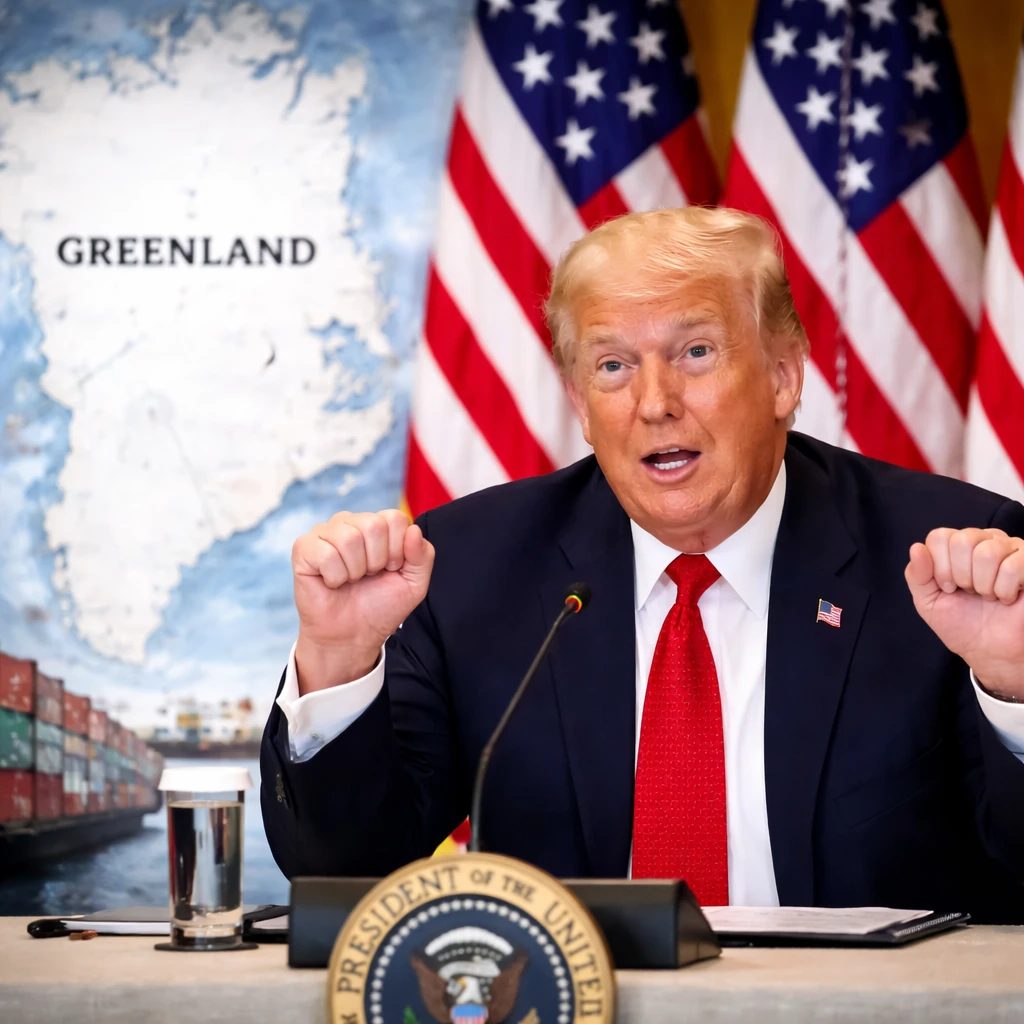

In a recent statement from Copenhagen, U.S. President Donald Trump suggested employing tariffs as a pressure tactic against countries that resist U.S. control over Greenland, a semi-autonomous Danish territory strategically significant for NATO. This assertion was made amidst ongoing discussions between a bipartisan group of U.S. legislators and Danish officials aimed at fostering cooperation and reducing friction around the island's status.
Trump reiterated his stance that the United States must have authority over Greenland, calling any alternative arrangement "unacceptable." During a separate White House event addressing rural healthcare, the president recounted previous threats he made against European allies concerning pharmaceutical tariffs, now extending that rhetoric to the Greenland issue. He declared, "I may put a tariff on countries if they don’t go along with Greenland, because we need Greenland for national security. So I may do that." This marks the first mention of tariffs as leverage in the context of Greenland by the president.
Earlier engagements included meetings in Washington, D.C., where the foreign ministers of Denmark and Greenland exchanged views with U.S. Vice President JD Vance and Secretary of State Marco Rubio. While these discussions did not resolve core disagreements, they led to the establishment of a bilateral working group. However, public communications from Denmark and the White House diverged sharply regarding the group's intended role.
European leaders have maintained that sovereignty matters concerning Greenland are solely the prerogative of Denmark and Greenland, emphasizing respect for existing governance structures. Denmark concurrently announced plans to enhance its military presence on the island, coordinating with allied forces.
In Copenhagen, a U.S. congressional delegation comprising senators and House members met with Danish Prime Minister Mette Frederiksen, Greenlandic representatives, and other local lawmakers. Senator Chris Coons, leading the delegation, expressed gratitude for over two centuries of alliance and spotlighted the importance of strengthening this partnership. Senator Lisa Murkowski underscored Greenland’s status as an ally rather than a mere territorial asset during her press remarks, emphasizing the necessity of nurturing this longstanding relationship.
This diplomatic tone contrasts with the White House's assertive approach. President Trump has justified his interest in Greenland by referencing perceived strategic threats from China and Russia, nations often cited as having interests in Arctic resources, including Greenland’s abundant critical minerals. Speculation concerning the means of securing U.S. interests has included the possibility of force, as suggested but not explicitly ruled out by the administration.
Voicing skepticism, Greenlandic politician and Danish parliament member Aaja Chemnitz critiqued the U.S. narrative, labeling it filled with exaggerations and falsehoods about external threats. Chemnitz argued that the primary source of current threats originates from the U.S. side rather than other global actors.
Senator Murkowski highlighted Congress's role not only in budgetary decisions but also as a conduit for constituent perspectives. She noted a significant majority of Americans oppose U.S. acquisition of Greenland, quoting polls showing around 75% of public dissent. Alongside Senator Jeanne Shaheen, she introduced bipartisan legislation restricting the allocation of Defense and State Department funds towards any attempt by the U.S. to annex Greenland or any NATO sovereign territory without respective consent.
The controversy significantly impacts Greenlanders directly. The island's Prime Minister Jens-Frederik Nielsen publicly affirmed the territory’s alignment with Denmark, NATO, and the European Union if forced to choose, rejecting U.S. dominion. Sara Olsvig, chair of the Inuit Circumpolar Council—a collective representing Inuit populations across Arctic regions including Greenland—voiced concerns about the U.S. administration's attitudes toward indigenous peoples and smaller populations. She characterized the persistent demands for U.S. ownership of Greenland as indicative of a dismissive and potentially colonizing mindset, emphasizing the indigenous community’s desire to avoid renewed subjugation.
The issue remains complex and multifaceted, encompassing strategic security interests, international law, indigenous rights, and longstanding diplomatic ties. While the White House espouses assertive unilateral approaches emphasizing national security, other U.S. institutions and allied nations advocate collaborative and respectful negotiations recognizing Greenland’s sovereignty and local populations' preferences.