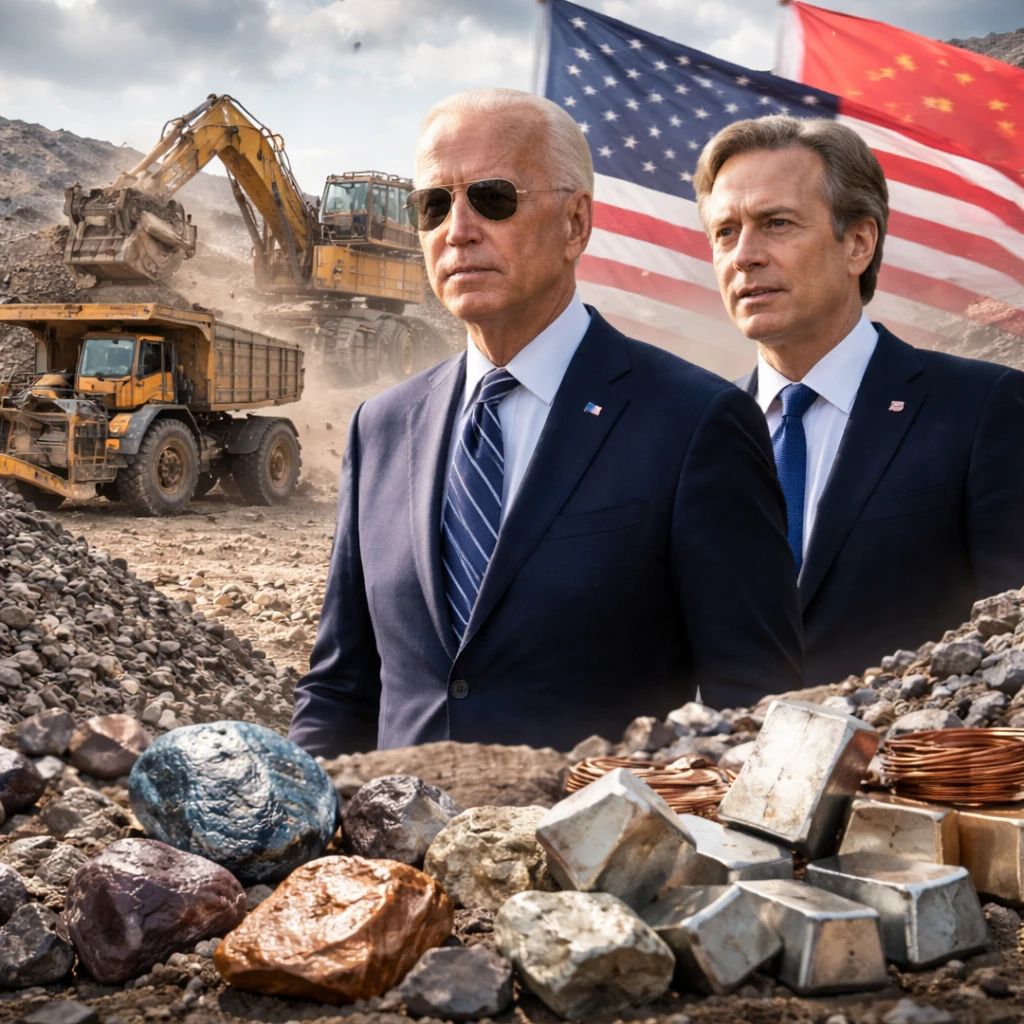

The current US administration is preparing to launch an extensive strategy aimed at revitalizing the supply of critical minerals that support a variety of technologically essential industries, including jet engine manufacturing and smartphone production. This large-scale plan is expected to involve formal agreements with allied nations, bolstering collaborative supply chain logistics alongside establishing a $12 billion strategic reserve dedicated to critical minerals.
Scheduled for a Wednesday keynote address, Vice President JD Vance will speak at a meeting orchestrated by Secretary of State Marco Rubio. This gathering will include representatives from over thirty countries spanning Europe, Asia, and Africa where supply chain partnerships are anticipated to be formalized, although specific details have yet to be publicly disclosed. Prior to this summit, Secretary Rubio engaged in discussions with the foreign ministers of South Korea and India, focusing on strategies related to mining and processing of these crucial minerals.
This diplomatic effort arrives mere days after President Donald Trump introduced "Project Vault," a new initiative aimed at creating a stockpile of critical minerals. The program is to be financed through a $10 billion loan facilitated by the US Export-Import Bank and supplemented by nearly $1.67 billion in private sector investment.
The administration's assertive approach comes in response to China's dominant position in the critical minerals market. Currently, China controls approximately 70% of the global rare earth elements mining output and possesses about 90% of the processing capabilities. This dominance previously enabled China to restrict the flow of rare earths during the period when the US-China tariff conflict intensified, exposing significant vulnerabilities in Western supply chains. A one-year détente was established following discussions between President Trump and Chinese President Xi Jinping in October, involving mutual tariff reductions and moderated rare earth export limitations.
Despite this truce, China's restrictions remain more stringent than prior to the onset of these trade tensions. Addressing this, President Trump emphasized the administration's commitment to avoid repeating the supply disruptions experienced previously when announcing Project Vault.
Industry experts highlight that the US is not alone in pursuing initiatives to counterbalance China's influence in critical minerals. Pini Althaus, founder of USA Rare Earth and active in developing mines outside the US, suggests that the administration and other nations are exploring the establishment of a "buyers' club" that would coordinate on pricing strategies, including price floors, to stabilize and secure supply chains.
Recently, the government extended a $1.6 billion investment to USA Rare Earth, marking the fourth significant infusion of public capital into American critical minerals producers. This funding arrangement includes equity stakes and repayment agreements and reflects the heightened scrutiny applied to companies seeking government backing, with an emphasis on reliable delivery and financial returns to taxpayers.
Complementing direct investments, the US Export-Import Bank has authorized the largest loan in its history—a $10 billion commitment—to develop the US Strategic Critical Minerals Reserve. This reserve aims to guarantee steady access to vital minerals for critical manufacturers such as battery producer Clarios, energy equipment company GE Vernova, digital storage leader Western Digital, and aerospace firm Boeing.
According to John Jovanovic, President and Chairman of the Export-Import Bank, this initiative represents a pioneering public-private partnership designed to ensure equitable contribution and benefit across stakeholders, preventing scenarios where any party becomes a "free rider." The reserve requires manufacturers who stand to gain most to engage in substantive, long-term financial participation, which in turn motivates additional private investment alongside government support.
Implementing a strategic stockpile is expected to foster a "more organic" pricing environment less susceptible to China's market impacts. Wade Senti, president of the US-based AML permanent magnet company, notes that China has historically leveraged its market control to undercut prices and outcompete rivals.
The Department of Defense has also been proactive, allocating close to $5 billion over the past year specifically to secure access to essential minerals following revelations of US reliance on China amid trade conflicts. This underscores the heightened national security significance of these materials.
On the legislative front, a bipartisan proposal introduced recently advocates for establishing a US agency endowed with $2.5 billion in funding to stimulate domestic production of rare earths and other critical minerals. Lawmakers from both parties have expressed strong support for federal efforts to diversify supply sources away from China and create a more stable market landscape.
Experts caution, however, that building a robust mineral stockpile represents a long-term endeavor. Current scarcity, driven by China's continuing export limitations, means supply interruptions remain a significant concern. David Abraham, an authority on rare earths and author of "The Elements of Power," emphasizes that fostering downstream manufacturing sectors—those industries that utilize these minerals—is also essential for a comprehensive strategy. Abraham critiques certain administrative policies that reduced incentives for electric vehicles and wind power, suggesting these have negatively influenced domestic demand for these critical elements.