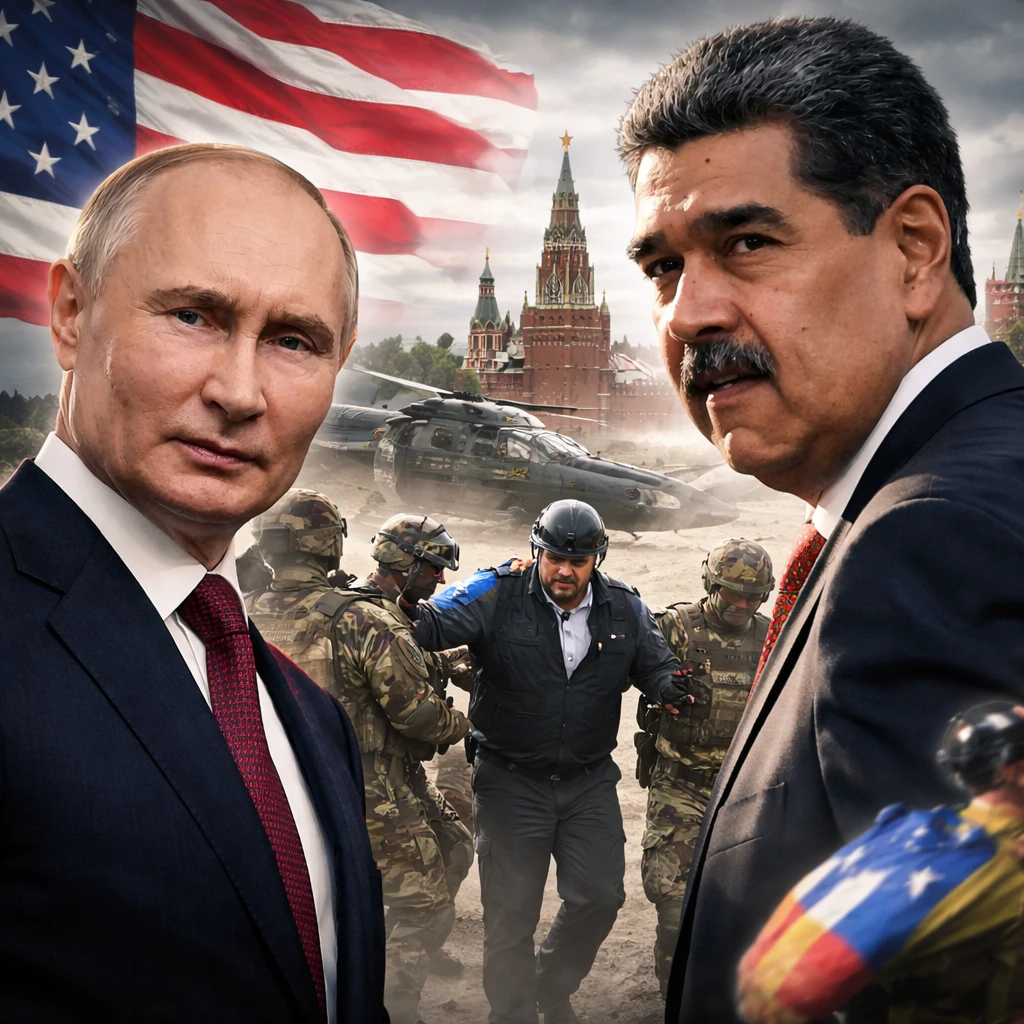

The swift action by the United States to apprehend Venezuelan President Nicolas Maduro embodies both an advantage and a challenge for Russian President Vladimir Putin. The Kremlin's forces previously faltered in their attempt to seize Kyiv and overthrow Ukraine’s leadership during the initial phase of Moscow’s invasion, nearly four years ago. The removal of Maduro underscores another instance where Russia has failed to sustain support for its allied governments, succeeding similar downfalls such as the collapse of Syria’s former President Bashar Assad in 2024 and the U.S. and Israeli strikes on Iran last year.
With the United States intent on asserting dominance over Venezuela, Russia risks losing a critical strategic position in the Western Hemisphere, along with the substantial investments made in Venezuela’s oil industry. This loss represents a significant setback for Moscow’s ambitions in the region.
Nonetheless, the maneuvers by then-President Donald Trump in Venezuela have caused unease among Western nations and equipped the Kremlin with fresh arguments to justify its military operation in Ukraine. Trump’s ambitions to assume control over Greenland from NATO ally Denmark have also raised concerns about potential destabilization within the alliance. This comes at a critical juncture when NATO members are focused on supporting Ukraine with security assurances and brokering peace.
To date, Putin has refrained from publicly commenting on the U.S. actions in Venezuela. However, Russian diplomats have condemned the operation as an overt act of aggression. Dmitry Medvedev, Russia’s former president and current deputy on the presidential Security Council, criticized Washington for violating international law while simultaneously acknowledging Trump’s unwavering commitment to defending U.S. national interests.
On a related development, the U.S. announced the seizure of two sanctioned oil tankers connected to Venezuela, one of which was Russian-flagged, in the North Atlantic. This move further constrains Russia’s operational ability in its remaining regional partnerships.
Moscow’s Concept of Spheres of Influence
Since Russia’s illegal annexation of Ukraine’s Crimean Peninsula in 2014, which followed the ousting of a pro-Kremlin president in Kyiv, Putin has framed the conflict as a defense of Russia’s sphere of influence and a stand against Western intrusion. He has drawn parallels with the U.S. opposition to foreign military presence in the Western Hemisphere and positioned NATO’s eastward expansion as a direct security threat. Putin has cited Ukraine’s aspirations to join NATO as a principal justification for the full-scale invasion that began in February 2022.
Prior to the invasion, Russian officials tested prospects for an arrangement whereby Moscow would desist from involvement in Latin America if the U.S. granted Russia uncontested influence in Europe. Fiona Hill, who managed Russia and Europe portfolios on Trump’s National Security Council during his first term, testified that Russian diplomats alluded to such a potential exchange involving Venezuela and Ukraine. Although no formal offer was made, the then-Russian ambassador to Washington, Anatoly Antonov, insinuated the possibility of such a deal during diplomatic engagements.
Hill conveyed to Moscow in 2019 that the Trump administration was uninterested in pursuing such a bilateral arrangement, emphasizing that Ukraine and Venezuela were unrelated matters. Whether this stance has shifted during Trump’s subsequent term or whether any informal understandings exist remains unclear, particularly given turnover within U.S. administration personnel.
Further speculation arose when reports indicated that Russia began evacuating families of its diplomats from Venezuela ahead of Maduro’s capture. Some observers inferred that a Trump envoy might have provided Moscow advance notice about impending U.S. actions.
Russia’s Strategic Foothold in the Americas
Before the Ukraine conflict escalated, Russian officials issued ambiguous warnings about deploying military forces or equipment to Cuba and Venezuela, which were largely dismissed by U.S. officials as mere posturing. Comparisons to the Cold War-era Cuban Missile Crisis have surfaced, highlighting the historical sensitivity of military presence in the Western Hemisphere. Following the Soviet Union’s dissolution in 1991, Russian-Cuban relations declined and a Soviet-era intelligence facility in Cuba was closed under Putin’s early presidency to improve ties with Washington.
However, with rising tensions with Western powers, Russia renewed economic and military contacts with Cuba, including warship visits. Russia also expanded investments in Venezuela’s oil sector and extended generous loans for advanced air defense systems, fighter aircraft, and other military hardware. It has periodically deployed its nuclear-capable Tupolev Tu-160 bombers to Venezuelan territory to demonstrate force projection.
Despite these endeavors, military experts emphasize that any permanent Russian military presence in the Western Hemisphere faces substantial logistical hurdles, which complicate Moscow’s ambitions for a sustained foothold.
The Resurgence of a 'Might-Makes-Right' Approach
The U.S. operation to detain Maduro and his wife is widely viewed as a reassertion of the ‘might-makes-right’ principle, echoing Moscow’s justification for its actions in Ukraine as protection of vital national interests. Medvedev asserted that the U.S. now holds a position that is difficult to criticize legally or morally.
Hill noted that the U.S.’s direct intervention complicates international condemnation of Russia, as it involves an extrajudicial move against a sovereign government, under criminal allegations involving drug trafficking. Such developments undermine efforts to delegitimize Russia’s campaign in Ukraine solely on moral grounds.
Kremlin-aligned analysts have suggested that these events establish a precedent reinforcing Trump’s belief that Venezuela’s government must align with Washington’s approval, strengthening Russia’s narrative for its own military pursuits. Russian nationalist voices have advocated intensification of the Ukraine offensive, positing that full control over Ukraine would solidify Russia’s status among global great powers.
Implications and Ongoing Developments
The U.S. action in Venezuela presents a multifaceted challenge for Russia, simultaneously diminishing its strategic reach in the Western Hemisphere and offering rhetorical support to its claims in the Ukraine conflict. The dynamics within NATO are also affected, as internal divisions over Greenland and Latin America may affect unified efforts supporting Kyiv.
The situation continues to unfold, and the full implications for U.S.-Russia relations, regional stability, and the broader geopolitical landscape warrant close observation.