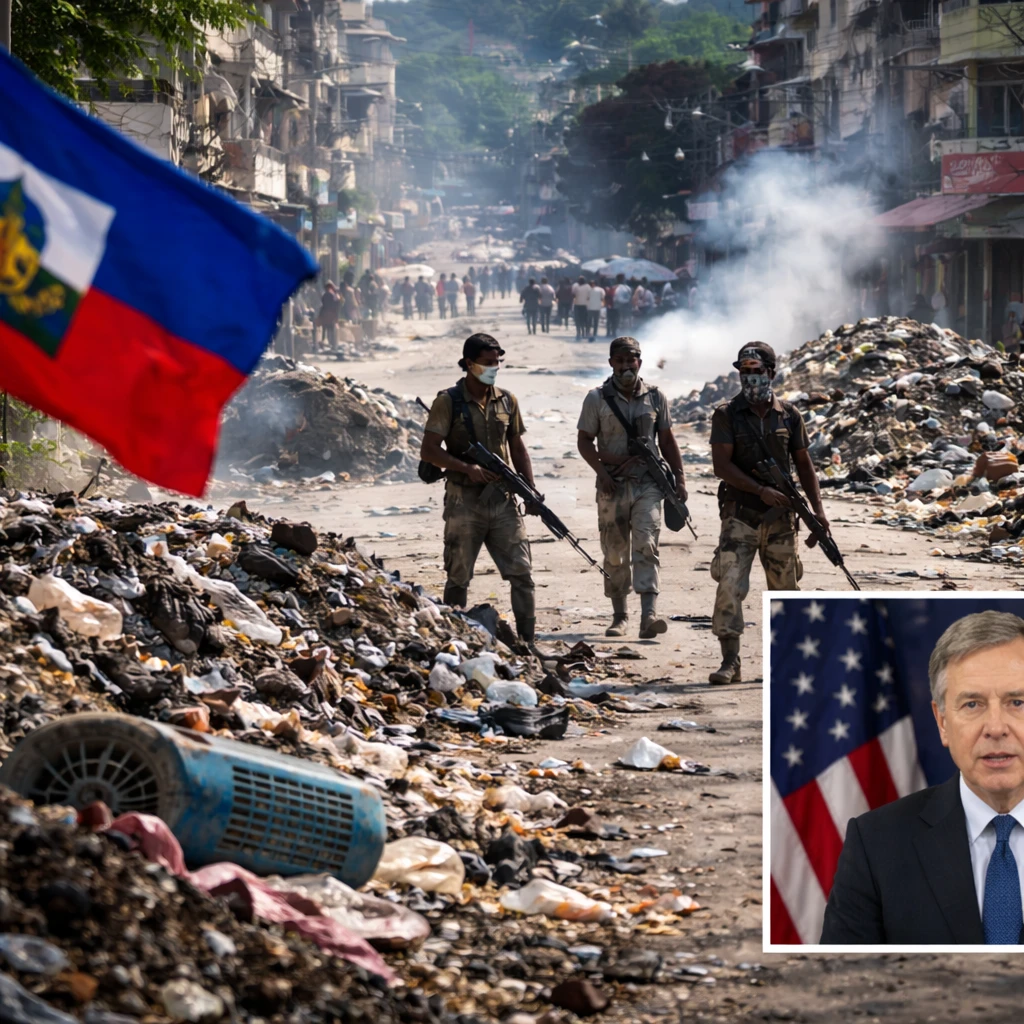

In Puerto Rico's capital San Juan, the United States government delivered a cautionary statement to Haiti's transitional governing council concerning potential alterations to the nation's already fragile governmental structure. Posted late Wednesday on the social media platform X, the U.S. Embassy in Haiti articulated that individuals supporting such destabilizing measures that might empower gang factions would be regarded as acting contrary to the interests of the United States, the broader region, and the Haitian populace, subsequently prompting suitable responsive actions by the U.S.
The embassy’s message also highlighted the risks these moves pose to establishing even minimal security and stability within Haiti, where gang-related violence has been intensifying amid increasingly severe socioeconomic challenges.
This warning arises amidst apparent discord within the transitional council and Haitian Prime Minister Alix Didier Fils-Aimé. Although the reasons behind this internal friction remain unclear, the council convened behind closed doors earlier the same day. Efforts to obtain comments from the prime minister’s office yielded no substantive information, and the council’s seven voting members did not respond to inquiries.
Laurent Saint-Cyr, leader of the transitional council, publicly opposed any attempts to undermine government stability prior to the council's scheduled relinquishment of authority on February 7. Saint-Cyr underscored the imminent institutional deadlines confronting the nation, describing initiatives that threaten to spawn instability, confusion, or erosion of public trust as carrying grave risks. He stressed that Haiti cannot afford decisions taken unilaterally or impulsively which might jeopardize the state's continuity and imperil the welfare of its already burdened population.
The transitional council, established in April 2024 with assistance from Caribbean leaders, emerged following a crippling campaign of gang violence that included closure of Haiti’s principal international airport and attacks on critical state infrastructure. This violence precipitated the resignation of former Prime Minister Ariel Henry.
Tasked principally with selecting the nation’s prime minister to restore order, the council appointed Alix Didier Fils-Aimé in November 2025, following the dismissal of his predecessor, Garry Conille. Fils-Aimé, a business figure with a background leading Haiti’s Chamber of Commerce and Industry, is now the third prime minister chosen by this governing body.
While the council’s mandate is slated to conclude on February 7, uncertainty persists as to whether it will indeed step aside. Critics allege that certain members aim to extend their tenure beyond the authorized period, raising concerns about potential outbreaks of further violent demonstrations. The February 7 deadline was predicated on the assumption that general elections would have taken place by then to elect a new president. However, gang violence has so far rendered election logistics impossible, although tentative voting dates have been announced for August, with a possible runoff in December.
The United Nations Security Council convened on the same day to address the deteriorating state of affairs in Haiti. A recent U.N. report noted persistent divisions among national stakeholders regarding the transitional governance model intended to shepherd elections. Carlos Ruiz-Massieu, the U.N. Secretary-General’s special representative in Haiti, emphasized that the country is at a pivotal stage in restoring democratic institutions, urging cessation of protracted infighting.
Panamanian U.N. Ambassador Eloy Alfaro de Alba characterized Haiti as facing a critical juncture, with the transitional council’s mandate expiring in just 18 days. Council members expressed utmost concern over persistent violence, which remains a significant barrier to progress.
Multiple Security Council voices called for an expedited democratic transition as gangs extend their control over increasingly broad territories. An estimated 90% of Port-au-Prince falls under gang dominion, along with substantial portions of the central region. According to U.N. data, over 8,100 homicides were reported between January and November of the previous year, likely an undercount due to restricted access to gang-controlled zones.
Haiti’s National Police continues efforts to combat gang violence with support from a U.N.-backed mission led by Kenyan police officers. Despite these contributions, the mission remains understaffed and underfunded. Plans are underway to transition this support into a gang suppression force authorized to detain suspects.
Additionally, the Haitian government has engaged a private military contractor to conduct drone strikes targeting presumed gang members, operations which have controversially resulted in civilian casualties. From March through December last year, these strikes accounted for over 970 deaths, including 39 civilians, 16 of whom were children, as reported by the U.N. Office of the High Commissioner for Human Rights.
An earlier report mistakenly identified Garry Conille as the first prime minister chosen by the transitional council; he was in fact the second.