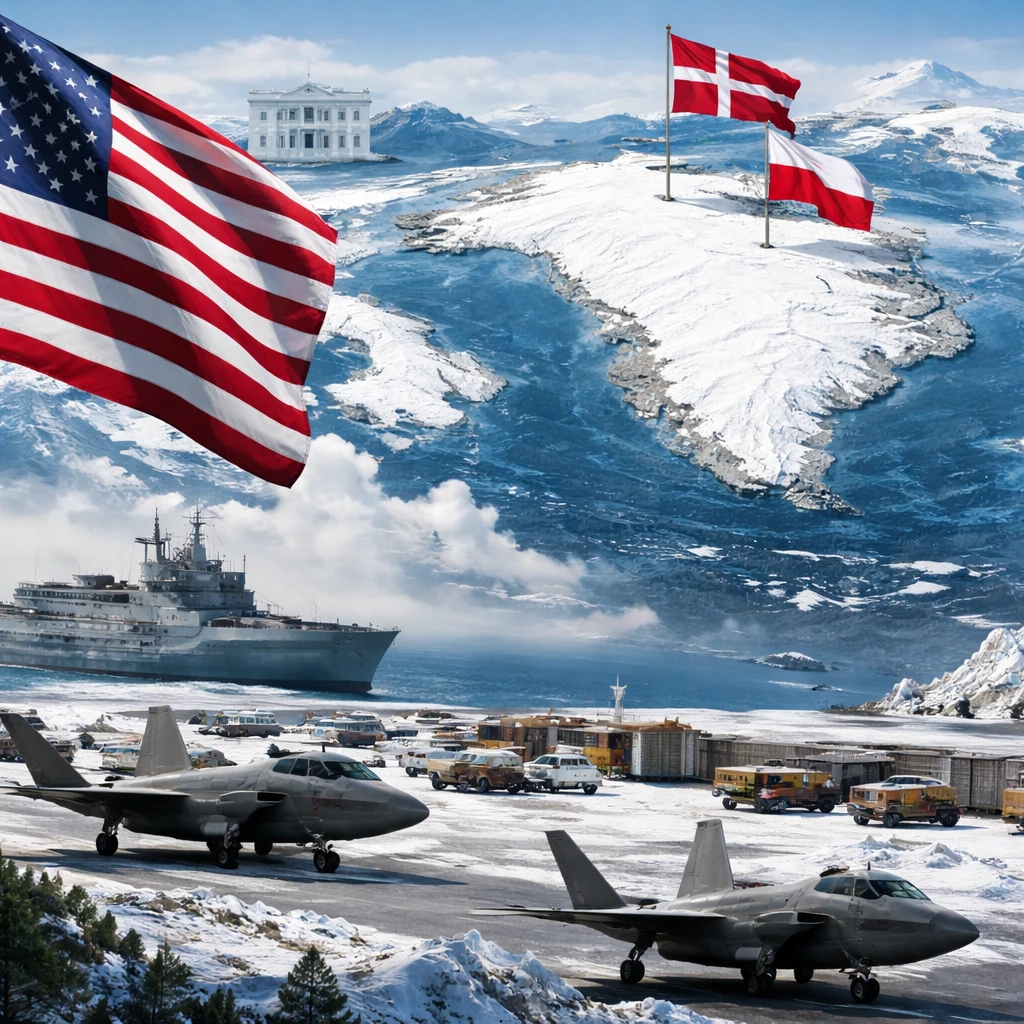

The White House declared on Tuesday that deploying the U.S. military remains a standing option in efforts regarding Greenland, amidst firm pushback from European leaders rejecting President Donald Trump’s propositions to acquire the vast Arctic island. Initially suggested during his first term, Trump has revived the notion of purchasing Greenland, an autonomous territory under Danish sovereignty. This resurgence follows recent U.S. military operations in Venezuela and is justified by the administration on strategic and security grounds.
White House Press Secretary Karoline Leavitt stated, “President Trump has made it well known that acquiring Greenland is a national security priority of the United States, and it’s vital to deter our adversaries in the Arctic region.” She further noted that the president and his team are exploring various approaches to advance this foreign policy objective, explicitly confirming that employing the U.S. military is always within the commander-in-chief’s prerogative.
This declaration contrasts earlier remarks from Stephen Miller, the deputy White House chief of staff and newly appointed special envoy to Greenland, who indicated military intervention was not anticipated. Miller confirmed on Monday that while the U.S. envisions Greenland as integral to its security architecture, the administration does not foresee the need for armed conflict. Separately, Republican House Speaker Mike Johnson expressed discomfort with the prospect of military action in Greenland, deeming it inappropriate.
Tensions surfaced after Miller’s wife posted a social media image of Greenland overlaid with the U.S. flag and the caption "SOON," which Denmark interpreted as signaling imminent American intervention. President Trump reinforced his position during comments to reporters, asserting the necessity of U.S. control over Greenland to counter Chinese and Russian influence in the Arctic. “It’s so strategic right now,” he remarked. “Greenland is covered with Russian and Chinese ships all over the place. We need Greenland from the standpoint of national security, and Denmark is not going to be able to do it.”
The Danish government, led by Prime Minister Mette Frederiksen, along with Greenland’s Prime Minister Jens Frederiksen Nielsen, has firmly rejected these claims and the notion of U.S. annexation. The leaders, joined by counterparts from France, Germany, Italy, Poland, Spain, and the United Kingdom, issued a collective statement underscoring that Greenland “belongs to its people,” affirming sovereignty belongs solely to Greenland and Denmark. Canadian Prime Minister Mark Carney echoed this stance, highlighting the importance of decisions concerning Greenland being made exclusively by the Danish and Greenlandic people. He also announced a forthcoming visit to Greenland by Canada’s Governor General Mary Simon and Foreign Minister Anita Anand.
Recently appointed U.S. Special Envoy to Greenland, Louisiana Governor Jeff Landry, conveyed an intent to engage directly with the people of Greenland, bypassing both Danish officials and European diplomats. On a Fox News radio broadcast, Landry emphasized discussions aimed at improving the quality of life for Greenlanders, describing an informal approach as “culinary diplomacy” given Greenlanders’ shared cultural interests, such as fishing and hunting.
Greenland holds critical strategic value due to its geographic location and abundant natural resources. More than two-thirds of the island lie within the Arctic Circle, offering a vital vantage point for North American defense since World War II. The U.S. operates the Pituffik Space Base on Greenland, significant for missile warning, defense, and space surveillance activities under a 1951 defense accord with Denmark. Furthermore, Greenland covers part of the GIUK Gap, a maritime corridor monitored by NATO to track Russian naval movements. The island also contains extensive rare earth elements essential for technology manufacturing and potential deposits of oil and natural gas, as identified by the U.S. Geological Survey.
The longstanding Danish sovereignty over Greenland, recognized since the early 20th century and solidified under the 2009 self-government legislation, also retains a provision for possible independence, an option supported by the majority of Greenland’s population. The dispute over potential U.S. acquisition has sparked considerable anxiety, with Frederiksen warning of severe consequences for NATO if the U.S. undertook military action against a NATO member territory.
Political figures including U.S. Representatives Steny H. Hoyer and Blake Moore, co-chairs of the Congressional Friends of Denmark Caucus, called for calm, cautioning against provocative rhetoric about annexation and reaffirming cooperative relations. They noted that the U.S. already has access to Greenland for military purposes through existing agreements with Denmark, enabling deployment of additional forces or missile defense assets if necessary.
Security analysts, such as Ulrik Pram Gad from the Danish Institute for International Studies, challenged some of the U.S. administration’s assertions regarding the presence of Russian and Chinese vessels near Greenland, clarifying that these ships remain distant and not readily observable from the island.
As the dialogue continues, efforts focus on balancing strategic defense interests with respecting sovereignty and self-determination, underscoring the evolving geopolitical contest in the Arctic region.