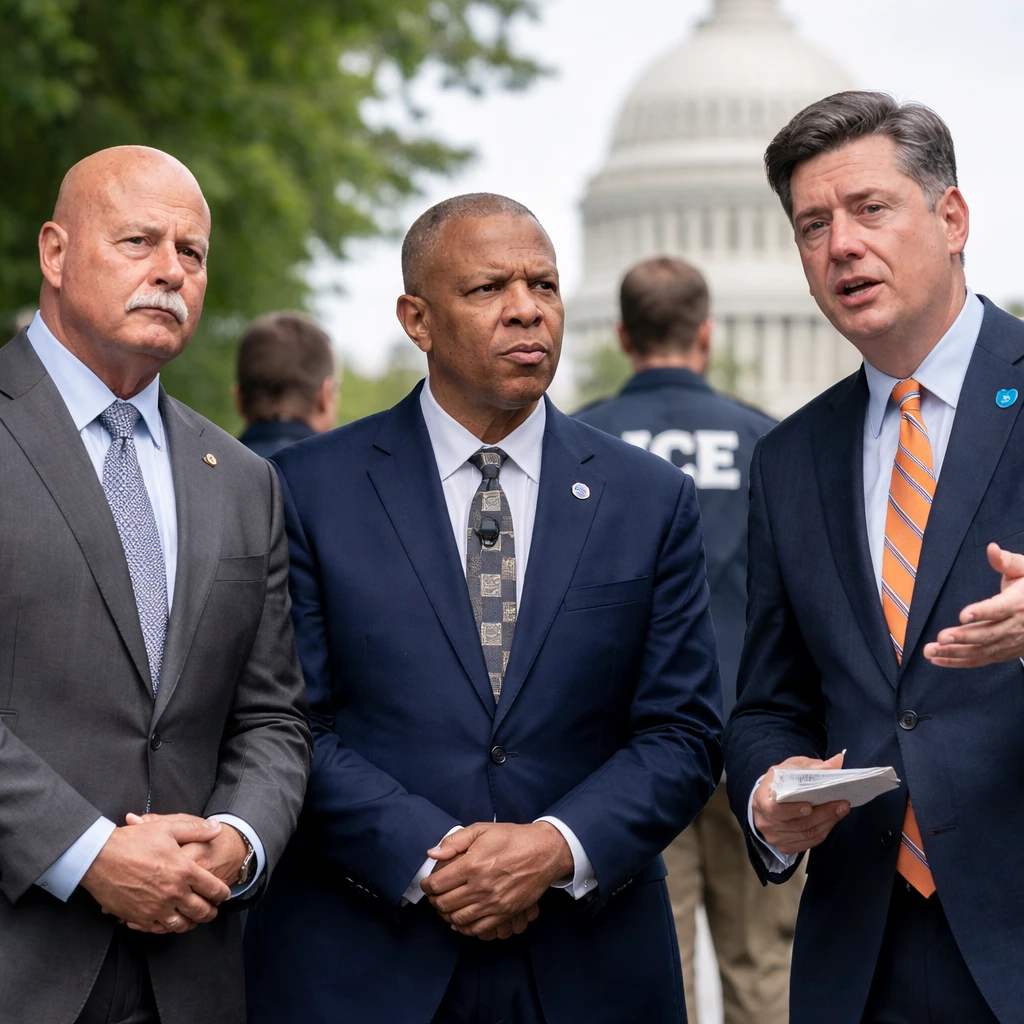

At a recent meeting of the United States Conference of Mayors held in Washington, D.C., various city leaders voiced their unease with the federal government's immigration enforcement tactics, particularly in light of a recent lethal encounter between federal agents and a Minnesota resident. Elizabeth Kautz, the Republican mayor of Burnsville, a suburb of Minneapolis, shared that she now feels compelled to carry her passport regularly to avoid possible misunderstandings or confrontations with Immigration and Customs Enforcement (ICE) agents amid heightened operations. "Those ICE agents don’t know that I’m the mayor of the city of Burnsville," she remarked, underscoring the tense atmosphere localities face.
Normally, such gatherings focus on collaborative strategies tackling issues like affordable housing, urban transit, climate change, and city crime. However, discussions at this meeting were largely dominated by the aftermath of Alex Jeffrey Pretti's death caused by federal agents during an enforcement action in Minneapolis, an episode that has reignited debates over the administration's rigorous approach to immigration enforcement in urban areas.
Oklahoma City Mayor David Holt, also a Republican and the conference president for the year, characterized the recent enforcement surge in Minnesota as a paramount challenge. "There has been no more urgent challenge facing all Americans these past few weeks than the chaos in Minnesota stemming from an unprecedented surge in immigration enforcement," Holt stated, reflecting a shared concern among mayors nationwide.
Several mayors acknowledged President Donald Trump's recent indication to scale back federal operations in Minnesota and concurred with the overarching aim of deporting undocumented immigrants with criminal records. Yet, they emphasized the complexities they face in balancing constituent pressures—some advocating for the removal of federal agents from their communities, a move beyond local authority—and maintaining cooperative ties with federal counterparts.
These enforcement measures have also reverberated beyond hotspots like Minneapolis. Lincoln, Nebraska Mayor Leirion Gaylor Baird, a Democrat, highlighted that growing mistrust in legal enforcement practices in one city can pose risks for police officers and residents nationally, even in cities less exposed to federal intervention. She elaborated, "When trust is lost in how laws are being enforced in one city, we feel the risks to our police officers and to our residents in all cities." In response to concerns raised by municipal leaders, Department of Homeland Security spokesperson Tricia McLaughlin pointed to declining murder rates, attributing improvements to the removal of numerous gang members, murderers, and suspected terrorists present illegally in the country.
Despite the conference being held in Washington, Holt noted an absence of invitations from the White House for city mayors to convene with federal officials during this period. President Trump has publicly placed responsibility on local leadership for cooperating with federal immigration enforcement efforts, sharply criticizing Minneapolis Mayor Jacob Frey's stance against enforcing federal immigration policies.
From the perspective of Jerry Dyer, Republican mayor of Fresno, California and a former police chief, while appreciative of the administration’s border security initiatives, concerns remain regarding the federal enforcement approach and community reactions. Dyer observed that ICE faces significant rejection from communities nationwide, which, he cautioned, jeopardizes public trust in law enforcement. He stressed the importance of policing neighborhoods with community consent, stating, "We cannot be seen as an occupying force when we go into these neighborhoods." Jim Hovland, the nonpartisan mayor of Edina, Minnesota, noted the challenge of navigating "external forces" that are disrupting the social cohesion of their communities. He described the situation as difficult to manage given the current political and social environment.