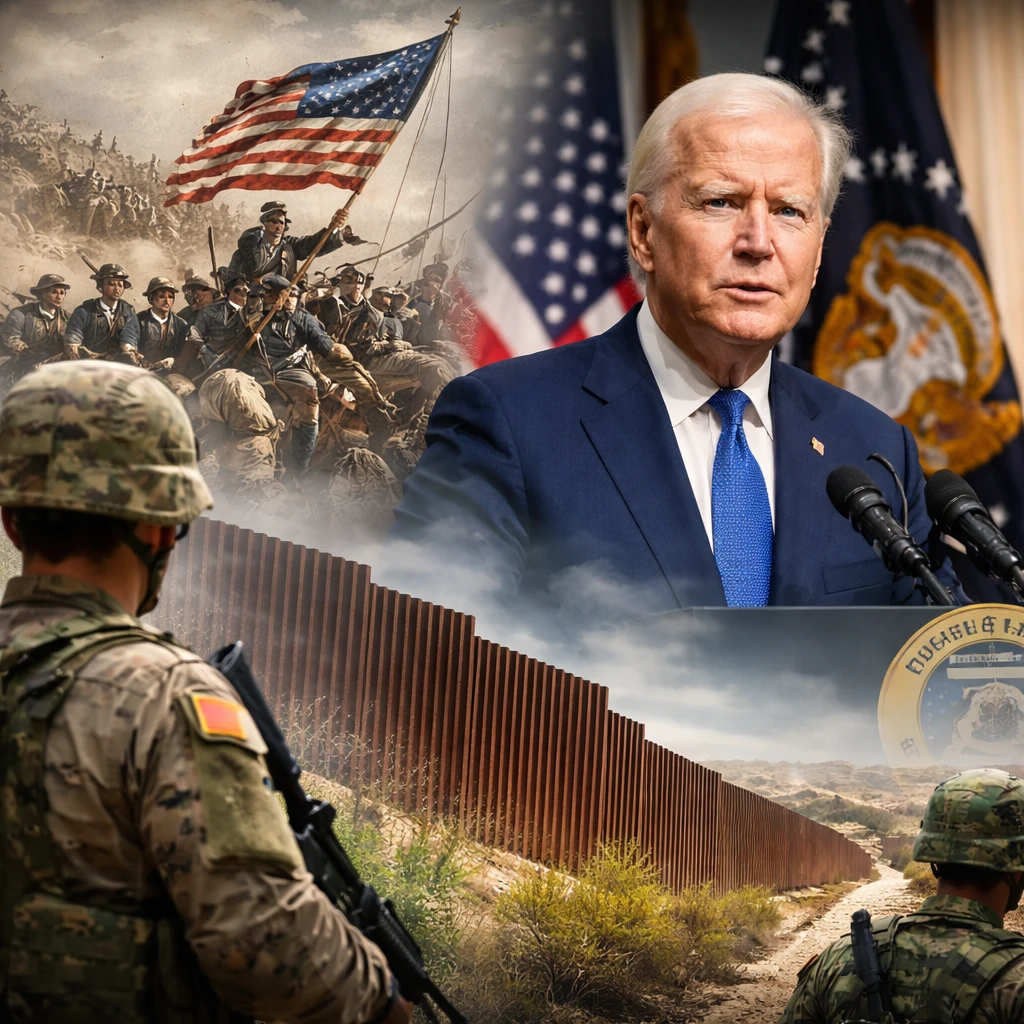

In Mexico City, historians and political analysts voiced strong objections on Tuesday against a recent statement issued by the US administration under President Donald Trump. They argue the statement attempts to recast the history of the 1846-1848 war between Mexico and the United States in a way that supports contemporary US foreign policy decisions toward Latin America. Critics highlight that the White House's version of events contains significant historical inaccuracies.
On Monday, the White House released a commemorative message marking the anniversary of the US-Mexico War, describing it as a "legendary victory" that secured the US southwest, reinforced American sovereignty, and extended the promise of independence across the continent. The statement further drew parallels between this historical period and the administration's current increasingly assertive policies in Latin America, which it claims are necessary to maintain security throughout the Western Hemisphere.
"Guided by our victory on the fields of Mexico 178 years ago, I have spared no effort in defending our southern border against invasion, upholding the rule of law, and protecting our homeland from the forces of evil, violence, and destruction," the unsigned statement proclaimed.
However, the document notably omits discussion of the pivotal role that slavery played in the war and broadly glorifies the era known as Manifest Destiny, a period that involved the forced displacement of hundreds of thousands of Native Americans from their ancestral lands.
Critical Reactions
Alexander Aviña, a Latin American history professor at Arizona State University, criticized the White House's characterization, stating it "minimizes the extensive violence required to expand US territory to the Pacific coast." He noted that the Trump administration's current interventions in Latin America—such as capturing Venezuela's president, interfering in electoral processes, and threatening Mexico and other nations with military action—are unprecedented in recent decades.
"US political leaders have traditionally viewed this chapter as a regrettable episode of imperialism against a southern neighbor," Aviña explained. "This administration, however, embraces this history as a positive example and frames it inaccurately as a defensive measure against a Mexican invasion."
The statement drew sharp criticism on social media throughout Tuesday.
When questioned about the White House communication during her morning press conference, Mexican President Claudia Sheinbaum responded with a laugh, adding, "We always must defend our sovereignty." Known for a delicate relationship with Washington, Sheinbaum has occasionally responded to President Trump with measured yet pointed remarks, such as when he renamed the Gulf of Mexico to the Gulf of the United States.
A Historic Point of Contention
The US-Mexico War originated from longstanding border disputes and the US annexation of Texas in 1845, a territory where American settlers had gradually moved. Mexico's ban on slavery and concerns from American abolitionists that the annexation aimed to expand slaveholding states were part of the conflict's background.
Following US military successes, Mexico ceded over 1.36 million square kilometers (525,000 square miles)—including present-day Arizona, California, western Colorado, Nevada, New Mexico, Texas, and Utah—to the United States. This acquisition made Texas strategically significant during the subsequent US Civil War.
Former US President Ulysses S. Grant once described the war as "one of the most unjust ever waged by a stronger nation against a weaker one."
The Associated Press has historic roots tracing to the era, as five New York newspapers funded a pony express route through Alabama to accelerate war news delivery, exceeding the speed of the US Postal Service at the time.
The war remains a source of friction between Mexico and the United States, particularly as President Sheinbaum repeatedly stresses Mexico’s sovereignty in response to US military threats against Mexican cartels and other pressure tactics.
Revisionism and Policy Implications
The White House statement reflects broader efforts by the Trump administration to shape federal historical narratives. Stanford University history professor Albert Camarillo characterized the message as a "distorted, ahistorical, imperialist version" of the war's events.
Aviña emphasized that the statement rhetorically attempts to legitimize the US policy of "America First" across the Americas, irrespective of historical accuracy.
Under direction from the White House, exhibits at the Smithsonian Institute have been rewritten to "restore truth and sanity" to US history, according to government officials. Concurrently, the administration has removed content from federal websites that it deems unfavorable, including records relating to slavery, destruction of indigenous cultures, and climate change. Orders have been issued to eliminate signage that allegedly disparages Americans of past or present generations.
"This communication is consistent with numerous other attempts to whitewash and reframe US history, erasing decades of scholarly research," said Camarillo.
Note: This article was translated and adapted from Spanish sources with assistance from generative AI tools.