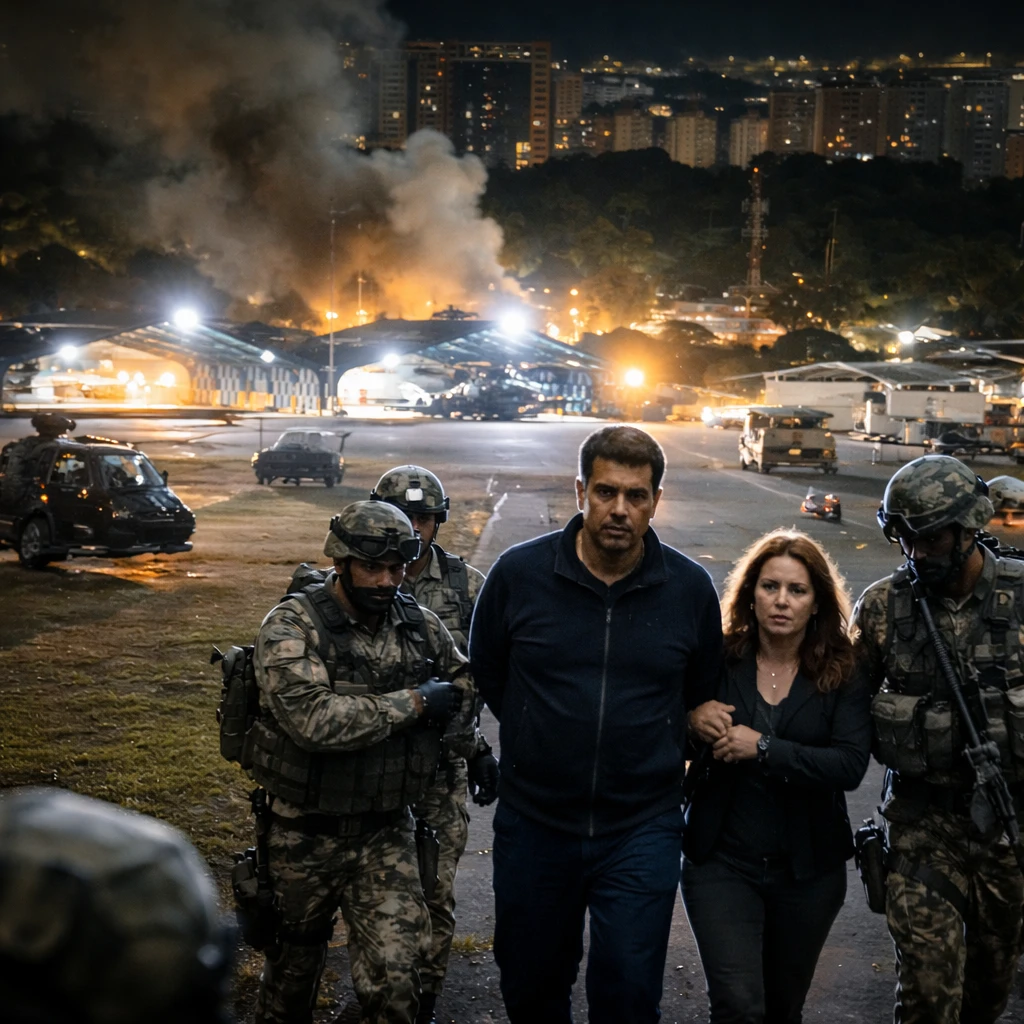

In the early hours of Saturday, a decisive and rapid U.S. military operation took place in Venezuela, leading to the apprehension of President Nicolás Maduro and his spouse, Cilia Flores. Both were subsequently extracted from Venezuelan territory, as confirmed by American authorities. These officials indicated that Maduro and Flores will face charges related to narco-terrorism in U.S. courts.
The consequences of this overnight assault have sent shockwaves through the Venezuelan government, leaving its command structure shaken and creating uncertainty regarding the immediate condition of its military forces and the toll in casualties. Meanwhile, countries within the region and beyond are assessing the destabilizing effects of what appears to be a unilateral action by the United States.
Explosions echoed throughout Caracas during the operation, accompanied by the passage of low-flying aircraft. Within a span of less than 30 minutes, at least seven explosions were detected, with military facilities among the apparent targets. Witnesses observed smoke billowing from a hangar at a Caracas military base and noted power outages in another military location.
Social media posts from then-President Trump confirmed Maduro's and Flores' capture and removal from Venezuela. According to Nahum Fernández, a leader within Venezuela’s ruling party, both Maduro and Flores were seized at their residence inside the Fort Tiuna military complex on the outskirts of Caracas.
While Venezuelan officials acknowledged fatalities resulting from the attack, comprehensive information regarding the extent of casualties has yet to be released.
This operation follows increased U.S. pressure within recent months, which involved the deployment of naval forces near South America and a sequence of lethal strikes targeting vessels suspected of drug trafficking within the eastern Pacific and Caribbean regions. A direct CIA drone strike on Venezuelan soil occurred just the previous week, aimed at a dock used allegedly by drug cartel operations.
U.S. Attorney General Pam Bondi announced that both Maduro and Flores have been indicted in the Southern District of New York, facing serious federal charges including narco-terrorism conspiracy, cocaine importation conspiracy, possession and conspiracy to possess machine guns and destructive devices. The 2020 indictment of Maduro was previously issued, while the charges against Flores are newly publicized. It was reported that they are currently aboard a U.S. warship, destined for prosecution in New York.
Legal considerations surrounding the strike are complex. The U.S. has not acknowledged the jurisdiction of the International Criminal Court over its actions. The Trump administration asserts that Maduro lacks legitimate authority in Venezuela and accuses him of transforming the nation into a criminal enterprise allied with drug traffickers and terrorists. A U.S. senator stated the raid likely falls within the President’s constitutional authority to protect American personnel.
Domestically, Maduro's administration condemned the offensive as an imperialist attack against civilians and military targets and called for public mobilization. In Caracas, armed groups and civilian militias appeared on the streets within traditionally pro-government neighborhoods, even as other city sectors remained quiet. Power outages persisted in parts of Caracas, although normal vehicular movement was observed. Despite legal stipulations designating Vice President Delcy Rodríguez as the successor, no confirmation has emerged indicating a transfer of power.
Opposition leader Maria Corina Machado did not issue immediate commentary; she recently traveled to Norway after a lengthy period in hiding. The U.S. indicated ongoing involvement in decisions regarding Venezuela’s political future.
Experts in international affairs characterize the U.S. strikes as initiating a series of unpredictable developments, with unclear outcomes regarding the nature of Venezuela’s subsequent government. Some analysts critique the assumption that removing Maduro would straightforwardly prompt democratic transition.
Regionally, Colombia has reinforced its border security in anticipation of potential refugee movements. Political leaders in Latin America responded divergently: Argentine President Milei, aligned with right-wing U.S. politics, endorsed the military action, while Brazilian President Lula da Silva denounced it, cautioning about the consequences of prior American interventions.
International reactions include condemnation from Cuba, an ally of Maduro, which called for a global response against what it termed a criminal attack. Russia criticized the operation as a violation of Venezuelan sovereignty.
European countries maintained cautious stances. The European Union emphasized respect for international law and called for restraint, noting Maduro’s contested legitimacy but advocating for peaceful change. The United Kingdom disavowed any involvement, and Spain called for de-escalation while monitoring unfolding events.
This operation signals a significant shift in the geopolitical landscape of the region, carrying implications for political stability, security dynamics, and international law considerations. The situation continues to evolve as further information becomes available.
The consequences of this overnight assault have sent shockwaves through the Venezuelan government, leaving its command structure shaken and creating uncertainty regarding the immediate condition of its military forces and the toll in casualties. Meanwhile, countries within the region and beyond are assessing the destabilizing effects of what appears to be a unilateral action by the United States.
Explosions echoed throughout Caracas during the operation, accompanied by the passage of low-flying aircraft. Within a span of less than 30 minutes, at least seven explosions were detected, with military facilities among the apparent targets. Witnesses observed smoke billowing from a hangar at a Caracas military base and noted power outages in another military location.
Social media posts from then-President Trump confirmed Maduro's and Flores' capture and removal from Venezuela. According to Nahum Fernández, a leader within Venezuela’s ruling party, both Maduro and Flores were seized at their residence inside the Fort Tiuna military complex on the outskirts of Caracas.
While Venezuelan officials acknowledged fatalities resulting from the attack, comprehensive information regarding the extent of casualties has yet to be released.
This operation follows increased U.S. pressure within recent months, which involved the deployment of naval forces near South America and a sequence of lethal strikes targeting vessels suspected of drug trafficking within the eastern Pacific and Caribbean regions. A direct CIA drone strike on Venezuelan soil occurred just the previous week, aimed at a dock used allegedly by drug cartel operations.
U.S. Attorney General Pam Bondi announced that both Maduro and Flores have been indicted in the Southern District of New York, facing serious federal charges including narco-terrorism conspiracy, cocaine importation conspiracy, possession and conspiracy to possess machine guns and destructive devices. The 2020 indictment of Maduro was previously issued, while the charges against Flores are newly publicized. It was reported that they are currently aboard a U.S. warship, destined for prosecution in New York.
Legal considerations surrounding the strike are complex. The U.S. has not acknowledged the jurisdiction of the International Criminal Court over its actions. The Trump administration asserts that Maduro lacks legitimate authority in Venezuela and accuses him of transforming the nation into a criminal enterprise allied with drug traffickers and terrorists. A U.S. senator stated the raid likely falls within the President’s constitutional authority to protect American personnel.
Domestically, Maduro's administration condemned the offensive as an imperialist attack against civilians and military targets and called for public mobilization. In Caracas, armed groups and civilian militias appeared on the streets within traditionally pro-government neighborhoods, even as other city sectors remained quiet. Power outages persisted in parts of Caracas, although normal vehicular movement was observed. Despite legal stipulations designating Vice President Delcy Rodríguez as the successor, no confirmation has emerged indicating a transfer of power.
Opposition leader Maria Corina Machado did not issue immediate commentary; she recently traveled to Norway after a lengthy period in hiding. The U.S. indicated ongoing involvement in decisions regarding Venezuela’s political future.
Experts in international affairs characterize the U.S. strikes as initiating a series of unpredictable developments, with unclear outcomes regarding the nature of Venezuela’s subsequent government. Some analysts critique the assumption that removing Maduro would straightforwardly prompt democratic transition.
Regionally, Colombia has reinforced its border security in anticipation of potential refugee movements. Political leaders in Latin America responded divergently: Argentine President Milei, aligned with right-wing U.S. politics, endorsed the military action, while Brazilian President Lula da Silva denounced it, cautioning about the consequences of prior American interventions.
International reactions include condemnation from Cuba, an ally of Maduro, which called for a global response against what it termed a criminal attack. Russia criticized the operation as a violation of Venezuelan sovereignty.
European countries maintained cautious stances. The European Union emphasized respect for international law and called for restraint, noting Maduro’s contested legitimacy but advocating for peaceful change. The United Kingdom disavowed any involvement, and Spain called for de-escalation while monitoring unfolding events.
This operation signals a significant shift in the geopolitical landscape of the region, carrying implications for political stability, security dynamics, and international law considerations. The situation continues to evolve as further information becomes available.