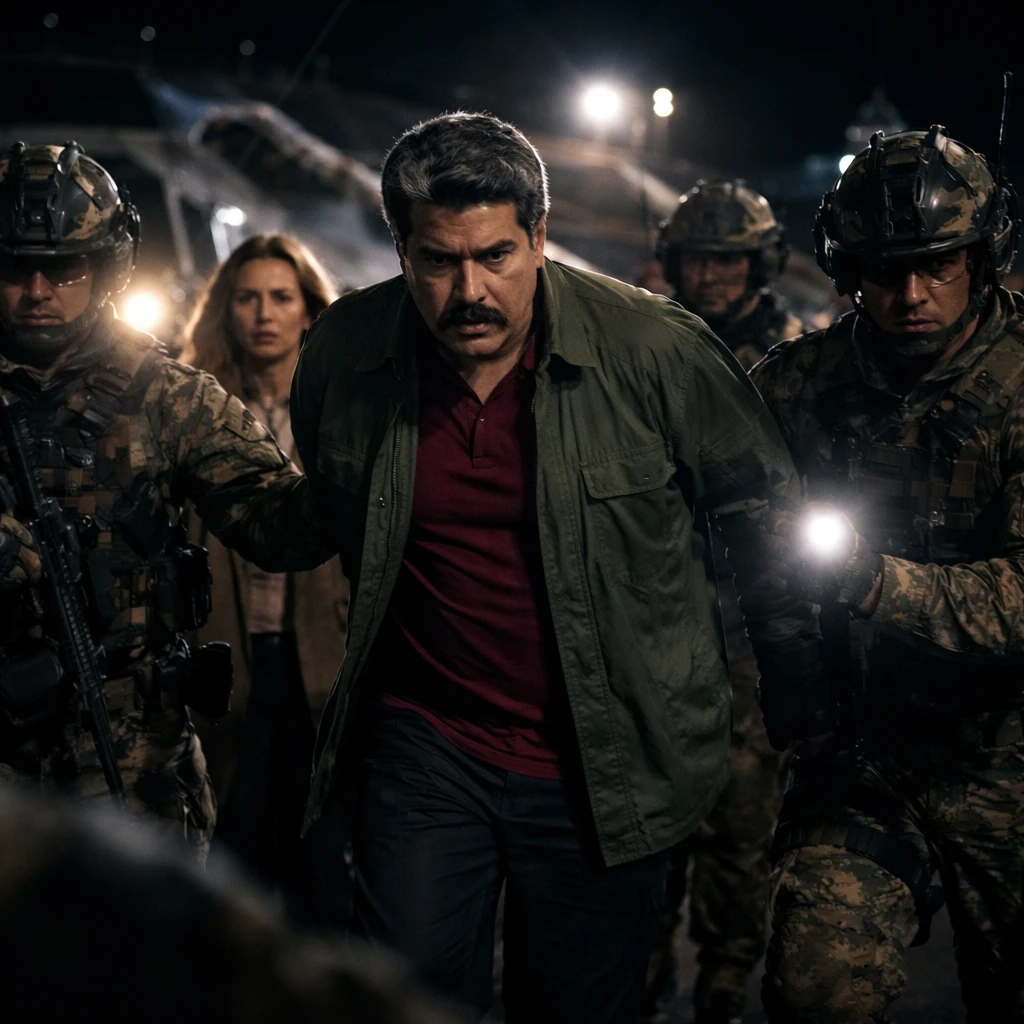
In an unprecedented overnight operation, U.S. forces executed a mission to apprehend Venezuelan President Nicolás Maduro, following intensified military pressure initiated months prior. Speaking in an early Saturday interview on “Fox and Friends Weekend,” President Donald Trump detailed the operation which concluded with Maduro and his wife, Cilia Flores, being airlifted by helicopter to an American naval vessel.
Trump characterized the Venezuelan presidential palace as a "fortress," highly secured and fortified with steel. Despite these security measures, Maduro was unable to reach a designated safe room during the raid. U.S. operatives were equipped with substantial tools including heavy-duty blowtorches prepared to breach steel barriers had Maduro succeeded in securing himself inside the safety space, a room made of solid steel.
Elaborating on the meticulous preparation, President Trump revealed that U.S. forces practiced extensively at a constructed replica of the palace. This training employed a building that mirrored the actual presidential residence in Caracas, incorporating similar steel reinforcements and layout features, ensuring readiness for the real operation.
The strike was conducted in darkness, with Trump noting that nearly all lighting in Caracas was turned off to facilitate the mission. He emphasized the high level of organization and cautioned about the machine gun positions surrounding the area where U.S. forces operated. The assault, lasting under thirty minutes, produced multiple explosions audible in the capital city.
In the immediate aftermath, Venezuela’s Vice President Delcy Rodríguez reported civilian and military casualties linked to the raid. Contrastingly, President Trump stated the U.S. experienced injuries among a few personnel but no fatalities. One helicopter involved in the operation sustained significant damage, yet there were no losses of aircraft.
The timing of the mission was influenced heavily by weather conditions. Trump explained that operations were postponed several times over a period of days until cloud cover dissipated, presenting an optimal window for action.
Following the capture, Maduro and Flores were transported via helicopter to a U.S. warship. According to the U.S. Justice Department, both face indictments related to alleged involvement in narco-terrorism conspiracies.
This mission marks a notable escalation compared to previous U.S. actions since September, which involved at least 35 drone strikes targeting vessels suspected of drug trafficking activities in the Caribbean Sea and eastern Pacific Ocean—operations that resulted in over 115 fatalities. Notably, on December 29, a CIA-led strike targeted a Venezuelan facility used by drug cartels to load boats, representing the first direct U.S. military action on Venezuelan soil in this context.
The operation highlights a significant shift in regional military strategy and underscores the ongoing complexities in addressing narcotics trafficking and governance issues linked to Venezuela.
January 3, 2026
News & Politics
US Military Operation Successfully Detains Venezuelan President Nicolás Maduro
A covert nighttime raid culminates in Maduro’s capture and transfer to U.S. custody amid escalating regional tensions
Derek Hwang
Materials & Mining Analyst
Summary
The United States carried out a precise and well-coordinated military operation targeting Venezuelan President Nicolás Maduro. Executed under the cover of darkness, the mission overcame the heavily fortified presidential palace to detain Maduro and his wife, Cilia Flores, before transporting them to a U.S. warship. This move follows months of intensified U.S. military actions against suspected drug trafficking operations linked to Venezuela. The detainees are slated to face charges in New York.
Key Points
The U.S. conducted a highly prepared and covert nighttime operation resulting in the capture of Venezuelan President Nicolás Maduro and his wife, removing them from power and transferring them into U.S. custody for trial.
Extensive preparatory measures included training at a replicated site matching the fortified presidential palace’s steel structure to ensure operational success.
The mission followed months of targeted U.S. military actions against suspected Venezuelan drug cartel operations, including at least 35 strikes that killed over 115 people, culminating in a CIA drone strike on Venezuelan soil.
Risks
- Potential for increased regional instability stemming from the removal of Venezuela’s president and ensuing power vacuum, which may impact geopolitical and economic conditions in Latin America, notably in energy and mining sectors sensitive to Venezuela’s political landscape.
- Risks to U.S. military personnel during covert operations in hostile environments demonstrated by injuries sustained despite careful planning, highlighting the hazards associated with conducting high-risk extraterritorial missions.
- Possible escalation of retaliatory actions by Venezuelan loyalists or allied armed groups, potentially affecting commodity supply chains linked to Venezuelan exports, including minerals and oil.
Disclosure
This article is based exclusively on information released by official statements and verified sources concerning the recent U.S. military operation in Venezuela. All factual content reflects available data without addition or speculation beyond what has been publicly communicated.