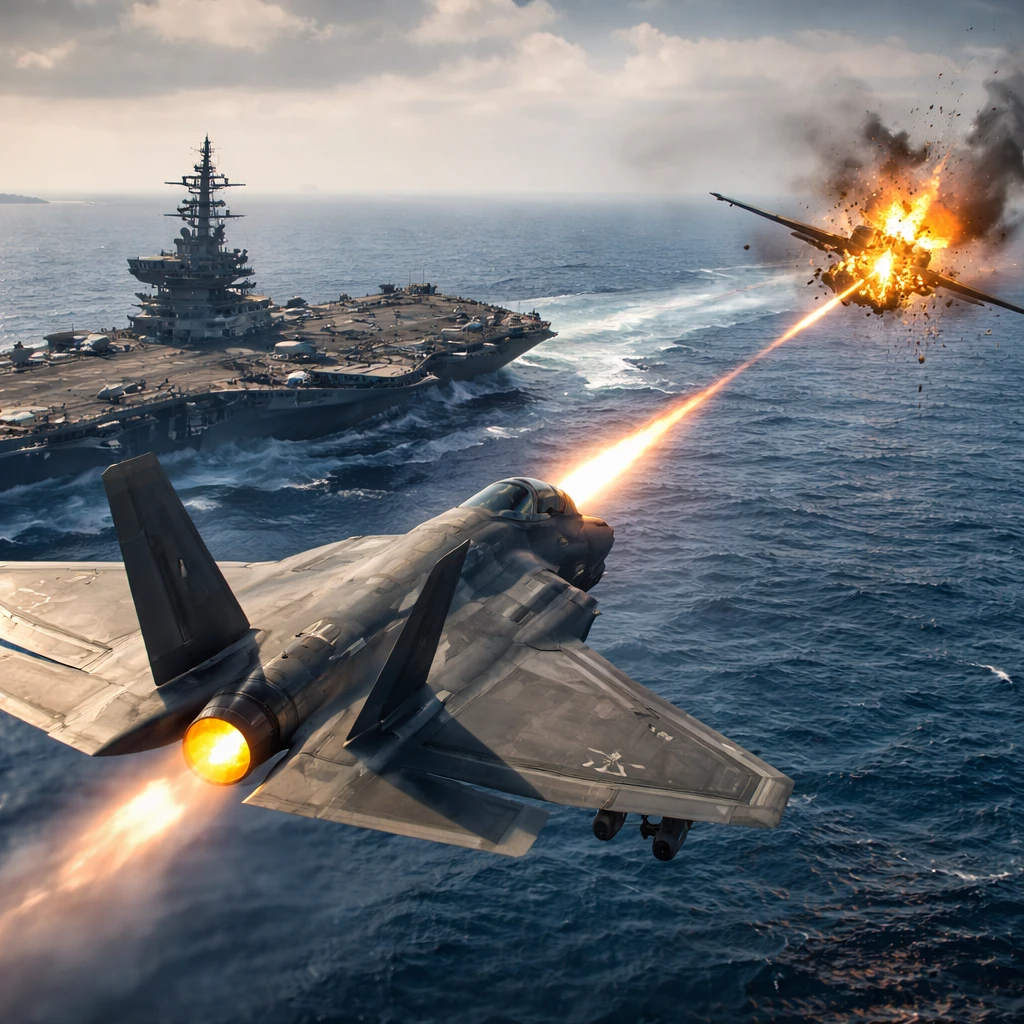

In a recent escalation in the Arabian Sea, a United States Navy fighter jet shot down an Iranian drone that advanced toward the aircraft carrier USS Abraham Lincoln, according to a statement released Tuesday by U.S. Central Command. The Iranian drone, identified as a Shahed-139, reportedly approached the U.S. carrier with "unclear intent" and continued its aggressive movement despite attempts by U.S. forces to de-escalate the situation while operating in international waters, the statement explained.
The encounter took place approximately 500 miles (800 kilometers) from southern Iran, and the interception was carried out by an F-35C fighter jet assigned to the Abraham Lincoln. The incident resulted in no American casualties or damage to U.S. military assets.
This event unfolded in proximity to another incident involving Iranian Revolutionary Guard personnel harassing the Stena Imperative, a U.S.-flagged and crewed commercial vessel transiting the Strait of Hormuz. According to Central Command, two fast-moving boats and an Iranian Mohajer drone approached the vessel in a threatening manner, indicating intentions to board and seize the tanker. The U.S. destroyer USS McFaul responded promptly, providing escort and defensive air cover, enabling the merchant ship to continue safely on its route.
State media in Iran reported that the Iranian Revolutionary Guard is actively investigating the loss of the Shahed-139 drone, noting that despite the drone's downing, it had successfully transmitted reconnaissance imagery back to Iran before contact was lost. Semi-official Iranian news sources have shared footage corroborating this transmission.
These incidents mark a further deterioration in relations between the two nations, which have been under strain from ongoing nationwide protests in Iran for months and confrontations over Iran's nuclear program. U.S. President Donald Trump’s administration has recently warned of potential military interventions to compel Iran to negotiate. Indeed, the U.S. military has reinforced its presence in the region by deploying the USS Abraham Lincoln carrier strike group along with multiple guided-missile destroyers and air defense units, escalating operational capacity near Iranian waters.
Diplomatic efforts continue alongside the military posturing, as special envoy Steve Witkoff is scheduled to engage in dialogue with Iranian officials. Although locations for discussions remain undecided, candidates include Turkey and Oman, which have extended hospitality for the talks. Iranian leaders have expressed a conditional willingness to participate in negotiations, emphasizing a preference for "fair and equitable" dialogue.
President Trump, referring to previous U.S. strikes on Iranian nuclear facilities, indicated ongoing negotiations but maintained a firm stance about continuing military preparedness should negotiations falter. Iranian authorities have echoed the desire to pursue talks but have underscored that logistical details are pending.
The renewed tensions follow weeks of internal unrest in Iran stemming from economic challenges and political dissatisfaction with the ruling regime’s response. President Trump had earlier expressed intentions to support protesters in Iran and apply pressure on the Iranian government to halt its nuclear activities. Analysts have observed increased U.S. military logistics traffic in the region, reminiscent of patterns from last year’s military escalations.
The current situation highlights the fragile balance between military deterrence and diplomatic engagement as both nations navigate complex and competing interests in the strategically critical Middle East region.