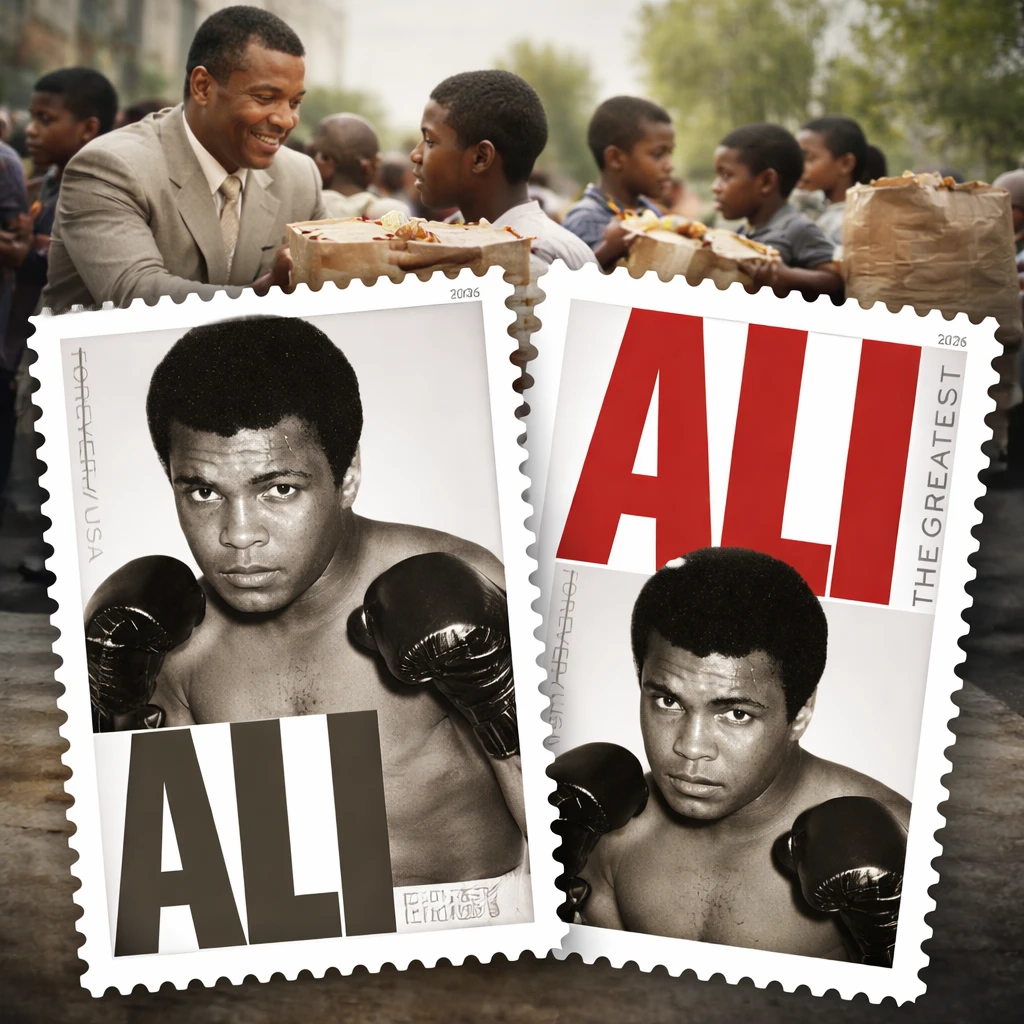
Muhammad Ali, widely regarded as an iconic figure in boxing history as well as a cultural symbol merging sport, politics, and entertainment, is receiving national recognition through the issuance of a commemorative U.S. postage stamp. Ali, a three-time heavyweight champion known for both his prowess in the ring and his outspoken views, passed away in 2016 after living with Parkinson's disease for over 30 years. His legacy has been honored through various awards during his lifetime, including an Olympic gold medal in 1960, the United Nations Messenger of Peace award in 1998, and the Presidential Medal of Freedom in 2005.
Lonnie Ali, Muhammad Ali’s widow of nearly three decades, expressed profound enthusiasm about the stamp issuance, emphasizing its significance in preserving Ali’s memory. She stated that each time individuals see the stamp, Ali’s influence and mission to foster connection and kindness will be brought to the forefront of their thoughts, which she finds deeply gratifying. She highlighted that the stamp provides a unique opportunity to reinforce Ali’s lifetime commitment to connecting with people on a personal level, especially through the act of sending letters adorned with his image.
The Muhammad Ali Forever Stamp is set to be officially unveiled at a ceremony in Louisville, Kentucky, Ali’s birthplace and the location of the Muhammad Ali Center, an institution dedicated to celebrating his life and values. The stamp showcases a powerful black-and-white photo from 1974 capturing Ali in his iconic boxing pose. Each sheet comprises 20 stamps alongside a photograph of Ali dressed in a pinstripe suit, reflecting recognition of his broader role as an activist and humanitarian. With 22 million stamps produced, the U.S. Postal Service has announced that once the supply is depleted, there will be no additional print runs. Anticipation is high for interest among collectors and the general public alike.
As a Forever Stamp, the Muhammad Ali stamp’s value remains constant for First-Class Mail postage regardless of future postal rate changes, an element Lonnie Ali describes as the ultimate tribute and a lasting component of his legacy. The permanence of the stamp’s postage validity ensures it will be a continual reminder of Ali's enduring impact.
The development of this commemorative stamp was initiated shortly after Ali's death nearly ten years ago, according to Lisa Bobb-Semple, director of stamp services for the U.S. Postal Service. She detailed that the selection and approval process for stamps is extensive, involving criteria such as a minimum three-year posthumous waiting period for individuals featured, with exceptions only made for presidents. The #GetTheChampAStamp campaign, created by a friend of Ali, contributed to public interest surrounding the stamp’s creation.
Bobb-Semple elaborated on the procedural aspects, noting that the Citizen Stamps Advisory Committee advises the postmaster general on subject selections for stamps, reviewing around 20 to 25 commemorative issues annually submitted by the public. Once a concept is chosen, design teams, including art directors like Antonio Alcalá, collaborate to finalize the postage imagery, followed by thorough reviews including legal scrutiny before public release.
Alcalá shared that the design process for the Muhammad Ali stamp involved evaluating hundreds of images before selecting the black-and-white photograph taken by an unnamed photographer. The image captures Ali during his prime, posing confidently with boxing gloves, making a strong visual statement suitable for representing the American experience through the medium of postage stamps. He regards stamps as miniature art pieces that commemorate heroes, historical moments, and cultural milestones.
Beyond the ring, Ali was a fearless advocate on issues of race, religion, and war during a period when many African Americans faced systemic challenges to their voices being heard. Born Cassius Clay Jr., he adopted the name Muhammad Ali following his conversion to Islam in the 1960s. Ali famously declined induction into the U.S. Army in 1967 due to his religious beliefs and opposition to the Vietnam War, a decision that resulted in losing his heavyweight title and a temporary ban on professional boxing for over three years. Although convicted of draft evasion and sentenced to five years in prison, he remained free during appeals, culminating in the U.S. Supreme Court overturning the conviction in 1971.
In his later years, despite the limitations imposed by Parkinson’s disease, Ali continued his humanitarian efforts, promoting peace, religious understanding, and charitable initiatives globally. The issuance of the commemorative stamp arrives during times of political polarization both in the United States and worldwide. Lonnie Ali remarked that Muhammad Ali, were he alive today, might choose to distance himself from divisive discourse and instead persist in embodying compassion and personal connection, values she encourages society to adopt as a tribute to Ali’s life and legacy.
January 12, 2026
News & Politics
U.S. Postal Service Honors Muhammad Ali with Commemorative Forever Stamp
Celebrating the legacy of The Greatest boxer through iconic imagery and humanitarian recognition

Derek Hwang
Materials & Mining Analyst
Summary
The U.S. Postal Service has released a commemorative Forever Stamp honoring Muhammad Ali, the legendary heavyweight boxing champion renowned for his athletic excellence and profound cultural impact. The stamp features a famous 1974 black-and-white photograph of Ali in a classic fighting stance and includes a secondary image portraying his humanitarian efforts. Scheduled to be unveiled in Louisville, Kentucky, the stamp serves not only as a tribute to Ali's sports achievements but also highlights his commitment to compassion and social justice.
Key Points
Muhammad Ali is being commemorated with a U.S. Postal Service Forever Stamp featuring iconic images symbolizing both his boxing career and humanitarian work.
The stamp's production included 22 million copies and will not be reprinted once sold out, ensuring its status as a limited edition collectible and lasting tribute.
The stamp honors Ali's lifelong dedication to compassion, social activism, and cultural influence beyond his athletic achievements, reflecting broader themes of political and civil rights advocacy.
Risks
- Interest in commemorative stamps can fluctuate, potentially impacting the anticipated collector and consumer demand linked to this issue, affecting postal service revenue from such collectibles.
- The enduring relevance of Ali’s legacy as symbolized by the stamp may be challenged by evolving cultural and societal dynamics, which could influence public engagement with the tribute.
- Production and distribution limitations mean that once the initial print run is exhausted, no additional stamps will be made, possibly limiting accessibility for some interested consumers.
Disclosure
This article is based entirely on factual information available regarding the issuance of the Muhammad Ali commemorative stamp and does not include speculative content or additional contextual details outside the provided information.