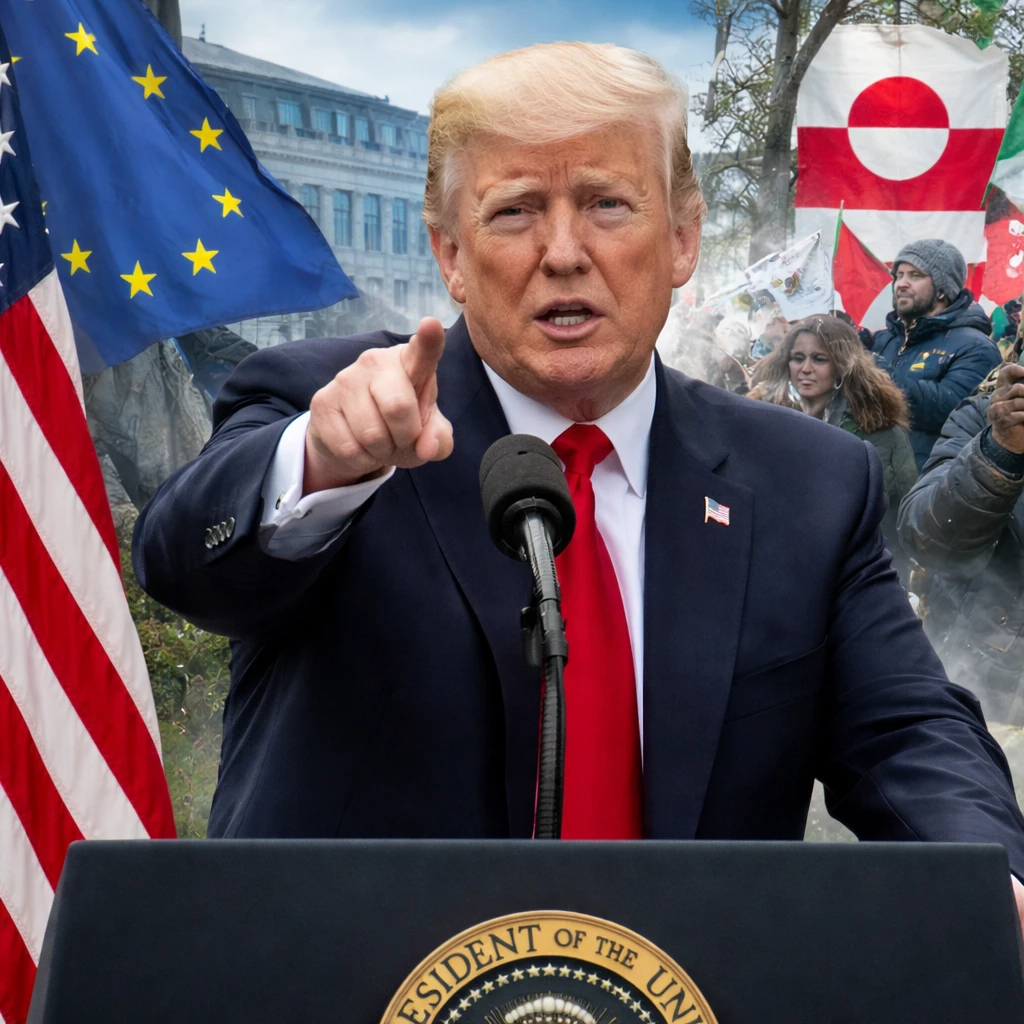

President Donald Trump declared on a social media platform that, starting in February, a 10% tariff will be levied on imports from Denmark, Norway, Sweden, France, Germany, the United Kingdom, the Netherlands, and Finland. These nations oppose U.S. ambitions to govern Greenland, an autonomous territory associated with Denmark. Trump further stated that, without a finalized agreement for what he termed the “Complete and Total purchase of Greenland,” the tariff will increase to 25% from June 1 onward.
This initiative marks a steep and potentially destabilizing escalation in tensions between the United States and its NATO partners. The alliance, established in 1949, plays a crucial role in collective defense across Europe and North America. President Trump has a history of leveraging trade tariffs to influence both allies and rivals, eliciting a range of reactions spanning engagement to defiance from countries including China, Brazil, and India.
Questions remain regarding the legal basis for enforcing these tariffs under U.S. legislation; however, Trump may resort to invoking economic emergency authorities currently under scrutiny in the U.S. Supreme Court.
Trump’s announcement characterized the tariffs as retaliatory measures following recent visits to Greenland by officials from the United Kingdom, the Netherlands, and Finland, as well as generalized opposition to his proposition for the U.S. to purchase Greenland. He emphasized Greenland's critical role in the U.S. missile defense infrastructure, dubbed the “Golden Dome,” and cited concerns about Russian and Chinese intentions to assert influence over the island.
There has been growing resistance within Europe to Trump’s plan, despite several countries agreeing last year to a 15% tariff to maintain economic and security ties with the U.S. On the day of the announcement, hundreds of Greenlandic residents gathered in Nuuk, braving severe weather conditions to demonstrate in favor of self-rule. Participants carried Greenland’s red and white flags and chanted traditional songs as they advanced through the city's center. Placards bore messages such as “We shape our future,” “Greenland is not for sale,” and “Greenland is already GREAT.” Similar rallies unfolded across the Danish realm.
Simultaneously, a bipartisan congressional delegation from the United States held talks in Copenhagen aiming to alleviate tensions and affirm support for Denmark and Greenland. U.S. Senator Chris Coons, a Democrat from Delaware, expressed concern that inflammatory rhetoric was unsettling the Danish kingdom and advocated for de-escalation. He stressed U.S. respect for Denmark and NATO, underscoring the importance of their enduring partnership.
In a statement to the Associated Press, Danish Major General Søren Andersen, commander of the Joint Arctic Command, rejected notions of a U.S. military assault against Greenland or other NATO members. Andersen noted the recent deployment of European troops to Nuuk intended for Arctic defense training exercises. He dismissed the idea that such maneuvers were symbolic gestures aimed at the U.S. administration, describing them as practical military cooperation efforts among allies.
The Danish military convened a planning session in Greenland with NATO allies, including U.S. representatives, to strategize Arctic security amid possible Russian threats. American participation in the forthcoming Operation Arctic Endurance in Greenland was confirmed. During his tenure in Greenland, Andersen has not observed any Chinese or Russian combat vessels approaching the island, countering previous claims by President Trump.
Should a scenario arise where U.S. forces employ force on Danish soil, Andersen cited Danish legislation stipulating that Danish military personnel are obliged to defend against attacks.
In Copenhagen, thousands marched holding Greenland’s flag alongside placards that read “Make America Smart Again” and “Hands Off.” Danish protester Elise Riechie portrayed the issue as globally significant, emphasizing the sovereignty of smaller nations and their resistance to being bartered.
Trump has justified U.S. acquisition ambitions by asserting that Greenland, rich in critical mineral resources, could be targeted by China and Russia. Nonetheless, Senator Coons stated, “There are no current security threats to Greenland.”
Trump has maintained for months that American control of Greenland is vital, recently labeling any outcome short of U.S. ownership as “unacceptable.” At a White House event unrelated to the Greenland matter, he mentioned threatening European allies with pharmaceutical tariffs and suggested similar measures might be applied regarding Greenland.
In recent diplomatic engagements, Denmark and Greenland’s foreign ministers met in Washington with Vice President JD Vance and Secretary of State Marco Rubio. Although differences persisted, they agreed to establish a working group. Official statements from Denmark and the White House differed in their interpretations of this group's scope. European officials maintain that decisions regarding Greenland’s future rest solely with Denmark and Greenland, and Denmark has announced plans to strengthen its military presence on the island in cooperation with allies.
Senator Coons emphasized Denmark’s position as a principal U.S. ally and warned that actions undermining Danish confidence in the U.S. could jeopardize broader alliances and international relations.