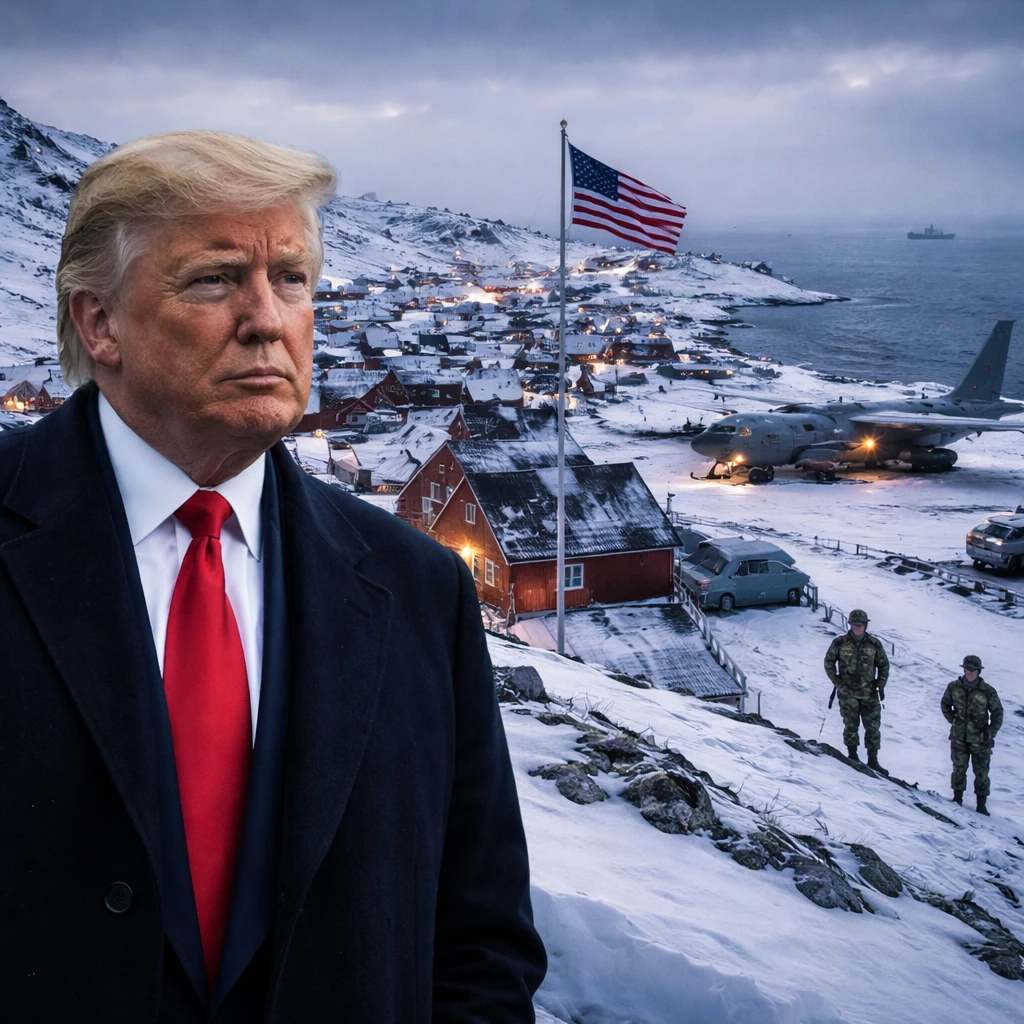

In recent statements, U.S. President Donald Trump has positioned Greenland as a critical national security concern and suggested that a takeover by the United States might be necessary to prevent the island from falling under Chinese or Russian control. These remarks have included the contemplation of utilizing military force to secure American interests in Greenland, a self-governing territory under the Danish realm and a NATO partner.
Trump has asserted, "We need that because if you take a look outside of Greenland right now, there are Russian destroyers, there are Chinese destroyers and, bigger, there are Russian submarines all over the place. We're not gonna have Russia or China occupy Greenland, and that's what they're going to do if we don't." This depiction of an immediate military threat has been scrutinized by Arctic experts and local residents.
Authorities specializing in Arctic geopolitics have consistently challenged the president's portrayal of Chinese and Russian naval forces surrounding Greenland. Andreas Østhagen, research director for Arctic and ocean politics at Norway's Fridtjof Nansen Institute, has stated that such claims lack factual validity, noting that no Russian or Chinese warships operate extensively around Greenland's coastline and neither nation has the capability to assume control over the island.
Residents of Nuuk, Greenland's capital, also refute these allegations. Heating engineer Lars Vintner, who regularly engages in sailing and hunting activities, remarked that he had never observed Russian or Chinese vessels nearby. Similarly, local Greenlander Hans Nørgaard described the assertions as fantasy. Further analysis by Lin Mortensgaard of the Danish Institute for International Studies indicates the presence of Russian submarines in the broader Arctic region but confirms the absence of surface ships around Greenland. While China maintains research vessels in the Central Arctic Ocean and military exercises with Russia have been conducted in areas closer to Alaska, these activities do not occur near Greenland.
Greenland's business minister, Naaja Nathanielsen, acknowledged the interests of Russia and China in the Arctic but emphasized that no immediate threat is detected, stating, "America is still recognized as quite a big superpower," and suggesting that Russia and China have little inclination to destabilize the region.
Addressing the security apparatus in Greenland, President Trump has commented, "You know what their defense is? Two dog sleds." This remark appears to reference the Sirius Dog Sled Patrol, a Danish naval unit specialized in long-range reconnaissance and sovereignty enforcement in Greenland’s challenging Arctic environment. Experts affirm the unit's importance within the Danish military presence in the region.
Steven Lamy, a professor at the University of Southern California and Arctic security expert, explained the logistical nuances of Greenland's terrain, noting the reliance on sea and air transport rather than conventional vehicles, thus the operational role of dog sleds. Moreover, Denmark sustains several patrol vessels and surveillance aircraft, and plans have been announced to substantially enhance military capabilities with investments totaling approximately 14.6 billion Danish kroner (around $2.3 billion). This initiative involves collaborative efforts by the Danish, Greenlandic, and Faroe Islands governments and includes new Arctic naval vessels, surveillance drones, and satellite technology.
The Danish Joint Arctic Command, based in Nuuk, coordinates the oversight, sovereignty assertion, and defense of Greenland and the Faroe Islands, supplemented by satellite outposts across Greenland. Additionally, Greenland plays a strategic role in monitoring the GIUK (Greenland, Iceland, United Kingdom) Gap, a crucial NATO checkpoint for observing Russian naval movements in the North Atlantic.
Furthermore, the United States operates the Pituffik Space Base in northwestern Greenland pursuant to a 1951 treaty with Denmark. This facility supports missile warning and defense operations vital to U.S. and NATO interests.
Addressing Greenland’s historical sovereignty, Trump remarked, "The fact that they had a boat land there 500 years ago doesn't mean that they own the land. I'm sure we had lots of boats go there also." Historical accounts reveal that Inuit populations arrived in Greenland around 2,500 B.C. via ice crossings from Canada. Subsequently, Norse explorers led by Erik the Red settled approximately in A.D. 985. Denmark's formal colonization began with Lutheran missionary Hans Egede in 1721 and was established as a Danish colony by 1814. The United States later recognized Denmark's sovereignty over Greenland. Since 2009, Greenland has functioned as a self-governing territory within the Danish kingdom, retaining the option for full independence based on local referenda.
International legal norms have evolved from colonial claims to respectful adherence to established borders recognized post-World War II. Ulrik Pram Gad of the Danish Institute for International Studies underscored the importance of respecting self-determination, advocating against unilateral military actions to seize territory.