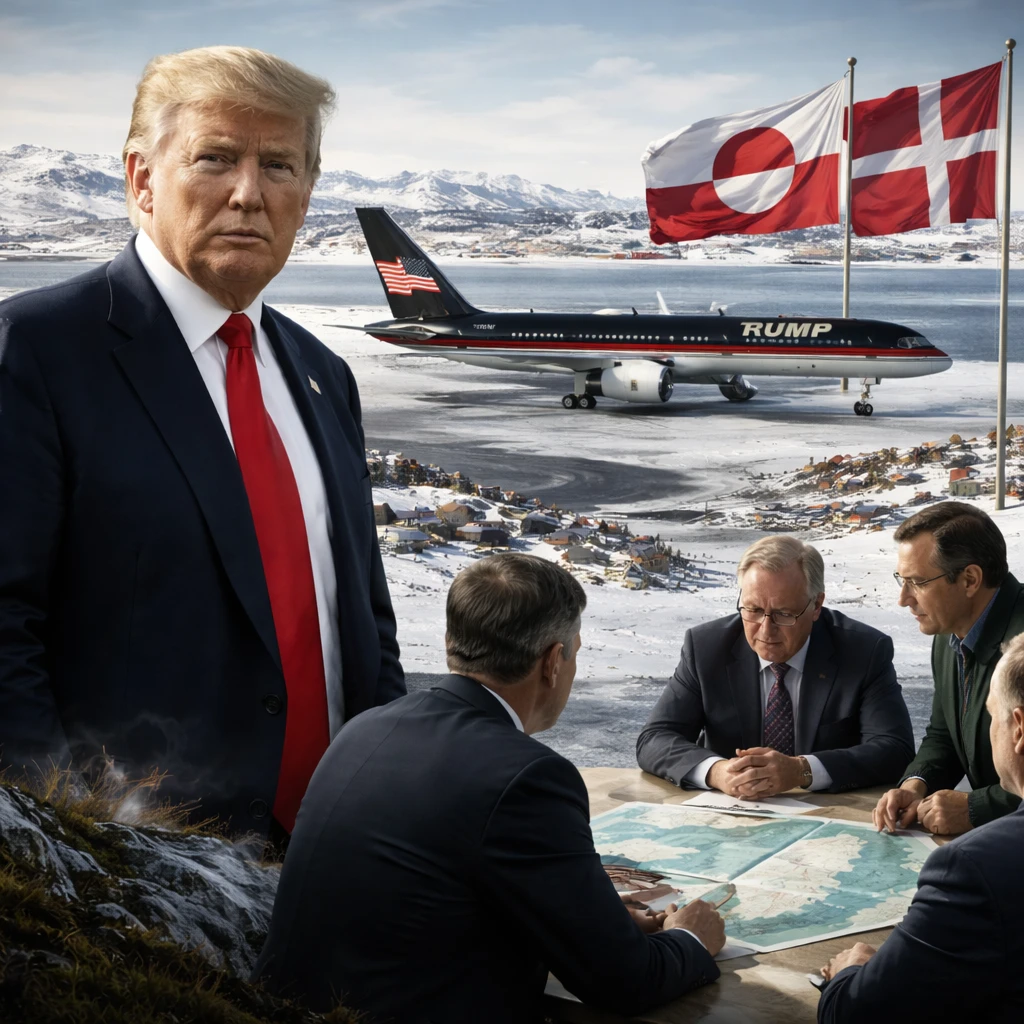

President Donald Trump has explicitly expressed interest in the United States acquiring Greenland, a vast island rich in minerals and of considerable strategic value. Greenland operates as a semiautonomous territory under the Kingdom of Denmark, a NATO member, and its ownership has attracted renewed dialogue among the involved parties.
Recent meetings held in Washington involved officials from Denmark, Greenland, and the United States, with follow-up discussions planned. The White House is exploring several avenues to assert control over the island, including controversial options encompassing the use of military force. President Trump indicated on Friday his intention to take action concerning Greenland "whether they like it or not," suggesting that if peaceful means fail, more forceful approaches might be undertaken, though he did not specify what those might entail.
During an interview with The New York Times, Trump elaborated that owning Greenland would provide the U.S. with tangible advantages unobtainable through mere agreements or documents.
Contrasting perspectives highlight significant friction. Danish Prime Minister Mette Frederiksen cautioned that any American attempt to seize Greenland could result in the dissolution of NATO, a cornerstone of Western security alliances. Simultaneously, Greenlandic leaders have voiced opposition to becoming part of the United States, emphasizing a desire to maintain their current status or pursue greater autonomy rather than U.S. annexation.
The strategic calculus underlining American intentions focuses on enhancing national security and accessing Greenland's business and mining potential. Experts such as Imran Bayoumi from the Atlantic Council suggest that the heightened focus on Greenland stems from a historical neglect of Arctic strategy by successive U.S. administrations, coupled with the current administration’s urgency to project a stronger presence in the region.
Potential military action in Greenland raises profound geopolitical risks. Should the U.S. attempt to take control of the island through force, the move might trigger a severe crisis within NATO, jeopardizing longstanding alliances. Despite Greenland’s expansive territory, it hosts approximately 57,000 residents and does not maintain its own military forces, relying instead on Danish defense, which itself is modest compared to the U.S. military capabilities.
The reaction from other NATO members remains uncertain, including whether they would support Denmark in the event of an American unilateral incursion. Prime Minister Frederiksen has warned that such actions would bring NATO activities to a halt.
President Trump cites Russian and Chinese maritime activities near Greenland as justification for increased American control. However, Lin Mortensgaard, an Arctic policy expert at the Danish Institute for International Studies (DIIS), counters that although Russian submarines are active in the Arctic, there are no surface fleet incursions proximate to Greenland, and Chinese presence is limited to research vessels farther afield.
Bayoumi and other analysts express skepticism regarding the likelihood of a forceful takeover. Such a measure lacks support across U.S. political parties and would significantly damage American relationships with allies globally.
The United States currently benefits from a 1951 defense agreement with Denmark, granting access to Greenlandic territory, which Greenland and Denmark reportedly would welcome in an expanded military capacity. This arrangement challenges the rationale for disrupting alliance ties over an issue already managed through cooperation.
Diplomatic channels appear more plausible than militarized options. U.S. Secretary of State Marco Rubio has stated to select lawmakers that the administration seeks to purchase Greenland outright rather than pursue military conquest. However, Greenlandic and Danish authorities have publicly asserted the island is not for sale. The financial implications of such a purchase remain unspecified, nor is it clear whether negotiations would be conducted with Denmark, Greenland, or both.
Diplomacy may also expand American influence without full acquisition. For example, Washington might negotiate security veto powers akin to agreements it holds in the Pacific, such as the Compacts of Free Association with Palau, Micronesia, and the Marshall Islands. Such arrangements allow the U.S. military to establish bases and direct security policy in exchange for economic assistance and security guarantees.
Currently, the U.S. operates the Pituffik Space Base in northwestern Greenland, supporting missile warning and space surveillance capabilities vital for both American and NATO defense. The U.S. can deploy forces freely within Greenland per existing agreements, underscoring that current access supports American strategic aims without formal ownership.
Greenlandic sentiment opposes integration into the U.S., with politicians advocating greater autonomy instead. Attempts by external actors to influence Greenlanders toward supporting a U.S. takeover face challenges due to the island's small population and linguistic barriers.
Danish Foreign Minister Lars Løkke Rasmussen highlighted covert foreign efforts to sway Greenland’s political direction, reportedly involving individuals connected to President Trump. Such interference further complicates diplomatic relations and fosters mistrust.
The fiscal and social costs associated with American governance of Greenland would be substantial. Greenlandic inhabitants are Danish citizens with access to comprehensive welfare benefits, including healthcare and education. Providing comparable services under U.S. administration would impose significant financial burdens unavailable under current U.S. domestic policies.
Since World War II, the American military presence in Greenland has contracted substantially from thousands of soldiers at multiple installations to a focused contingent at a single base, reflecting changes in strategic priorities. The Pituffik facility remains critical for early missile detection and defense collaboration.
In response to criticism from U.S. officials about Denmark’s defense commitments in Greenland, experts argue that Denmark's defense role complements U.S. strategic interests effectively. Enhancing or renewing the 1951 defense agreement could be a constructive step forward, yet political dynamics influenced by President Trump’s preference for asserting control complicate prospects for a smooth resolution.
Consequently, the debate over Greenland’s status continues to surface intermittently, influenced by shifting American political priorities and domestic considerations. Such provocative signaling keeps the issue prominent in international discourse, despite limited progress toward a definitive solution.