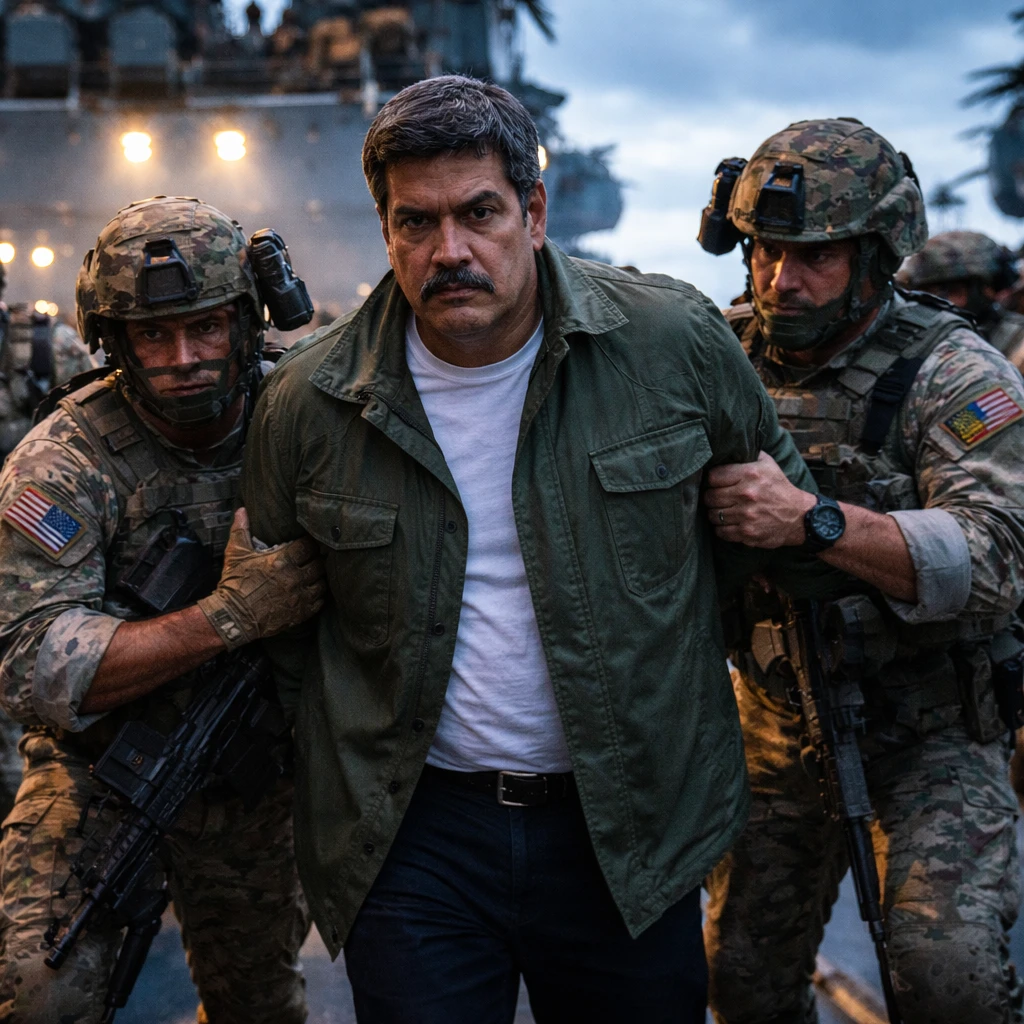

In a significant development that challenges established norms of international engagement, the Trump administration has orchestrated the midnight apprehension of Venezuelan President Nicolás Maduro. Transported on a U.S. naval vessel to face narcoterrorism conspiracy charges in New York, this action is considered by legal authorities to surpass prior American interventions against autocratic regimes, including historical cases in Panama and Iraq.
This dramatic operation followed an unanticipated U.S. military presence within Caracas, a city simultaneously unsettled by sudden explosions disrupting the night. Legal scholar and former assistant U.S. attorney Jimmy Gurule characterized the seizure as a "blatant, illegal and criminal act," emphasizing its departure from accepted legal norms.
Mark Nevitt, a former Navy attorney and academic at Emory University School of Law, expressed unequivocal skepticism about the legal grounds for the mission, noting the absence of an extradition treaty authorizing such an incursion to remove a foreign leader.
The capture culminates months of intensified U.S. military engagement in the region, involving air strikes against boats implicated in drug trafficking and the seizure of oil tankers near Venezuelan waters. Since September, 35 documented maritime attacks have resulted in over 115 fatalities. Michael Schmitt, a retired Air Force legal officer and professor emeritus, contends these operations together constitute clear breaches of international law.
The timing of Maduro’s detention coincides with the 36th anniversary of Panamanian dictator Manuel Noriega’s surrender, a significant moment reflecting U.S. interventionist history in the Western Hemisphere. However, unlike Noriega’s case—where national security interests explicitly connected to the Panama Canal and American citizens justified the U.S. invasion—no congressional authorization exists for military or law enforcement actions targeting Venezuela.
Although clandestine extrajudicial captures by American agents have precedent, such as the 1990 DEA-led abduction of a Mexican suspect for the killing of an agent, courts traditionally display considerable deference to presidential discretion on national security issues. Gurule acknowledged this latitude but cautioned against unlimited authority, underscoring that deference does not equate to unfettered executive power.
Notably, the Trump administration has reclassified Venezuelan drug cartels as unlawful combatants, stating that the U.S. is engaged in an "armed conflict" with these entities per an internal memo acquired in October. This interpretation extends presidential war powers by framing drug trafficking as an armed conflict necessitating military intervention, a novel legal rationale underpinning both past and anticipated future campaigns.
Despite Congress’s pivotal role in authorizing military engagements, lawmakers have yet to approve or oppose the administration’s escalating operations, fostering bipartisan unease. This tension intensified after revelations that U.S. forces eradicated survivors from a prior boat attack during a subsequent strike.
Schmitt contends the present circumstances amount to "a state of war" between the U.S. and Venezuela, invoking the legal classification of "international armed conflict." This designation implies that hostilities between two states legally constitute war, further elevating the gravity of recent actions.
Congressional leaders within the "gang of eight," encompassing bipartisan top members and intelligence committee chairs, were informed shortly after operation commencement. House Speaker Mike Johnson indicated plans to organize briefings for lawmakers upon reconvening.
However, Democratic voices express serious concerns about undermining the rule of law and setting dangerous precedents. Senator Mark Warner warned that deviation from established legal constraints risks eroding global stability and empowering authoritarian regimes like China or Russia to exploit similar justifications for extrajudicial acts.
Warner emphasized that America’s international influence derives from adherence to legal norms, democratic principles, and constitutional restraints. Erosion of these values, even in combating malign actors, threatens credibility and invites unchecked authority beyond the tenure of any president.
In response to these developments, the Senate is poised to revisit efforts to limit presidential war powers with a bipartisan resolution aimed at blocking unauthorized use of military force against Venezuela. Senate Majority Leader John Thune expressed gratitude toward the armed forces for executing what he described as a necessary mission and anticipates comprehensive briefings upon Senate return.
Secretary of State Marco Rubio noted that due to the operation’s covert nature, prior notification to Congress was not feasible, underscoring the administration’s strategic considerations in executing surprise military actions.
These events underscore a complex nexus of international law, executive authority, and congressional oversight, raising fundamental questions about the conduct of U.S. foreign policy and military engagement in the Western Hemisphere.