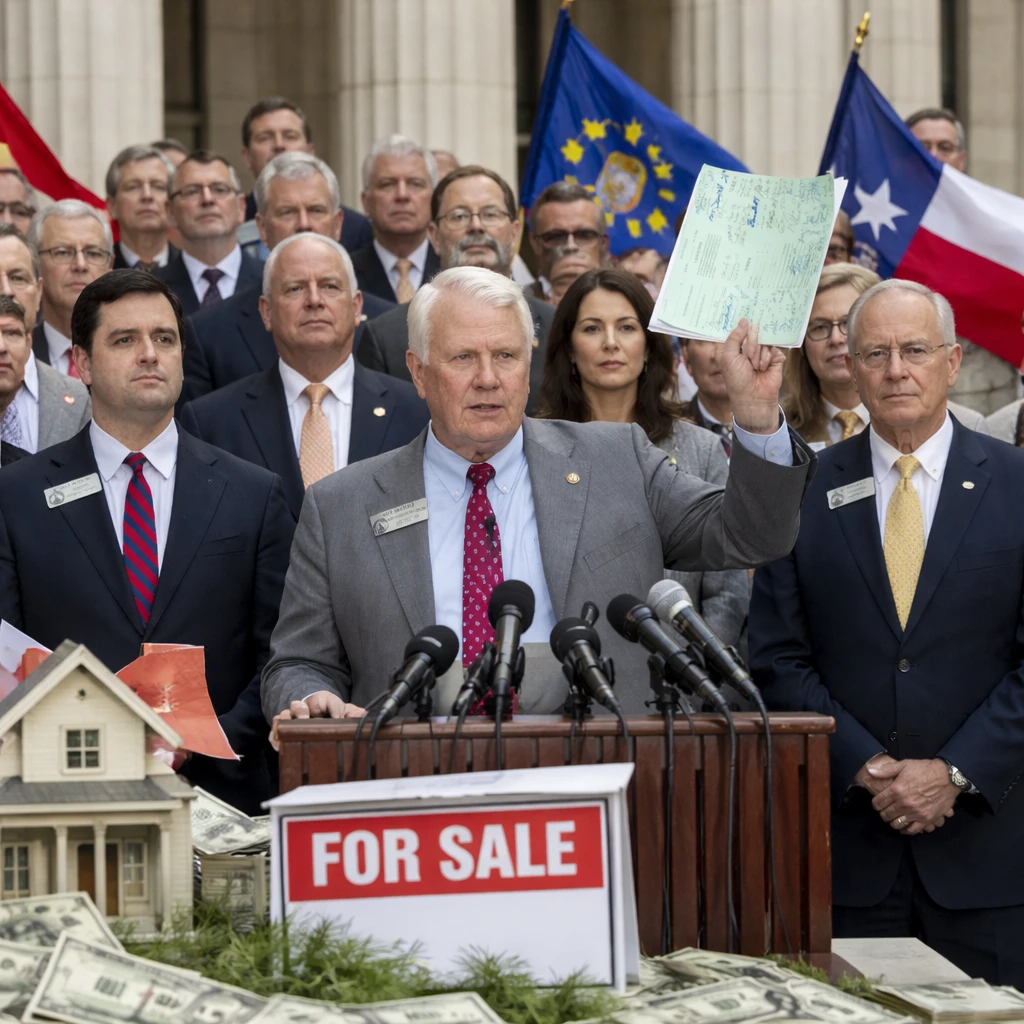
In recent developments across several American states, a growing movement seeks to entirely eliminate property tax obligations for homeowners. This trend has surfaced amid escalating property valuations driving higher tax liabilities, which have intensified public scrutiny of property tax systems and sparked ambitious reform proposals. While the approach varies state-by-state, the challenges inherent in balancing revenue loss with public service funding remain a central debate.
North Dakota serves as a notable example by utilizing proceeds from its $13.4 billion oil tax savings account to curtail homeowner property taxes incrementally. The state’s Republican legislature last year broadened a tax credit for primary residences from $500 to $1,600 annually. This adjustment resulted in the complete elimination of property taxes for 50,000 households and provided significant reductions for nearly 100,000 others during the 2025 and 2026 tax years. State subsidies have so far amounted to $400 million. Governor Kelly Armstrong highlighted the success, emphasizing confidence in extending this relief to the majority of homeowners across North Dakota.
In Georgia, a Republican-led initiative unveiled a comprehensive plan aimed at completely phasing out homeowner property taxes by 2032. The measure entails protecting an increasing value of homes from taxation—from $5,000 currently to $150,000 by 2031—before the full elimination target. To compensate for the resulting revenue loss, the proposal directs cities, counties, and school districts to rely on existing or new sales tax revenues. The implementation, however, hinges on legislative approval and securing a two-thirds majority for a constitutional amendment, followed by voter ratification.
The Georgia framework further proposes capping annual growth of property tax revenues on other property types at 3%. Additionally, local governments would have the facility to issue annual charges for specified services such as waste management, street lighting, water control, and fire protection, though these charges would not be legally categorized as taxes. Future decisions are pending on whether unpaid assessments could trigger property seizure. The state's ongoing debate extends to enhancing existing property value growth limitations for tax calculation purposes, which some school districts and localities currently waive.
Florida’s leadership, with Governor Ron DeSantis at the forefront, is advocating for a 10-year phased elimination of nonschool property taxes on homeowners. Legislative discussions are active but details and timelines remain fluid. Florida Chief Financial Officer Blaise Ingoglia has publicly challenged the necessity of the $19 billion in property tax revenue from homeowners, suggesting local government overspending as a factor. This position has been contested by local jurisdictions.
Texas Governor Greg Abbott has expressed ambitions to abolish property taxes earmarked for school funding, although the pathway to accomplish this and its fiscal implications remain less defined. The state has employed temporary use of surplus funds to reduce property taxes previously, underscoring the complexities linked to sustainable implementation.
Complementing the legislative proposals, ballot initiatives targeting full property tax elimination are under consideration in states like Oklahoma and Ohio. Previous initiatives with similar aims were defeated in North Dakota in 2024 and failed to reach ballots in Nebraska and Michigan. These political activities signal a notable election-year tax resistance environment, echoing historical patterns of property tax backlash.
These tax reform endeavors evoke concerns among experts about replacing crucial public funding sources. Property taxes traditionally underpin local schools and government services, and their eradication without adequate revenue substitutions could potentially precipitate budget shortfalls. The limitations on expanding sales tax rates and the disparities in their allocations add to the complexity of finding equitable, sufficient replacements.
For homeowners like Tim Hodnett, a retiree in suburban Atlanta living on a fixed income, rising property tax bills pose a tangible hardship. Despite existing tax breaks, Hodnett continues to seek full exemption from property taxes to ease financial burdens.
Economists and land policy scholars underscore the difficulty and undesirability of fully abolishing residential property taxes in most jurisdictions, emphasizing the potential fiscal consequences. Ongoing legislative debates reflect a search for mechanisms that balance taxpayer relief with the fiscal sustainability of essential community services.
January 28, 2026
News & Politics
U.S. States Explore Ambitious Plans to Eradicate Homeowner Property Taxes
Georgia, Florida, North Dakota, and Texas discuss pathways to phase out residential property taxes amid political and fiscal challenges

Derek Hwang
Materials & Mining Analyst
Summary
Several U.S. states are pursuing initiatives to eliminate property taxes on homeowners, a move gaining traction among lawmakers and voters frustrated by escalating tax bills due to rising property values. Plans vary by state, with North Dakota leveraging oil revenues, Georgia proposing phased tax elimination coupled with enhanced sales taxes, Florida considering a decade-long phase-out, and Texas aiming to remove school-related property taxes. These efforts raise questions regarding funding replacements for critical local government and school district revenues.
Key Points
Multiple states including Georgia, Florida, North Dakota, and Texas are formulating strategies to eliminate or substantially reduce homeowner property taxes, responding to public concern over rising tax bills driven by increasing property values.
North Dakota employs oil tax savings to fund property tax credits, effectively eliminating homeowner taxes for tens of thousands of households, showcasing a resource-dependent model for tax relief.
Georgia's comprehensive plan links phasing out property taxes with expanding sales tax revenues, but requires legislative agreement and voter approval amid concerns about maintaining funding for schools and local services.
Risks
- Eliminating homeowner property taxes threatens to reduce essential funding for public schools and local government services, potentially impacting education and community infrastructure sectors.
- Revenue replacement through sales taxes may be insufficient or unevenly distributed, complicating local government budgeting and possibly leading to service cutbacks or tax shifts.
- Large-scale tax reform initiatives face political uncertainties, including legislative hurdles and ballot measure challenges, which could delay or derail implementation affecting market and economic stability.
Disclosure
This article is authored by Derek Hwang, a materials and mining analyst with expertise in commodity strategy and project pipelines. The analysis is based solely on publicly available information without speculation or additional unverifiable data.