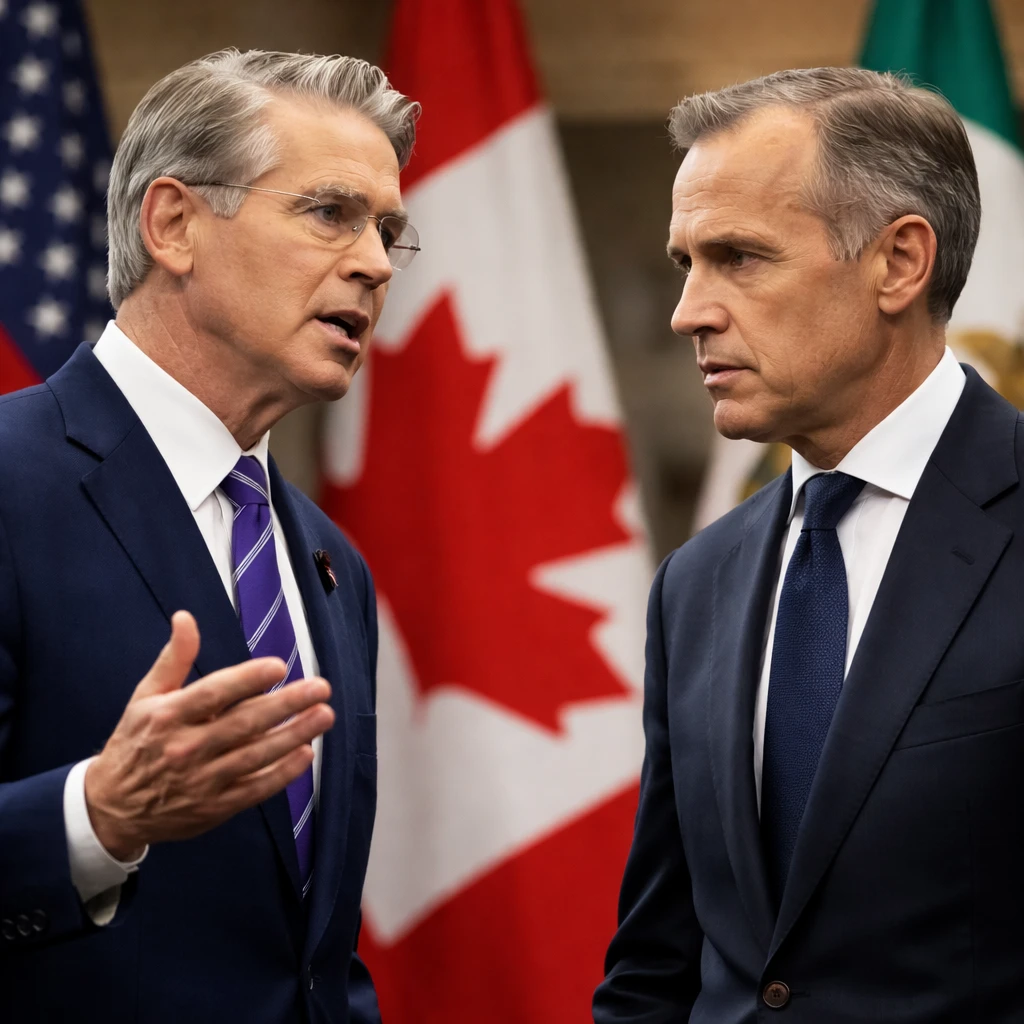

Amid escalating trade discussions centered on the North American Free Trade Agreement's successor, the United States-Mexico-Canada Agreement (USMCA), U.S. Treasury Secretary Scott Bessent advised Canadian Prime Minister Mark Carney against inflaming tensions through public criticism of American trade strategies. The warnings come ahead of a formal review process of the USMCA, a pact that has offered Canada significant protection against the most severe effects of tariffs imposed by U.S. President Donald Trump.
Carney recently gained international attention at the World Economic Forum in Davos, Switzerland, where he delivered a prominent speech denouncing economic coercion by dominant powers over smaller nations. His remarks have since led to a public disagreement with both President Trump and Secretary Bessent concerning trade policy matters.
In one notable escalation, President Trump threatened on a recent Saturday to implement a 100% tariff on Canadian goods in response to Canada’s pursuit of a trade agreement with China. This threat comes at a sensitive time as the member nations gear up for renewed USMCA negotiations.
In an interview with CNBC, Bessent emphasized the potential dangers of Carney’s confrontational approach, stating, 93I would not pick a fight going into USMCA to score some cheap political points -- either you93re working for your own political career or you93re working for the Canadian people.94 He further remarked on Carney93s transition from central banking technocrat to political actor, suggesting this shift tends to be problematic: 93I93ve seen what happens when a technocrat tries to pivot and become a politician. It never really works out well.94
This commentary highlights the delicate balance in high-stakes international negotiations, where tone and rhetoric can be as significant as policy itself.
Following these developments, President Trump and Prime Minister Carney engaged in direct talks. Secretary Bessent relayed to Fox News that Carney was actively retracting some of his earlier harsh statements made in Davos. However, Carney took a different stance the subsequent day, clarifying to reporters, 93To be absolutely clear, and I said this to the president, I meant what I said in Davos.94 This exchange underscores the complexities in diplomatic communication and potential difficulties in de-escalating trade tensions rapidly.
The original North American trade agreement, ratified during Trump administration's first term in 2020, has recently been met with apathy from President Trump, who earlier in the month admitted, 93I don93t really care about it.94 Despite this, Bessent expressed cautious optimism during his CNBC interview, indicating, 93In the end, I think we will end up in a good place 97 may not be a straight line.94
This outlook suggests that while the path may be fraught with hurdles, a resolution that sustains the trilateral trade pact remains possible. The ongoing exchanges between U.S. and Canadian leaders reflect broader challenges in balancing national interests with the demands of international cooperation in trade policy.