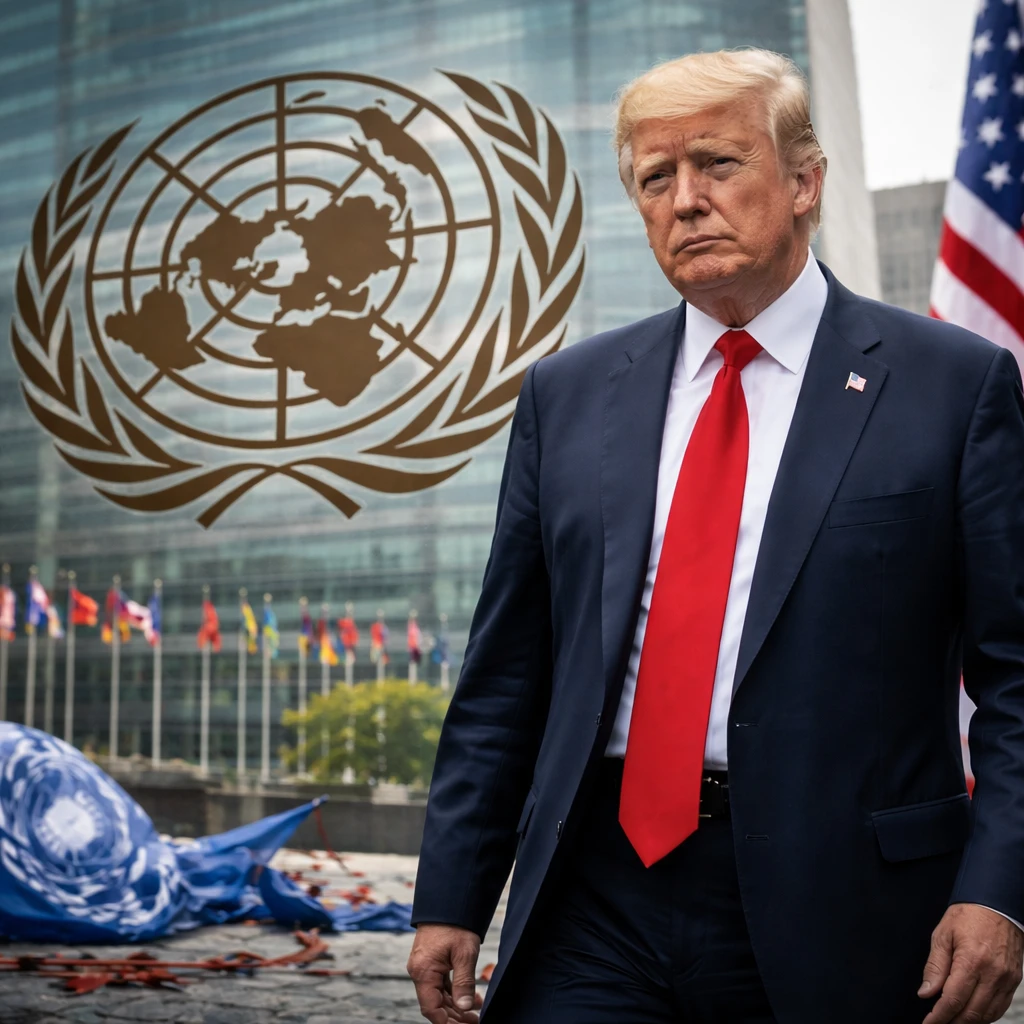

WASHINGTON – In a decisive shift away from multilateral engagement, the US administration has formally ceased participation in and financial support for 66 distinct international organizations. This decision, announced through an executive order, follows an extensive review of America's involvement in various global entities, with a considerable focus on those linked to the United Nations.
The majority of the affected institutions are subsidiary bodies or advisory committees under the UN umbrella, which deal with issues ranging from climate change and labor standards to migration and diversity initiatives. Many of these programs have been targeted by the administration for allegedly pursuing agendas deemed counterproductive to US priorities and for promoting policies labeled as excessively progressive or "woke." Additional organizations outside the UN framework, such as the Partnership for Atlantic Cooperation, the International Institute for Democracy and Electoral Assistance, and the Global Counterterrorism Forum, are also on the list of withdrawals.
According to the State Department, these decisions are grounded in a perception that the agencies are redundant, financially inefficient, mismanaged, or otherwise act contrary to US sovereignty and prosperity. "The Trump administration has found these institutions to be redundant in their scope, mismanaged, unnecessary, wasteful, poorly run, captured by interests advancing agendas contrary to ours, or threatening our sovereignty," the department asserted.
This withdrawal strategy coincides with other assertive and controversial foreign policy moves, including military actions and strategic threats that have unsettled both allies and competitors alike. Examples include attempts to capture Venezuelan leader Nicolás Maduro and considerations surrounding Greenland. Such actions underscore a trend emphasizing unilateralism and national interests over collective global problem-solving.
This latest disengagement continues a pattern established earlier in the administration, which saw suspensions of support for prominent bodies such as the World Health Organization, the UN Relief and Works Agency for Palestinian Refugees (UNRWA), the UN Human Rights Council, and UNESCO. The approach rationalizes funding based on alignment with specific US agendas, favoring agencies perceived to bolster American influence, particularly when countering China's rising role. This includes participation in priority forums like the International Telecommunications Union and the International Maritime Organization.
Notably, the administration's exit from the UN Framework Convention on Climate Change (UNFCCC) exemplifies its retreat from cooperative environmental efforts. The UNFCCC, established in 1992 and integral to the Paris Agreement, facilitates financial support to developing countries in combating climate change. The US, under this administration, previously denounced the scientific consensus on climate issues and withdrew from the Paris Agreement, a move widely criticized by environmental experts and global leaders.
Climate experts view this withdrawal as a setback for worldwide initiatives aimed at reducing greenhouse gas emissions. Stanford University climate scientist Rob Jackson remarked that US disengagement potentially encourages other nations to delay their commitments by invoking America's absence. Similarly, Gina McCarthy, former White House National Climate Advisor, labeled the decision as "shortsighted, embarrassing, and foolish," emphasizing the loss of US leadership and influence in directing substantial investment towards climate-related responses.
The administration has also reversed funding to the United Nations Population Fund, an agency providing reproductive health services globally, which has been a frequent target of Republican opposition due to unfounded claims concerning coercive abortion practices. A subsequent State Department review found no evidence supporting those allegations, yet funding cuts persisted during the previous term.
Besides these prominent bodies, the US is disengaging from a range of other international groups, including the Carbon Free Energy Compact, United Nations University, International Cotton Advisory Committee, International Tropical Timber Organization, the Pan-American Institute for Geography and History, and others involved in arts, culture, and commodity studies. The State Department noted that further assessments of international affiliation and funding will continue.