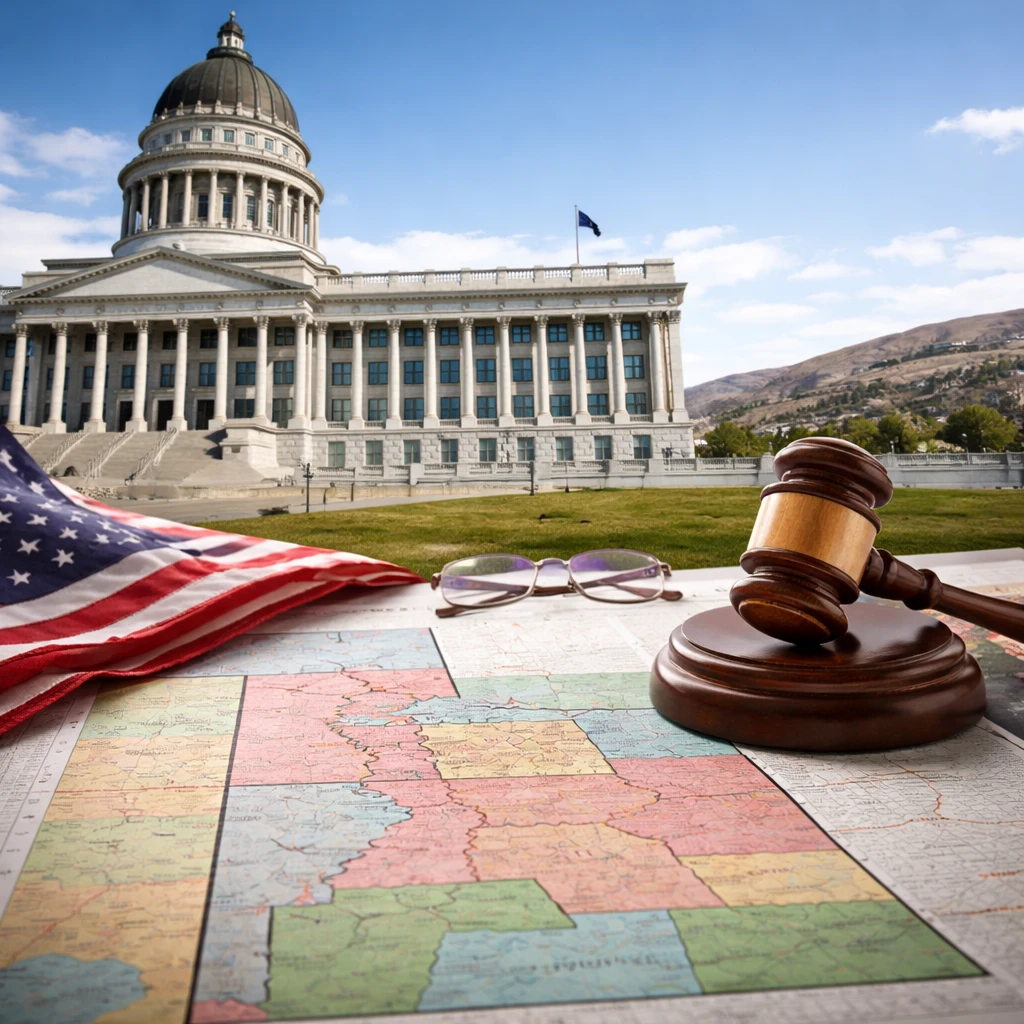

With the primary deadline for filing reelection campaigns approaching in just over a month, two Republican congress members from Utah have petitioned a federal court to intervene and thwart the enforcement of newly drawn U.S. House districts. These revised districts could potentially improve the likelihood of Democratic victories in a key Salt Lake City-area seat during the November elections. This legal action, filed late Monday, involves U.S. Representatives Celeste Maloy and Burgess Owens along with approximately a dozen local officials.
The lawsuit challenges the legitimacy of a state judge's decision last year, which discarded congressional districts developed by the Republican-controlled Utah Legislature. Instead, the judge imposed an alternative district map submitted by plaintiff groups opposing the Legislature. The suit asserts that both the U.S. and Utah Constitutions assign redistricting authority exclusively to the state Legislature, thus denying courts the power to design congressional districts.
As a result, the plaintiffs argue, congressional districts should revert to those enacted by the Legislature in 2021 unless new maps are passed by lawmakers.
Utah is one of several states currently entangled in legal battles concerning congressional voting districts amid preparations for the upcoming midterm elections this fall.
Across the nation, other significant redistricting disputes include a recent New York court order directing a commission to redraw the sole Republican-held U.S. House district in New York City, citing unconstitutional dilution of Black and Hispanic votes. That ruling is under appeal by Republicans. The U.S. Supreme Court is also reviewing an appeal against a Democratic-backed congressional redistricting plan approved by California voters. In Missouri, courts are considering various challenges to a newly enacted U.S. House map passed by the state’s Republican-led Legislature.
The issue of redistricting has gained heightened urgency following interventions by former President Donald Trump, who urged Texas Republicans last year to redraw congressional districts to advantage their party in the midterms. This mid-decade redistricting controversy has since intensified in numerous states and remains active in Democratic-led Maryland and Virginia as well.
Utah’s current congressional map, drawn by state lawmakers after the 2020 census, gave Republicans control of all four U.S. House seats. However, State Judge Dianna Gibson ruled in August that these districts violated anti-gerrymandering standards established by Utah voters in 2018, who approved rules to prevent deliberate partisan bias in district drawing.
In November, Judge Gibson also rejected a replacement district map passed by the Legislature and instead mandated an alternative map proposed by the lawsuit’s plaintiffs, including the League of Women Voters of Utah and Mormon Women for Ethical Government. This updated map largely consolidates Salt Lake County’s Democratic base into a single district rather than dividing it among all four districts.
Responding to the federal lawsuit, Katharine Biele, president of the League of Women Voters of Utah, stated that the imposed map is "fair and legal." Meanwhile, attorneys representing the Legislature have appealed Gibson’s ruling to the Utah Supreme Court.
Recently, Governor Spencer Cox signed legislation expanding the Utah Supreme Court from five to seven justices. New justices, appointed by the governor and confirmed by the state Senate, could participate in the court’s review of the congressional map’s legality. Governor Cox has denied that this expansion was intended for political advantage.
Furthermore, the filing deadline for congressional candidates in Utah, typically January 8, was postponed this year to March 13. Neither Maloy nor Owens has filed for reelection yet, and their lawsuit highlights the complication that district boundary changes present, stating that "the Representatives do not know which district to choose." Concurrently, Republicans are gathering signatures for a ballot initiative in November aimed at repealing Utah’s anti-gerrymandering provisions.
This evolving legal and political situation underscores the complexity and high stakes surrounding redistricting processes in Utah as the midterm elections approach.