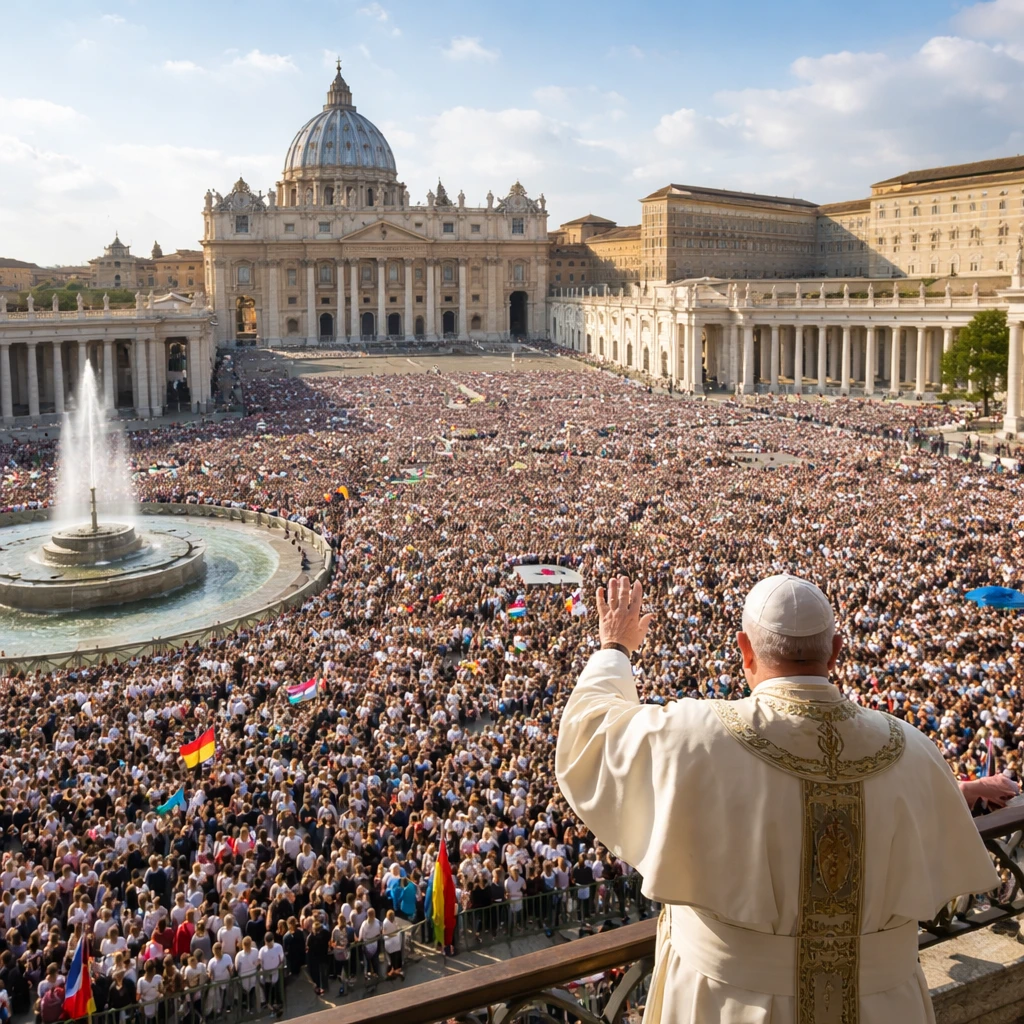

The Vatican revealed on Monday a comprehensive overview of participation in the Holy Year 2025, reporting that in excess of 33 million pilgrims engaged in the religious events throughout the year. The upcoming Tuesday will witness the formal conclusion of this Holy Year, as Pope Leo XIV is set to officially close the Holy Door of St. Peter’s Basilica, ending a Jubilee uniquely initiated and concluded by different pontiffs.
Holy Years are long-standing events in the Catholic tradition, occurring every quarter-century, offering the faithful an opportunity to journey to Rome, visit the tombs of Saints Peter and Paul, and obtain indulgences aimed at spiritual remission.
For the city of Rome, such Jubilees represent not only a spiritual occasion but a significant urban makeover. The municipal government capitalized on an infusion of approximately 4 billion euros in public funding, aimed at revitalizing infrastructure and elevating the city’s amenities to European standards after periods of neglect.
Participation metrics for this year’s Jubilee were collected through a synthesis of official registration data, volunteer headcounts at basilicas surrounding Rome, and surveillance methods including closed-circuit television at St. Peter’s Basilica. The basilica alone recorded daily footfall through the Holy Door ranging between 25,000 and 30,000 individuals.
Aggregating these measures, the Vatican estimated that about 10 million pilgrims passed through the Holy Door during the full year, with the remaining pilgrim visits attributed to other city basilicas hosting Holy Doors. While the total figure of 33,475,369 exceeds earlier projections of around 31.7 million pilgrims made by a Roma Tre University study, the Vatican’s Holy Year coordinator, Archbishop Rino Fisichella, cautioned that these numbers remain approximations and may contain instances of repeat counting. A specific separation between Jubilee participants and general tourist numbers in Rome was not provided.
The attendance experienced an uptick following the death of Pope Francis in April 2025 and the election of Pope Leo XIV, making this event historically notable as only the second Holy Year to span the leadership of two Popes since the 18th century.
On the municipal front, Rome’s mayor Roberto Gualtieri announced that 110 of the 117 public work initiatives associated with the Jubilee preparations have been completed. Highlighted among these was the ambitious construction of a pedestrian piazza at the terminus of Via della Conciliazione, directly facing St. Peter’s Basilica, which involved diverting the area's traffic beneath the surface via a new tunnel.
The development of Piazza Pia became a locus of contention between Archbishop Fisichella and Mayor Gualtieri owing to contrasting opinions on the installed features, notably two circular stone fountains framing the boulevard’s vista. While Gualtieri expressed approval for the fountains, Fisichella was less enthusiastic, preferring alternative designs more sympathetic to the baroque and fascist-era architectural surroundings of the piazza.
Despite his reservations and likening the fountains to "foot baths," Fisichella deferred to the city authorities given the piazza's location within Italian jurisdiction, describing the disagreement as amicable yet noteworthy.
The relationship between Jubilees and urban enhancement in Rome has historical precedence dating back to the inaugural Holy Year in 1300 under Pope Boniface VIII. Past Jubilees inspired significant projects such as the Sistine Chapel in 1475 and a large Vatican garage for the 2000 Jubilee.
The current Pope Leo XIV has already called for the next Jubilee to be observed in 2033, a year significant to Christian tradition marking the death and resurrection of Christ.