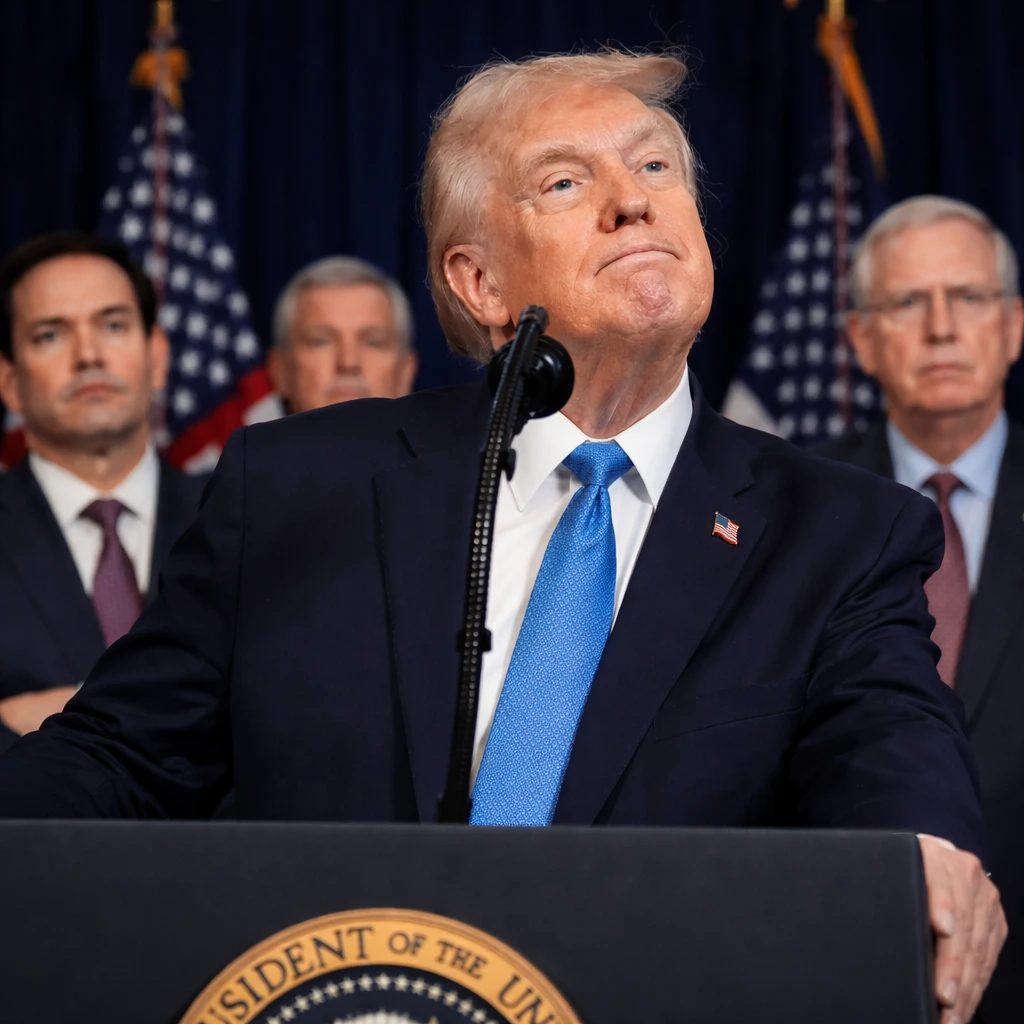

President Donald Trump's recent military involvement in Venezuela introduces a complex test of his ability to maintain cohesion within a diverse and occasionally fractious Republican Party as the 2024 election cycle gains momentum. The swift U.S. initiative to capture Venezuelan President Nicolás Maduro and bring him to American courts on criminal allegations initially garnered widespread backing from GOP members. However, broader unease has become evident across the party spectrum, particularly concerning Trump’s indication that the United States might "run" Venezuela.
This notion has raised alarms among Republicans who see a departure from Trump's hallmark "America First" approach, which had set him apart from traditional party conservatives and served as a cornerstone of his political appeal. Representative Marjorie Taylor Greene, an outgoing Georgia Republican and formerly a Trump confidante, voiced criticism on NBC's "Meet the Press," registering her concern that the strategy follows the familiar Washington playbook. According to Greene, these policies favor large corporations, banks, and oil executives rather than serving the interests of ordinary Americans.
Such skepticism is not confined to the party’s far-right faction. Moderate Republicans have also expressed reservations. Representative Brian Fitzpatrick of Pennsylvania, a GOP member considered vulnerable in the coming midterms, emphatically stated that the United States should focus solely on governing itself, not another nation.
The dynamics within the Republican Party are delicate as they face the possibility of losing congressional control. While Trump remains the dominant figure, recent months have seen his previously unassailable influence encounter challenges. Various GOP groups have pressed the president on issues ranging from transparency surrounding the Jeffrey Epstein files to economic concerns such as affordability.
Foreign policy, particularly Trump's commitment to limiting overseas entanglements that might compromise domestic priorities, remains central to his political identity. He has criticized past conflicts such as the Iraq War, describing it as a major misstep during a 2016 Republican debate. Contrastingly, in the latest Venezuela operation, Trump signaled readiness to deploy ground forces if necessary, framing the intervention as a move aimed at protecting American security. He articulated a vision of reinforcing U.S. influence in its hemisphere by fostering alliances with reliable neighbors. Trump’s references to reinvigorating Venezuela’s oil industry echo his earlier critiques of foreign interventions, including his 2013 remarks advocating for reclaiming oil assets abroad as a form of reimbursement.
Amid dissent surrounding the extent of U.S. responsibilities in Venezuela, Secretary of State Marco Rubio clarified a more restrained objective. Rubio emphasized that U.S. involvement would not extend to governing Venezuela directly beyond enforcing an existing oil embargo.
No strong organized opposition to Trump's approach has yet emerged from within the GOP. Instead, lawmakers largely appear to afford the administration some leeway, tempered with cautionary statements. Senator Susan Collins of Maine, who is facing a challenging reelection, categorized Maduro as a "narco-terrorist and international drug trafficker" warranting trial, while advocating for increased congressional involvement as the situation unfolds. Senator Rand Paul of Kentucky, known for his criticisms of military interventions, refrained from outright opposition but acknowledged the uncertainty of achieving regime change in Venezuela without considerable financial or human costs.
Senate Minority Leader Mitch McConnell, also from Kentucky and not seeking reelection, described Maduro as a "thug" and supported Trump’s constitutional authority to employ limited military force in this context.