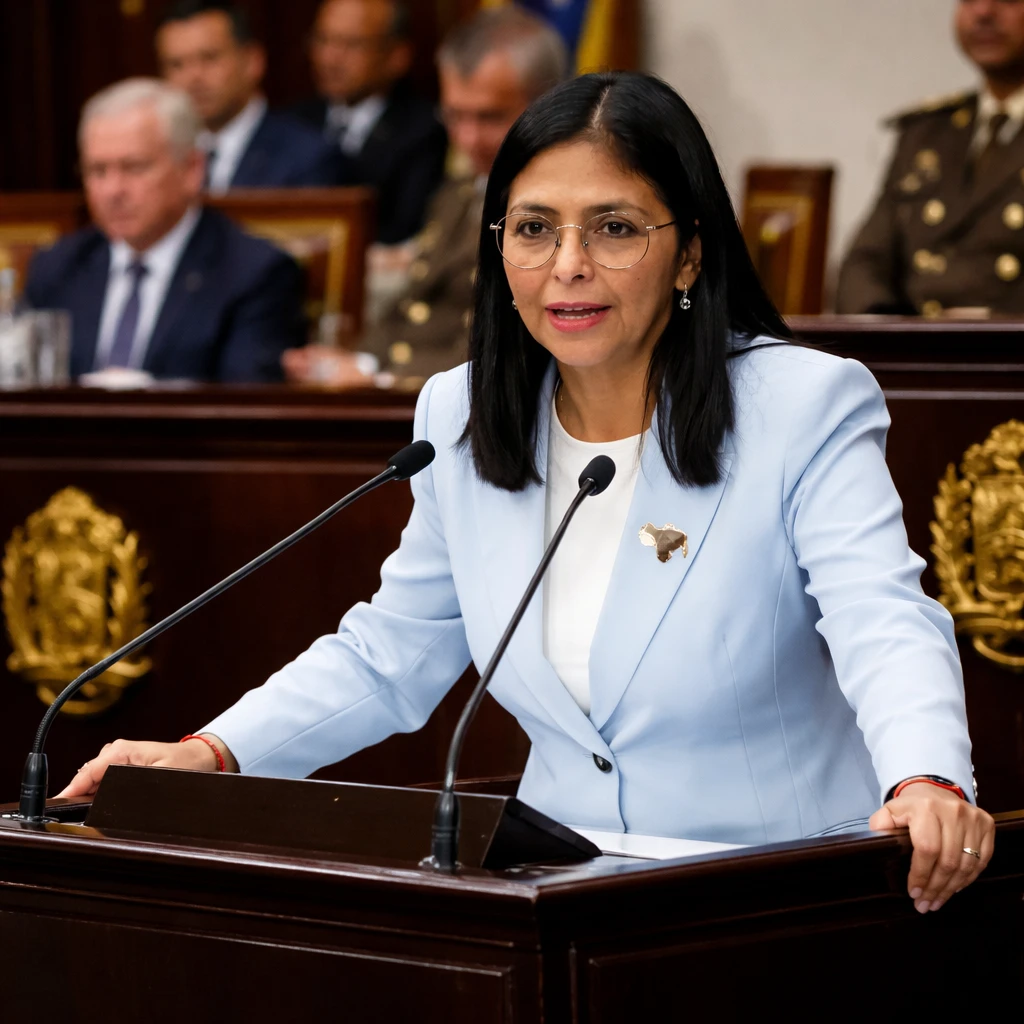
In a significant development in Venezuela’s political landscape, acting President Delcy Rodríguez announced on Friday a legislative proposal for amnesty that may result in the release of a considerable number of prisoners held on politically motivated charges. This initiative targets hundreds of detainees, encompassing opposition figures, members of the press, and human rights advocates.
The proposed amnesty bill is a response that aligns with longstanding demands from the opposition factions supported by the United States. Rodríguez, who assumed a pivotal leadership role on January 3 following the controversial removal of former President Nicolás Maduro through a U.S. military operation in Caracas, presented this measure amidst a high-profile event attended by judicial authorities, government ministers, senior military officials, and other influential leaders controlled by the ruling party.
Addressing the gathered officials during a prerecorded broadcast, Rodríguez emphasized the intent of the amnesty to "heal the wounds caused by political conflicts exacerbated by violence and extremism." She further expressed the hope that the legislation would "redirect the course of justice in Venezuela and foster improved coexistence among its citizens."
Alongside the amnesty announcement, Rodríguez disclosed the decision to close Helicoide, a Caracas-based prison notorious for documented instances of torture and human rights violations, as reported by independent observers. The facility is slated to be transformed into a community-oriented space dedicated to sports, social activities, and cultural programs serving police personnel and local neighborhood residents.
The president’s remarks were delivered in the presence of officials implicated by former detainees and human rights organizations in ordering maltreatment within Helicoide and other detention centers, highlighting the complex and sensitive nature of the announcement.
Outside Helicoide, relatives of those imprisoned streamed Rodríguez’s speech live via mobile devices. Emotions ran high, with some relatives tearful and crowds chanting slogans advocating freedom. Johana Chirinos, aunt to one of the detainees, expressed profound relief, stating, "God is good. God heard us," as tears streamed down her face.
Voicing a critical perspective, opposition leader and Nobel Peace laureate María Corina Machado issued a statement discounting the government’s initiative as a voluntary act. She attributed it to external pressure exerted by the United States and reminded that individuals have endured political imprisonment periods ranging from one month to over two decades.
Machado described the regime’s enforcement mechanisms as "brutal" and dominated by "numerous criminal forces answerable to this regime," underscoring the persistence of repression as the regime's remaining tool. She also suggested that the cessation of repression and the fading of fear would signal the collapse of tyranny.
According to Venezuela-based human rights group Foro Penal, approximately 711 people remain detained across the nation due to their political engagement, with 183 having received formal sentences. Prominent opposition members detained following the 2024 presidential election, including former legislator Freddy Superlano, Perkins Rocha (Machado’s legal counsel), and former governor Juan Pablo Guanipa (a close ally of Machado), continue to be incarcerated.
While the government has yet to publicly disclose the bill’s text, Rodríguez indicated the “general amnesty law” would encompass the entire duration of political unrest dating back to 1999. The legislation aims to exclude individuals convicted for crimes such as murder, drug trafficking, corruption, or violations of human rights from eligibility for amnesty.
Earlier in January, Rodríguez’s administration outlined intentions to discharge a significant number of detainees as a gesture of goodwill; nevertheless, detainees’ relatives have criticized the slow pace of releases. Alfredo Romero, Foro Penal's president, commended the move as constructive, provided that it fairly includes all sectors of civil society without discrimination, avoids fostering impunity, and contributes to dismantling political repression mechanisms.
In parallel, human rights organization Provea criticized the opacity and gradual nature of the release process. The group emphasized that releasing political prisoners is an urgent matter but cautioned that the amnesty should not be perceived as an act of forgiveness or clemency conferred by the state. Provea reaffirmed that the detainees were imprisoned arbitrarily for exercising rights protected by Venezuelan law, the National Constitution, and international human rights instruments.
The U.S. Department of State confirmed the liberation of all U.S. citizens previously held in Venezuelan prisons and noted the imminent arrival of Laura Dogu as the top U.S. diplomat in Venezuela. This diplomatic development aligns with efforts to address detainee issues and broader political concerns.
At another detention site in Caracas, Edward Ocariz, incarcerated for over five months after the 2024 election, joined with relatives of prisoners to demand expedited release. He reflected on the suffering endured by Venezuelans due to unjust actions that undermine their dignity, lamenting that those responsible remain in power.