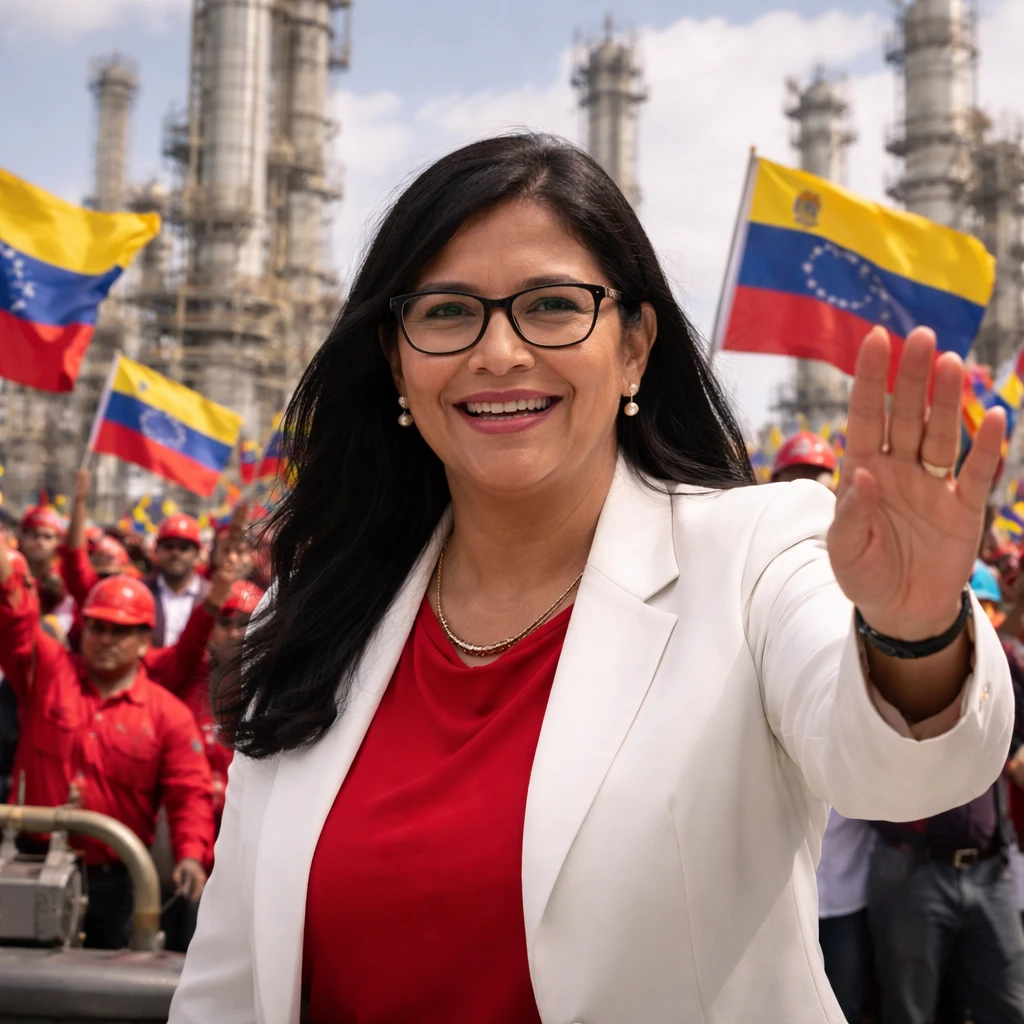

In a decisive policy shift, Venezuela’s acting President Delcy Rodredguez signed into law transformative changes on Thursday that open the nation's oil sector to privatization. This action marks a significant departure from the self-declared socialist governance framework that has shaped the country's oil management for more than twenty years.
The newly enacted legislation represents a cornerstone policy for Rodríguez's administration, designed to attract foreign investment critical for overhauling an oil industry long hampered by systemic neglect and economic sanctions. The law came into effect shortly after a provocative military episode targeting Nicolás Maduro in Caracas, underscoring the political turbulence surrounding the sector.
At a session dense with oil industry employees and supporters from the ruling party, Rodríguez ratified the legislation within two hours of its approval by the National Assembly. Concurrently, the U.S. Department of Treasury initiated measures to ease restrictive sanctions on Venezuelan petroleum, initially imposed under the Trump administration, thereby broadening the scope for American energy corporations to engage commercially within Venezuela.
Further solidifying diplomatic and economic coordination, Rodríguez held discussions Thursday with U.S. President Donald Trump and Secretary of State Marco Rubio. Rubio had previously briefed U.S. senators on plans to manage Venezuela's substantial oil exports and supervise the allocation of resulting revenues. Notably, Venezuela holds the world's largest proven crude reserves, positioning these developments as highly consequential for the global energy market.
These orchestrated moves signal a major geopolitical and economic realignment for Venezuela, with both governments paving paths for renewed activity in the oil sector.
Speaking on the reform, Rodríguez emphasized its long-term vision, stating, "We're discussing the future and the nation we intend to bequeath to our children." The president had proposed the reforms earlier in the month following President Trump's declaration to oversee Venezuela's oil sales and rejuvenate the mining of crude by inviting foreign capital.
President Trump also announced his commitment to opening Venezuela's commercial airspace to American visitors, assigning actions to Transportation Secretary Sean Duffy and military leadership to implement this directive promptly.
Shift to Private Sector Management
The law introduces a system whereby private enterprises will assume responsibility for the production and sale of oil, terminating the exclusive rights previously held by state-owned Petrƒleos de Venezuela SA (PDVSA). Under the legislation, private operators are required to demonstrate financial and technical capabilities through approved business plans before taking charge of operations. Despite privatization of activity management, ownership of hydrocarbon reservoirs remains with the state, preserving sovereign control over resource ownership.
Notably, the law authorizes independent arbitration for conflict resolution, a departure from the earlier stipulation mandating resolution exclusively through domestic courts perceived to be influenced by the ruling party. This change is intended to afford foreign investors greater legal protections against potential expropriation risks.
This regulatory update seeks to reassure hesitating multinational oil companies, including major U.S. corporations that suffered losses following the state-centric policies established two decades ago. Adjustments to extraction taxation have been incorporated, setting a 30% maximum royalty rate and granting executive authorities discretion to tailor rates based on project investment profiles and competitive factors.
Economic and Political Reception
Government legislator Orlando Camacho, heading the assembly's oil committee, declared the reform as transformative for Venezuela's economy. Conversely, opposition legislator Antonio Ecarri advocated for the inclusion of transparency and accountability frameworks within the statute, such as publicly accessible data platforms on oil revenues and allocations. Ecarri argued that existing opacity fosters corruption and that these provisions could also serve as judicial assurances critical to garnering international investor confidence.
Supporters from Venezuela's oil workforce, clad in signature red jumpsuits and helmets, endorsed the reform with patriotic fervor at the legislative palace before joining lawmakers and party loyalists in broader public demonstrations.
Decades of Contrasting Oil Policies
This reform reverses a policy trajectory set two decades ago under late President Hugo Ch¡vez, whose 2006 modifications codified PDVSA's dominant control and nationalized assets to align with his socialist vision. These actions included nullifying foreign oil contracts from the 1990s and confiscating stakes from companies like ExxonMobil and ConocoPhillips, which remain in arbitration disputes seeking compensation for seized assets.
Following a period of prodigious oil-fueled social spending, PDVSA and Venezuela's wider economy deteriorated amid plunging crude prices, corruption, and managerial lapses. This decline accelerated after Maduro assumed office, culminating in a severe economic crisis beginning in 2013 that has fueled the exodus of over 7.7 million citizens. U.S. sanctions have further exacerbated the industry's challenges.
These legislative changes, aligned with adjusted U.S. policies, are poised to redefine Venezuela's oil landscape amid ongoing political and economic complexities.