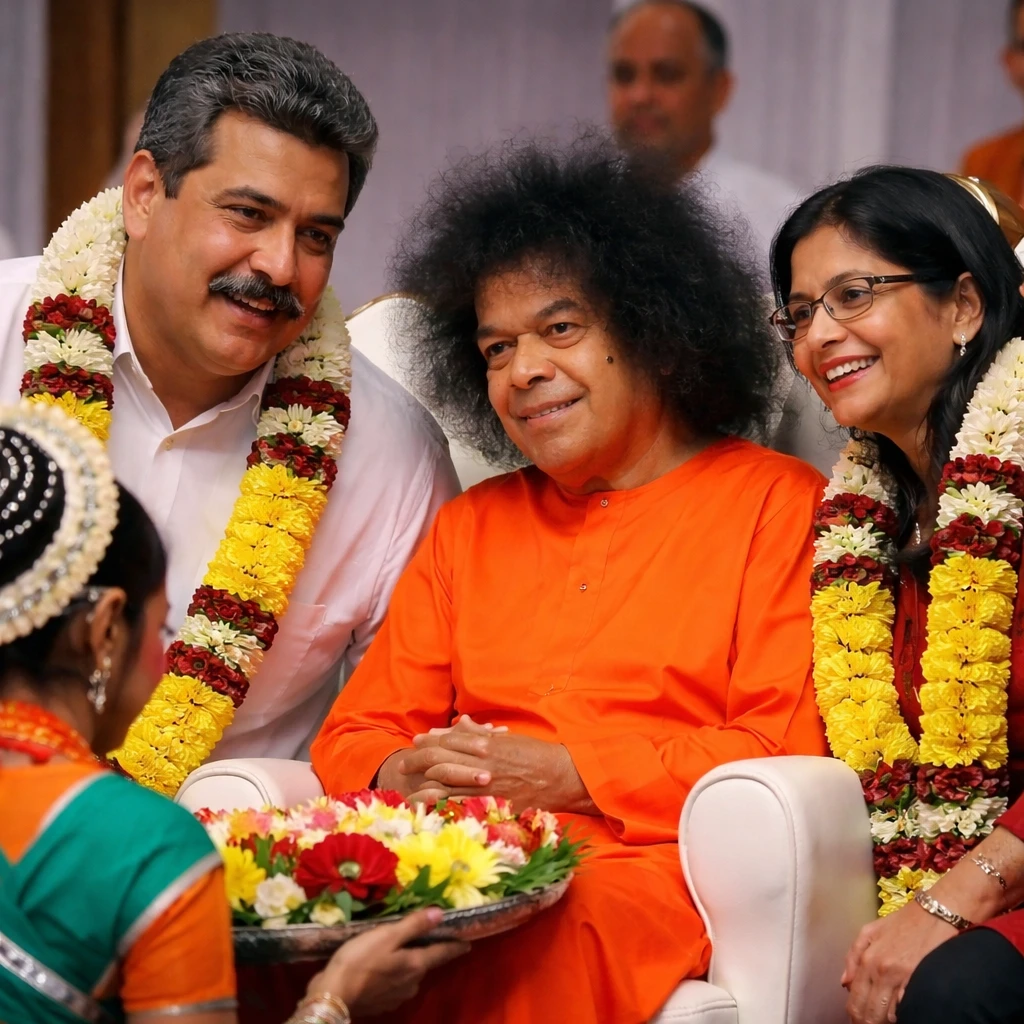
In Venezuela, a nation overwhelmingly Christian and predominantly Catholic, former President Nicolás Maduro and current acting President Delcy Rodríguez exhibit a deep admiration for the late Indian spiritual leader Sathya Sai Baba, who passed away in 2011. Their religious identities intertwine traditional Catholicism with Sai Baba's teachings, showcasing Venezuela's complex practice of integrating multiple religious and spiritual elements.
The teachings of Sathya Sai Baba, who garnered an international following for over half a century, center on messages of unity, love, and spiritual oneness that transcend conventional religious, cultural, and social boundaries. Maduro often invoked Christian figures such as Christ, the Holy Spirit, and God in his public addresses, framing his administration's challenges as spiritual struggles for the nation's soul and autonomy.
Notably, just weeks before his capture by U.S. authorities on January 3, Maduro marked Sai Baba's centenary on social media. He expressed hope that the guru's wisdom would continue to guide Venezuela towards creating a homeland rooted in love, peace, and spirituality.
Delcy Rodríguez has actively engaged with Sai Baba's legacy as well. She undertook a trip to his ashram in southern India as recently as 2024. At her inaugural presidential press briefing, Rodríguez highlighted a transformed Venezuelan landscape characterized by coexistence, mutual respect, and the cultivation of a renewed spirituality.
In a 2023 interview with the guru organization's official media channel, Rodríguez spoke of feeling Sai Baba's presence during challenging moments, emphasizing his role as a constant teacher guiding the path toward peace and love for her, her family, and the country.
Following Maduro's January 3 detention by U.S. forces—an operation that brought him and his wife, Cilia Flores, from Caracas to New York to face federal drug trafficking allegations—images emerged in Indian media showing the couple in a 2005 photograph seated at the feet of Sai Baba. Maduro's office in the Miraflores Palace reportedly featured a prominent framed picture of Sai Baba alongside portraits of Simón Bolívar and Hugo Chávez, emphasizing the guru's symbolic stature.
Maduro had declared a national mourning period upon Sai Baba's death, and in 2025, commemorated the guru as "a being of light" and a symbol embodying unconditional love, selfless service, and truth. Video footage shared by the ongoing Sai Baba organization documents Rodríguez praying at Sai Baba's sanctum in Puttaparthi, located in Andhra Pradesh, during her 2023 and 2024 visits. She is also seen engaging with R.J. Rathnakar, Sai Baba's nephew and the current head of the movement. Attempts to obtain commentary from the Sai Baba organization in India and Venezuela were unsuccessful.
The Sai Baba movement's origins in Venezuela date back to August 22, 1974, with the opening of its first center in Caracas by devotee Arlette Meyer. Meyer authored Spanish literature focused on the guru's teachings and led small study and devotional hymn sessions, marking the first Latin American foothold of the organization.
Today, the movement's Venezuelan hub is apparently centered in Abejales, Táchira state, a considerable distance from Caracas, home to a "Human Values School" run by the organization. Abejales is the birthplace of former legislator and ambassador to India Walter Márquez, a figure with enduring connections to the Sai Baba organization, whose contributions were honored locally late last year. Estimates suggest approximately 200,000 Sai Baba followers reside in Venezuela, with millions affiliated worldwide.
Andrew Chesnut, professor of religious studies at Virginia Commonwealth University, addressed Venezuela's religious dynamics, pointing out the coexistence of Catholicism with evangelical Protestantism, Afro-Indigenous customs, and global religious figures. He highlighted the country's tradition of syncretism, where multiple religious influences merge without demanding exclusive conversion.
Chesnut observed that political invocations of religion in Venezuela serve more symbolic and performative functions than direct ideological or policymaking purposes. The embrace of figures like Sai Baba reflects this dynamic where spiritual affiliations complement political narratives rather than dictate them.
Sathya Sai Baba himself was known for claiming reincarnation of Shirdi Sai Baba, another revered guru among Hindus and Muslims. Celebrated in the 1970s and 1980s for purported miraculous feats like materializing sacred ash and jewelry, Sai Baba encouraged followers to honor all religions, encapsulated in his messages of universal love and service such as "Love All, Serve All" and "Help Ever, Hurt Never."
Though Sai Baba traveled outside India only once—to East Africa in the 1960s—his movement expanded globally, establishing nearly 2,000 centers across 120 nations, including 200 in the United States. His followers span diverse sectors, including Bollywood celebrities, cricketers, prominent business figures, and everyday devotees who engage in worship and devotional singing at Sai Baba centers.
Despite his acclaim, Sai Baba faced significant skepticism and accusations. Critics, including scientists and rationalists, challenged his alleged miracles as deceptive, alongside serious criminal allegations that remained legally unproven. His adherents consistently dismissed such claims as unfounded slander.
Devotees like Dr. Samuel Sandweiss, a retired psychiatrist from Southern California with nearly 80 visits to the guru since 1972, attest to witnessing Sai Baba's materializations. Sandweiss highlighted Sai Baba's universal appeal across social strata and his overriding message that love transcends religious divides.