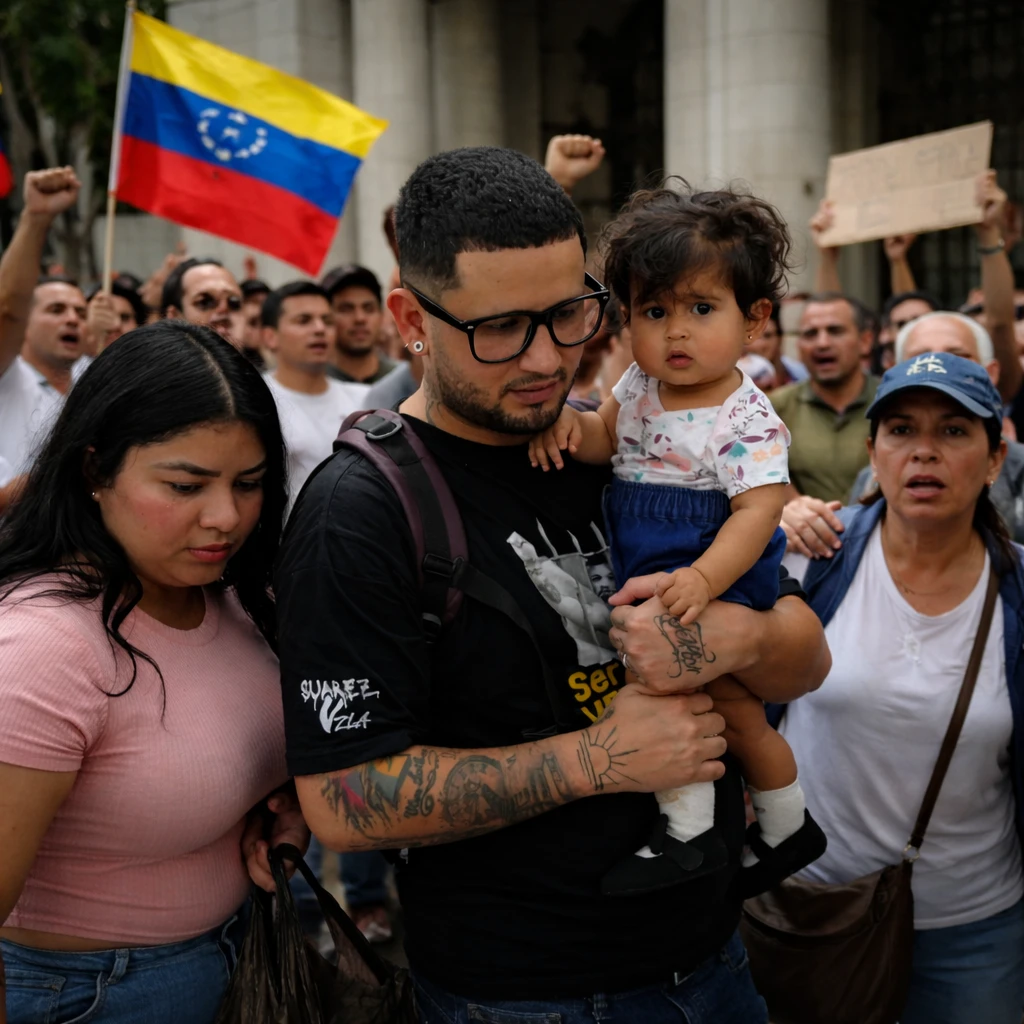

Venezuelan Migrants Sent to El Salvador Demand Justice Following U.S. Court Ruling
December 26, 2025
News & Politics

Venezuelan Migrants Sent to El Salvador Demand Justice Following U.S. Court Ruling

Federal Judge in Washington Mandates Legal Due Process for Migrants; Venezuelan Government Seeks Legal Recourse

Summary

A group of Venezuelan migrants transferred by the U.S. government to a Salvadoran prison earlier this year are calling for justice in Caracas. This demand follows a federal judge’s decision in Washington ordering the U.S. government to provide due process or return them to the United States. The migrants allege physical and psychological abuse while detained, and the Venezuelan government is supporting legal efforts on their behalf.

Key Points

The U.S. government relocated 252 Venezuelan migrants to a prison facility in El Salvador earlier in 2023.
A federal judge in Washington ruled that the U.S. must provide due process or return these migrants to the U.S.
The Trump administration classified these migrants as members of the Tren de Aragua gang, allowing deportation under a historical wartime law.
Migrants claim they experienced physical and psychological torture while detained in El Salvador.
The Venezuelan government is actively supporting legal efforts to defend the migrants, including contracting U.S. legal assistance.
The men face ongoing fears and trauma resulting from their imprisonment and abuses suffered.
The migrants' justice demands are broadly aimed at stopping ongoing human rights violations and seeking legal redress.
Not all migrants wish to return to the United States, indicating diverse individual perspectives on their futures.

CARACAS – A contingent of Venezuelan men who were relocated by U.S. authorities to a correctional facility in El Salvador at the start of this year are pressing for justice. Their calls come just days after a federal judge in Washington, D.C., ruled that the U.S. government must ensure these individuals receive due legal process.

Speaking in Caracas, the migrants expressed hope that legal organizations will assist in advancing their claims through the judiciary. The press event was coordinated by the Venezuelan government, which previously announced it had engaged legal counsel to represent the migrants' interests.

On Monday, the federal court mandated the U.S. government to provide judicial hearings to 252 Venezuelan men or alternatively to repatriate them. This ruling challenges the Trump administration's classification of these men as members of the Tren de Aragua gang, a designation which justified their deportation under a centuries-old wartime statute.

Since their incarceration in El Salvador, the men have consistently reported enduring both physical and psychological torture.

In Caracas, about twenty of the migrants gathered to publicly denounce human rights violations inflicted upon them. "Today, we demand justice before the world for the human rights abuses each of us suffered, and we seek the support of international organizations to defend us so that our rights are respected and not further violated," stated Andry Blanco during the briefing.

The migrants shared accounts of ongoing hardships linked to their detention, including pervasive fear about leaving their homes or encountering police. These fears stem from what they describe as severe mistreatment during imprisonment. The group did not articulate specific remedies they seek but conveyed that not all desire to return to the United States.

"I do not trust them," said Nolberto Aguilar when commenting on the U.S. government's role. The migrants had been transferred to El Salvador in March, and returned to Venezuela in July through a prisoner exchange agreement between the U.S. and President Nicolás Maduro’s government.

Camilla Fabri, Venezuela's Deputy Minister of Foreign Affairs for International Communication, indicated that the Maduro administration is collaborating with a U.S. law firm and human rights entities to "file a substantial legal claim against Trump and the U.S. government, demanding formal acknowledgment of the abuses committed against them."

Risks
  • Potential prolonged legal battles complicate diplomatic relations between Venezuela, El Salvador, and the U.S., affecting political stability in the region.
  • Human rights concerns related to migrant treatment may lead to international scrutiny or sanctions affecting governments involved.
  • The uncertainty surrounding migrants’ legal statuses could impact migration policies and border control economics.
  • The reputational risk for governments involved could influence investor confidence, particularly in sectors exposed to regulatory or political risks.
  • Ongoing trauma among migrants may have long-term public health and social service implications in affected countries.
Disclosure
This article was composed based solely on the original report provided, maintaining all stated facts without introduction of external information or speculation. The article translation was supported by a generative AI tool in accordance with AP editing standards.
Search Articles
Category
News & Politics

News & Politics

Related Articles
FDA Initiates Review of BHA Food Additive Safety

The U.S. Food and Drug Administration (FDA) has announced plans to conduct a comprehensive reassessm...

Partisan Divide Deepens as White House Excludes Democratic Governors from NGA Meeting

The longstanding bipartisan forum of the National Governors Association (NGA) is facing disruption a...

Using Fireplace Ashes in Your Garden: Benefits and Considerations

Amidst a notably cold winter leading to increased fireplace use, many homeowners are seeking sustain...