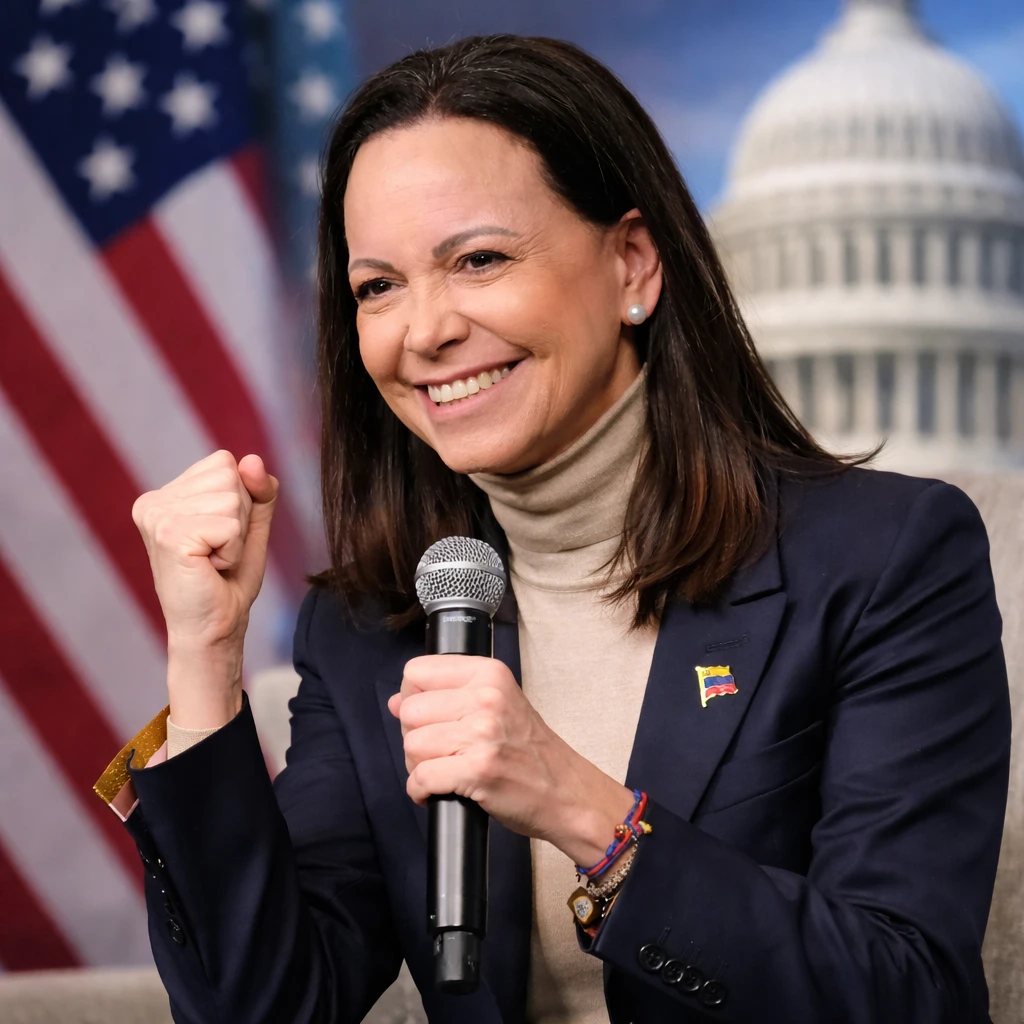

In a recent event held at The Heritage Foundation, Venezuelan opposition leader María Corina Machado conveyed her profound conviction that Venezuela is on a path towards a peaceful and structured transition to democracy. This outlook emerges in the context of Venezuela's continuing political turbulence following the displacement of former President Nicolás Maduro.
Machado, however, cautioned against underestimating the challenges ahead, particularly the complexities of conducting free elections after almost three decades of authoritarian governance. When questioned about the timing of such electoral processes and her own repatriation plans, she refrained from offering concrete details, stating only that her return to Venezuela would occur "as soon as possible." This reticence was noted during her press briefing, reflecting the difficult environment in which her opposition movement operates, especially given the endorsement by the U.S. administration of Maduro’s loyalist appointee effectively managing Venezuelan affairs for the time being.
During a meeting in Washington, D.C., Machado presented then-President Trump with her Nobel Peace Prize medal, symbolizing an appeal for sustained U.S. support for democratic restoration; however, the Nobel committee has made clear that such awards are non-transferable. This gesture occurred concurrently with CIA Director John Ratcliffe's engagement in Caracas with acting President Delcy Rodríguez, reinforcing Washington's current preference for Rodríguez's administration amidst ongoing diplomatic maneuvers.
Machado categorized the Maduro regime as fundamentally reliant on terror tactics, dismissing perceptions of deep societal divisions such as religious, racial, or regional tensions as nonexistent in Venezuela. She acknowledged, nonetheless, the entrenched alliance of the ruling structure with external actors like Russia and Iran, highlighting the depth and endurance of existing political frameworks.
Machado declined to elaborate extensively on her policy dialogue with the U.S. President or to advocate for any specific U.S. actions, underscoring a reliance on the executive's judgment in navigating the Venezuelan crisis. President Trump’s administration has thus far prioritized an oil blockade and the possibility of military options to enforce compliance on the interim government, while publicly expressing limited plans for orchestrating new elections.
The possibility of reopening the U.S. Embassy in Caracas marks a potential shift toward renewed diplomatic engagement. Machado's visit to Washington aimed to rejuvenate the pro-democracy momentum apparent during the prior administration, though her political influence within Venezuela remains constrained following her disqualification from the 2024 presidential election. Despite receiving broad public support preceding the election, Machado was barred from candidacy, resulting in the nomination of Edmundo Gonzalez, a diplomat with limited prior public recognition. Official election results declared Maduro victorious amid widespread objections and credible evidence suggesting electoral irregularities.
Following the election, Machado went into hiding, vowing to continue her efforts advocating for democratic governance. Her attendance in Norway to receive the Nobel Peace Prize in December marked a rare public appearance outside Venezuela in more than ten years. Through these developments, Machado remains a symbol of opposition resistance while navigating international relations and domestic constraints in pursuit of Venezuela's political transformation.