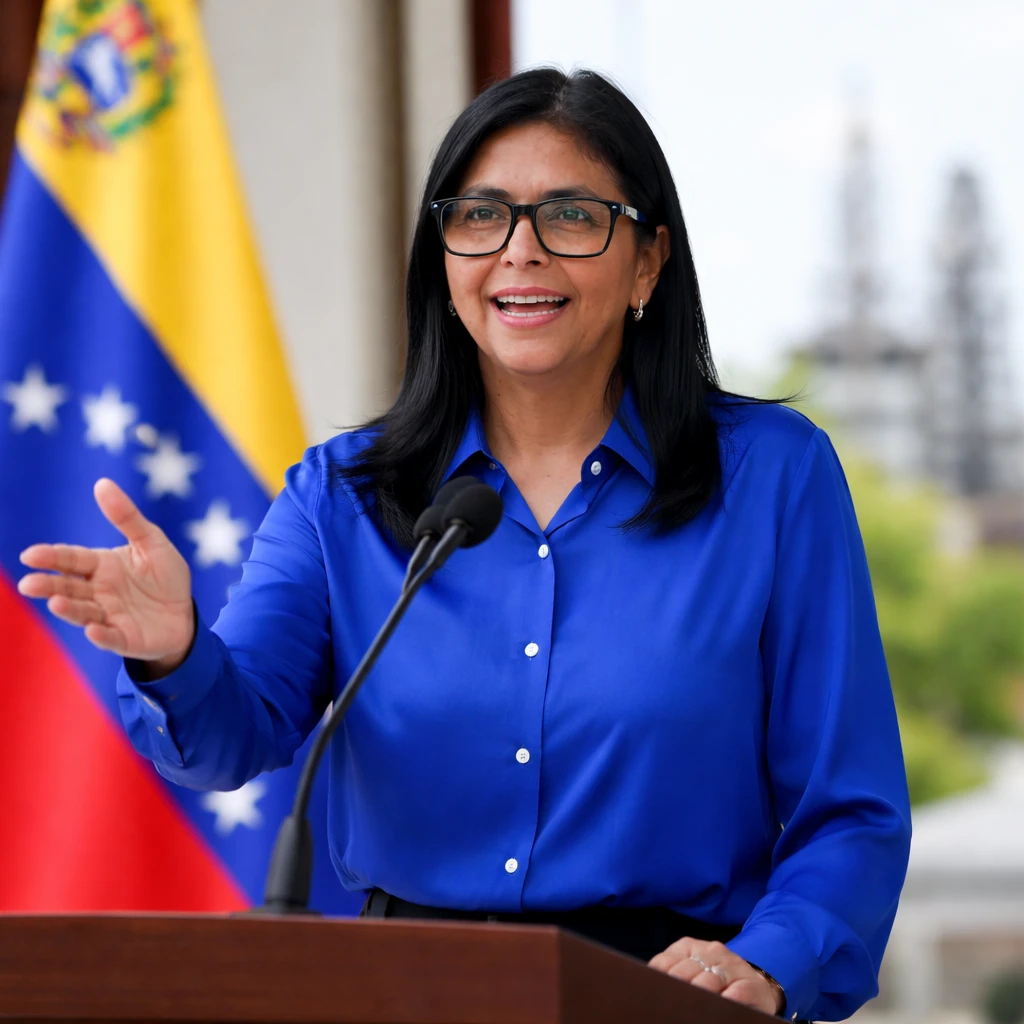
In a poignant address marking her first state of the union, Venezuela’s interim President Delcy Rodríguez outlined a strategic pivot regarding the country’s oil sector and international relations. This speech came less than two weeks after the United States assumed control of Venezuelan crude sales and the removal of former President Nicolás Maduro from power. Rodríguez’s message signaled a departure from entrenched government stances by encouraging increased foreign participation in the vital state-run oil industry.
In an effort to adjust to the new political dynamics imposed by the U.S., Rodríguez, who previously served as Vice President under Maduro, revealed that Venezuela is developing a "new policy" in its oil domain. She actively urged foreign diplomats to communicate these adjustments to potential investors overseas, advocating for the swift passage of legislative reforms to facilitate access by international firms to the country’s extensive oil reserves.
“Venezuela, engaging in free trade relations with the global community, is positioned to market the output of its energy sector,” Rodríguez declared. This marks a notable shift from previous isolationist rhetoric, as the Trump administration has articulated intentions to direct future oil revenues in ways that benefit the Venezuelan populace directly. To that end, Rodríguez described plans for revenue allocation into two sovereign wealth funds: one aimed at revitalizing the strain-ridden healthcare system, and another intended to reinforce public infrastructure severely degraded since the era of Hugo Chávez.
Currently, Venezuela faces a severe healthcare crisis, with many hospitals lacking critical equipment, requiring patients to supply essentials ranging from syringes to surgical hardware for their care. Through her speech, Rodríguez not only condemned the U.S. operation to detain Maduro—labeling it a "stain on our relations"—but also advocated for the restoration of diplomatic channels with the United States. Her measured 44-minute speech contrasted sharply with prior government leaders’ lengthy, inflamed denunciations of U.S. actions.
Advocating diplomacy, Rodríguez urged: “Let us not be afraid of diplomacy. I ask that politics not be transformed by hatred and intolerance.” In a preceding brief statement, she affirmed intentions to continue releasing detainees incarcerated under Maduro’s administration, although human rights groups have only substantiated a limited number of these purported releases.
Throughout her address, Rodríguez maintained a delicate balance, symbolically displaying portraits of Maduro and his spouse, Cilia Flores, and calling for U.S. respect for Maduro’s dignity amid his detention in Brooklyn on drug-trafficking charges. Simultaneously, she projected a firm stance of national sovereignty, asserting, “If ever required to visit Washington as acting president, I will do so standing tall, walking upright—not being dragged,” underscoring her resolve not to concede under pressure.
While Rodríguez addressed the nation, Venezuela’s opposition leader, Nobel laureate María Corina Machado, was in Washington meeting President Donald Trump. Since Maduro’s removal, Trump has distanced himself from Machado despite her party’s apparent success in the recent 2024 presidential elections, favoring Rodríguez—whom he recently described as a “terrific person” following their initial phone conversation.
Machado reported presenting her Nobel Peace Prize medal to Trump during their private meeting and emerged energized, telling supporters, “We can count on President Trump,” though she declined to expand on the discussion. The future role she may play in Venezuelan politics remains unclear, especially as Rodríguez’s government is not expected to conduct elections in the near term.
Notably, Machado’s Washington visit received no media coverage within Venezuela, where state-run television continues rigorous promotion of the incumbent government. Broadcasts feature statements from Iranian and Russian officials condemning U.S. actions and extensive state-organized demonstrations demanding Maduro's reinstatement.
Public displays of loyalty to the government persist in Caracas, where educators marched carrying signs condemning the United States for “kidnapping” Maduro and chanted pro-government slogans. Riot-equipped national police maintained heavy presence throughout the city. Government-sanctioned graffiti spreads messages such as “To doubt is to betray,” underscoring an ongoing narrative of patriotic unity.
David Smilde, a Venezuela expert from Tulane University, observed that while anti-imperialist rhetoric remains, it now manifests in a subdued manner. “The approach seems to be conceding economically to Trump’s demands while maintaining political principles,” he explained.
Amid this complex and evolving situation, the general population remains cautious or uncertain. In central Caracas, many citizens declined interviews, citing fears of reprisal from Maduro’s still-present security forces. Others expressed bewilderment toward the unfolding reality where the United States asserts significant influence over Venezuelan affairs.
One Caracas resident, Pablo Rojas, a 28-year-old music producer, described the atmosphere as “a complete sea of uncertainty,” highlighting his attentiveness to political developments, particularly regarding Machado’s emerging role as a potential national leader facilitated by U.S. support. “It’s impossible to know what will happen,” he admitted, reflecting the ambiguity that now defines Venezuela’s path forward.