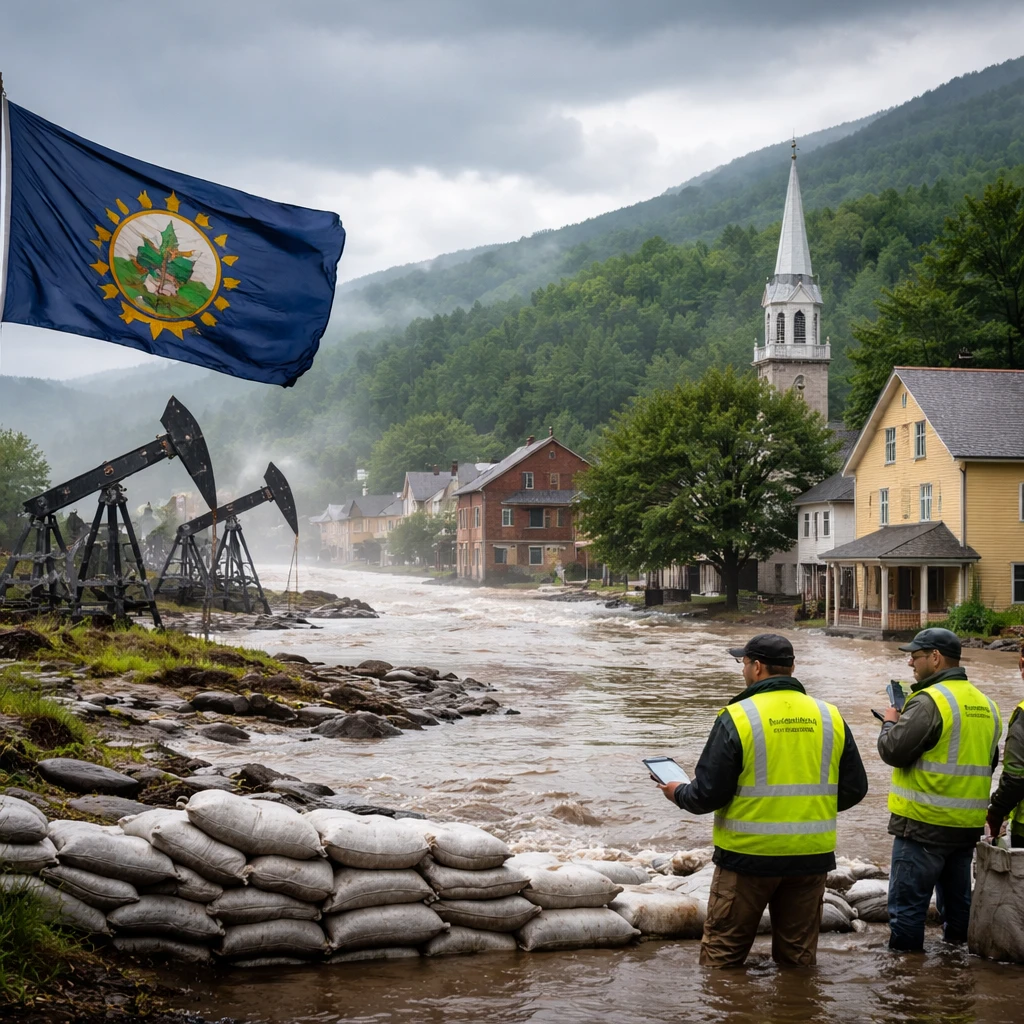
For Sue Minter, Vermont's appointment as the state’s Climate Superfund specialist traces back to firsthand experience with devastating floods starting over a decade ago. During Tropical Storm Irene in 2011, in her role as deputy secretary of transportation, Minter was instrumental in repairing the extensive damage to Vermont’s infrastructure, including hundreds of bridges and hundreds of miles of roads. Later, as executive director of Capstone Community Action, she supported vulnerable and low-income Vermonters displaced by major flood events in 2023 and 2024. With public service dating from the 1990s, Minter was selected in September 2023 to oversee the Climate Superfund Act, a novel state law aiming to hold large fossil fuel producers accountable for their pollution contribution. This law—currently subject to legal scrutiny in federal courts following challenges by the U.S. government and states—imposes a one-time fee on companies that extracted or refined fossil fuels responsible for at least one billion metric tons of carbon emissions from 1995 through 2024. The resulting funds are designated to finance Vermont’s climate adaptation efforts, driven largely by the impacts of fossil fuel emissions.
Minter, a former Vermont state representative and 2016 gubernatorial candidate, described her work as a meaningful extension of recovery efforts she pioneered after Irene. Her focus is on ensuring taxpayers are not left to cover the escalating costs of climate disasters unilaterally. As program manager, she coordinates the intricate process of quantifying Vermont’s climate change expenditures through attribution science. This scientific methodology links extreme weather events—such as heat waves and floods—to climate change by calculating how increased greenhouse gas emissions have raised the probability of such occurrences.
She leads collaboration with Industrial Economics, Incorporated, alongside Vermont’s treasurer’s office and the Climate Action Office within the Agency of Natural Resources. State Treasurer Mike Pieciak acknowledged the assessment as technically demanding, emphasizing the rigor of the forthcoming report due in January 2027. Afterward, the Agency of Natural Resources will spend up to another year applying these findings to calculate financial liabilities for major fossil fuel corporations including Chevron, ExxonMobil, and British Petroleum, aligning with the legislation’s directives. Minter underscored the focus on credible, scientific substantiation rather than arbitrary estimates. Though Pieciak refrained from projecting total costs before the report’s completion, a Vermont Resilience Implementation Strategy recently identified hundreds of potential resilience projects with preliminary costs reaching into the hundreds of millions.
Minter’s experience with flood recovery and resilient infrastructure, honed through her tenure managing post-Irene reconstruction and advocating for federal funding through FEMA, informs her approach. Investments made with state and federal dollars post-2011 measurably mitigated damage from subsequent floods in 2023 and 2024, which cumulatively inflicted over $1 billion in losses. However, uncertainty about future FEMA disaster declarations complicates funding prospects. Notably, Vermont’s latest flood disaster declaration was denied by the prior federal administration. Minter cautions that without a robust recovery program, it will be increasingly difficult for Vermont’s communities to afford necessary resilient designs. Thus, the Superfund law gains additional importance as a potential financial safeguard for taxpayers.
Legal opposition to Vermont’s Climate Superfund Act is substantial. Filed in May by the federal government and 24 states led by West Virginia, alongside industry groups like the U.S. Chamber of Commerce and American Petroleum Institute, lawsuits argue that the state law unlawfully interferes with federal authority under the Clean Air Act over greenhouse gas regulation. In response, advocacy groups including the Vermont Public Interest Research Group (VPIRG) argue the law does not regulate emissions but rather compels polluters to contribute fairly to adaptation costs, similar to the original 1980 Superfund law's polluter-pays framework. VPIRG and others emphasize that the law neither mandates emission reductions nor behavioral changes, but addresses equitable financial responsibility.
VPIRG's executive director, Paul Burns, detailed the organization's long-standing commitment to climate superfund initiatives, initially supporting proposed federal legislation to tax fossil fuel companies for major climate-related damages. When federal efforts stalled, advocates shifted focus to state-level action, leading to strong local support in the aftermath of the 2023 floods. Parallel arguments in favor of the law have been presented by the Northeast Organic Farming Association of Vermont and the Conservation Law Foundation.
Vermont has requested dismissal of the pending federal lawsuits, while the government continues to press for the law’s invalidation. The state has sought an extension to respond to these legal motions, anticipating the courts will determine how to handle the multiple filings. Regardless of legal outcomes, Minter asserts that defining Vermont’s climate change impacts remains a critical, ongoing endeavor for the state’s adaptation planning and accountability efforts.
December 26, 2025
News & Politics
Vermont Advances Climate Superfund Amid Federal Legal Challenges
New law targets leading fossil fuel companies for historic emissions to fund statewide climate resilience measures

Maya Rios
Energy & Utilities Analyst
Summary
Vermont continues to implement its Climate Superfund Act, a 2024 law charging major fossil fuel companies for carbon pollution dating back to 1995. While the state moves forward with detailed scientific assessments to measure climate change costs, federal lawsuits seek to invalidate the legislation. The law aims to recoup billions to finance adaptation efforts spurred by recurring, severe flooding events linked to climate change, placing Vermont at the forefront of state-level accountability initiatives against oil giants.
Key Points
The Vermont Climate Superfund Act imposes a one-time fee on fossil fuel companies responsible for over one billion metric tons of emissions from 1995 to 2024.
The law aims to finance climate adaptation initiatives in Vermont, addressing the state's vulnerability to flooding and other extreme weather events linked to climate change.
Sue Minter, appointed in 2023 as Climate Superfund specialist, oversees the scientific assessment quantifying climate-related costs to Vermont.
Attribution science is applied to tie weather disasters to anthropogenic greenhouse gas emissions, a foundational component in the cost assessment process.
Flooding disasters in 2011, 2023 and 2024 have demonstrated the increasing scale and cost of climate impacts in Vermont, exceeding $1 billion in damages.
The resilience strategy includes potential investments totaling hundreds of millions of dollars, emphasizing durable infrastructure and community protection.
Legal challenges against Vermont’s law, led by the federal government and multiple states, question its compatibility with federal Clean Air Act authority.
Advocates clarify the law does not regulate emissions but requires fossil fuel companies to pay for climate adaptation costs, paralleling traditional superfund models.
Risks
- Ongoing federal and multi-state lawsuits may result in the Vermont Climate Superfund Act being invalidated or substantially altered, impacting funding mechanisms.
- Uncertainty surrounding federal disaster aid through FEMA complicates reliance on federal support for climate resilience investments.
- The complexity of scientifically attributing climate change costs to specific events and companies could delay or reduce financial recoveries.
- Potential resistance from major fossil fuel firms and industry groups may prolong litigation and political challenges.
- The extensive costs projected for climate resilience measures may strain state budgets and require difficult prioritization of investments.
Disclosure
The article presents factual reporting based on currently available information regarding Vermont’s Climate Superfund Act, its implementation, and related legal challenges. No forward-looking statements or speculative commentary beyond source data are included.