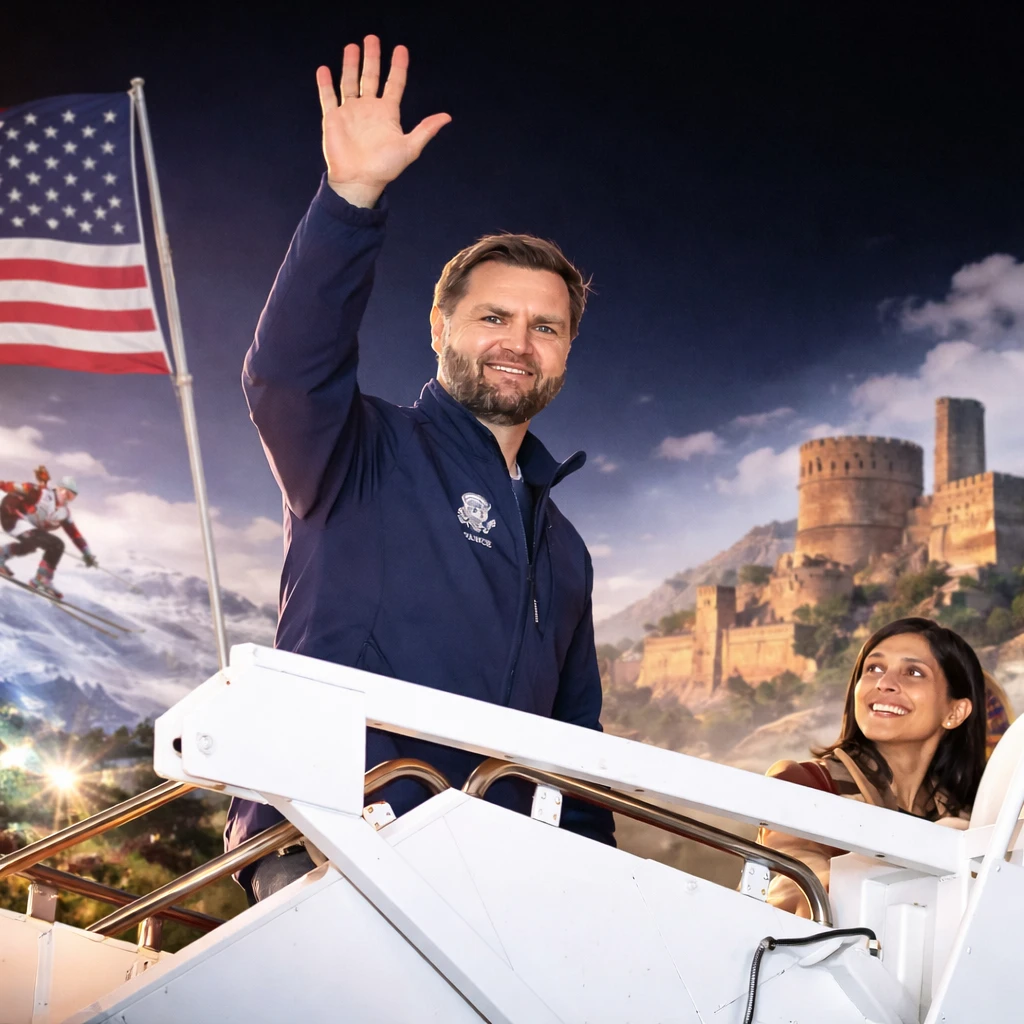

In a move reflecting both diplomatic outreach and sporting representation, Vice President JD Vance will spearhead the United States delegation to the 2026 Winter Olympics in Milan-Cortina, Italy. This marks a significant international engagement for the vice president amid a period of heightened domestic focus by the administration, particularly with the upcoming November midterm elections. White House Chief of Staff Susie Wiles recently confirmed that Vance’s weeklong overseas journey would likely constitute the bulk of his foreign travels this year as President Donald Trump’s administration concentrates on domestic priorities.
At the opening ceremony of the Winter Games scheduled for Friday, Vance will be accompanied by his spouse, Second Lady Usha Vance; Secretary of State Marco Rubio; and U.S. Ambassador to Italy, Tilman Fertitta. The delegation also boasts a distinguished contingent of former Olympic gold medalists including hockey player sisters Jocelyne Lamoureux-Davidson and Monique Lamoureux-Morando, speedskater Apolo Ohno, and figure skater Evan Lysacek.
Prior to the official commencement of the Games, Vance intends to attend a preliminary women’s hockey match between the United States and Czechia on Thursday. His engagement in the Olympics aligns with precedents set by past vice presidents such as Joe Biden’s participation in the 2010 Winter Olympics in Vancouver and Mike Pence’s attendance at the 2018 Pyeongchang Games. Conversely, former Vice President Kamala Harris did not attend the 2022 Beijing Winter Olympics, as the Biden administration chose to forgo diplomatic representation in protest over human rights issues.
Following his Olympic responsibilities, Vice President Vance will travel to Armenia and Azerbaijan. His objective there is to build upon a peace accord facilitated by the Trump administration aimed at resolving more than forty years of conflict between the two nations. This agreement not only represents a diplomatic milestone but also serves to bolster U.S. influence in a region where Russian dominance is waning.
The accord includes terms for reopening vital transportation links and enhancing bilateral cooperation with the United States in sectors such as energy, technology, and economic development. Central to the treaty is the creation of a significant transit corridor—termed the Trump Route for International Peace and Prosperity—expected to connect Azerbaijani territory with its autonomous Nakhchivan exclave, which is geographically separated by Armenian land approximately 32 kilometers wide.
Vance’s diplomatic mission to Armenia and Azerbaijan parallels his October engagement in Israel, where he reaffirmed U.S. commitment shortly after a ceasefire was established in the conflict between Israel and Hamas in Gaza. His recent travel portfolio includes visits to France, Germany, Greenland, India, and the United Kingdom, as well as two separate trips to Italy. During these, he met with popes Pope Francis before his passing and his successor Pope Leo XIV.
Vice presidential travels often encompass locations and functions divergent from those typically attended by presidents, whose foreign visits prioritize established allied powers. Biden undertook a notable visit to Mongolia in 2011, engaging in cultural exchanges that included archery and receiving a horse as a gift. During Trump’s administration, Pence’s 2017 European tour featured stops in Estonia, Georgia, and Montenegro, emphasizing NATO support and symbolic diplomatic acts such as the ceremonial planting of an oak tree.
According to Marc Short, former chief of staff to Pence during Trump’s first term, the scope of vice presidential trips largely depends on the president’s preferences and availability. On occasion, these travels involve unanticipated elements, such as Pence’s informal encounter with Russian President Vladimir Putin during the 2018 East Asia Summit in Singapore. Short also recounted an instance in 2019 when Pence fulfilled presidential duties in Poland amid a hurricane back home by meeting with Ukrainian President Volodymyr Zelenskyy. Such examples illustrate how vice presidents often represent the nation’s highest available officials on the global stage when the president is otherwise engaged.