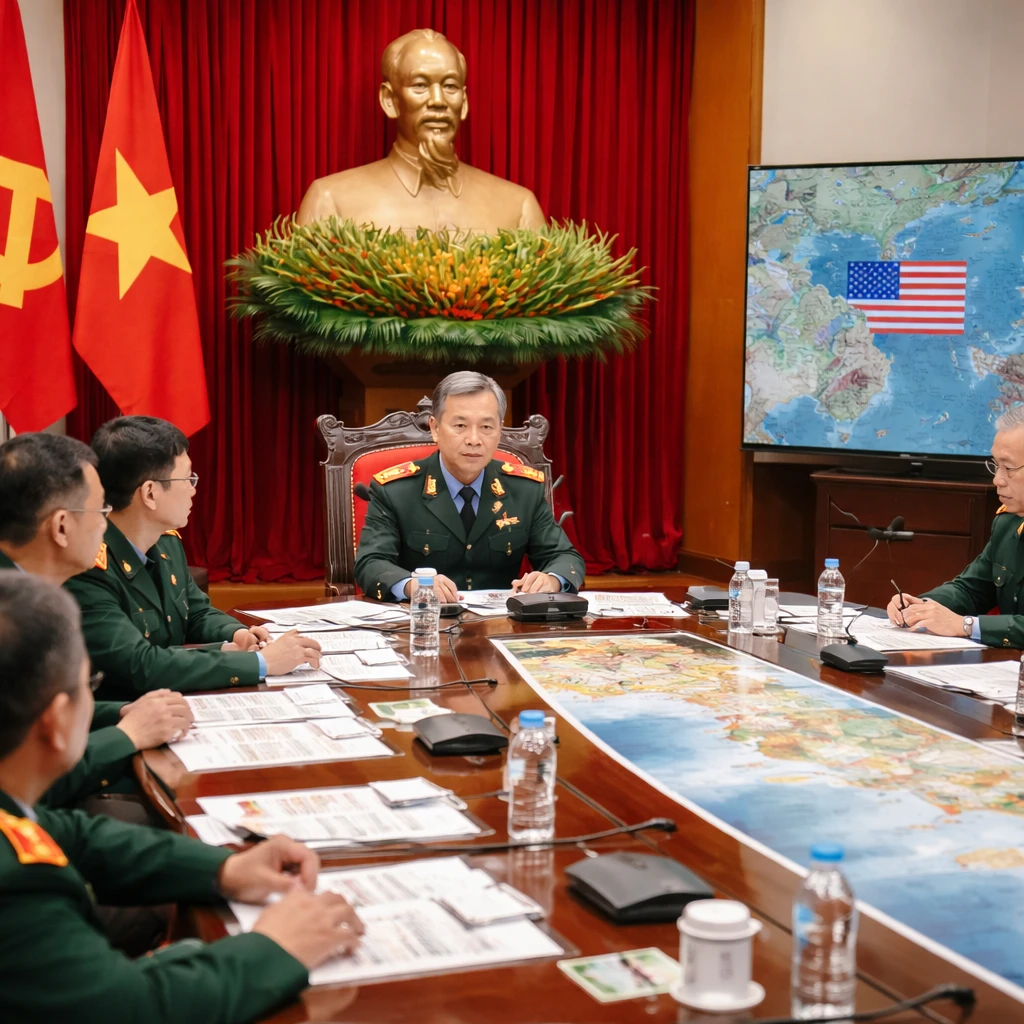

Vietnam's military has been making strategic preparations due to concerns about a potential American "war of aggression," according to a confidential document produced by the Vietnamese Ministry of Defense in August 2024. This document, titled "The 2nd U.S. Invasion Plan," characterizes the United States as a "belligerent" power that could engage in unconventional warfare, military intervention, or large-scale invasions against countries that deviate from its geopolitical interests, such as Vietnam.
The document indicates an evolution in U.S. policy toward the region through three presidential administrations, highlighting a trend toward forming coalitions with Asian countries to counter China. Although it states that the current risk of war with Vietnam is low, Vietnamese planners emphasize the necessity of vigilance against American attempts to create a pretext for invasion.
Despite elevating bilateral ties to a "Comprehensive Strategic Partnership" in 2023, raised to the highest diplomatic rank alongside relationships with Russia and China, Hanoi remains wary of U.S. intentions. The military perceives the American strategy as an effort to spread values of freedom, democracy, human rights, ethnicity, and religion with the goal of gradually transforming Vietnam's socialist system. This dual stance—engaging diplomatically while maintaining suspicion—is revealing of Vietnam's foreign policy complexities.
Ben Swanton, co-director of The 88 Project, a human rights organization monitoring Vietnam, explains that this perspective is broadly shared across various government sectors and ministries, rather than representing a fringe ideology. The report emphasizes that Vietnam does not view the U.S. as a strategic partner in the context of its anti-China alliances but rather as an existential threat.
Efforts to comment on these internal documents from Vietnam's Foreign Ministry have gone unanswered, whereas the U.S. State Department declined to comment on the specific "2nd U.S. Invasion Plan," instead underscoring the benefits of the partnership agreement focused on prosperity and security, contributing to stability in the Indo-Pacific region.
Analysts note that this internal military viewpoint reflects tensions within Vietnam's political leadership, where conservative, military-aligned factions remain apprehensive about external threats, particularly those that could destabilize the Communist Party. Nguyen Khac Giang from the ISEAS–Yusof Ishak Institute highlights the military's discomfort with deepening U.S. ties despite official diplomatic progress.
Public manifestations of these tensions have surfaced. For example, in June 2024, a Vietnamese army TV report accused the U.S.-linked Fulbright University of attempting to incite a "color revolution," a claim the Foreign Ministry later refuted despite the university's role in enhancing bilateral cooperation.
Washington-based analyst Zachary Abuza notes that the Vietnamese military's apprehensions are rooted in a historical context, recalling the Vietnam War’s lasting impact. Contrary to external perceptions emphasizing the threat posed by China, the military's primary concern is the risk of foreign-backed internal uprisings resembling "color revolutions," driven by fundamental fears of regime destabilization.
Support for this suspicion was further undermined by previous U.S. administration actions, including funding cuts from the Trump era to programs addressing Agent Orange contamination and clearing unexploded munitions, which had adversely affected trust.
Vietnam’s relationship with China is portrayed more as one of regional rivalry rather than existential threat. China remains the country’s largest trading partner, while the United States is the biggest export market, illustrating Hanoi's need to carefully balance its diplomatic and economic engagements.
Even reform-minded Vietnamese leaders reportedly express skepticism toward U.S. intentions, acknowledging the partnership’s benefits but wary that the U.S. might support internal opposition should the opportunity arise for regime change.
Under current Communist Party General Secretary To Lam, who rose to leadership contemporaneously with the document's publication, Vietnam has bolstered ties with the United States, particularly during Donald Trump’s presidency. This period saw significant developments such as Trump’s family initiating a $1.5 billion luxury real estate project in northern Vietnam and Lam accepting an invitation to join Trump's Board of Peace, moves considered unexpectedly swift and suggestive of a strategic diplomatic approach mindful of Beijing's sensitivities.
However, Trump’s military actions, for example, attempts to capture former Venezuelan President Nicolás Maduro, have reinforced the reservations of conservative Vietnamese factions about closer U.S. ties. Such actions heighten fears that American military interventions in allied states like Cuba could destabilize Vietnam's strategic equilibrium.
Abuza observes a dichotomy in U.S. policy under Trump’s second administration: a deprioritization of human rights and democracy promotion coupled with a willingness to override state sovereignty and remove unfavored leaders. This inconsistency has left Vietnamese officials both hopeful and uncertain about future bilateral relations.