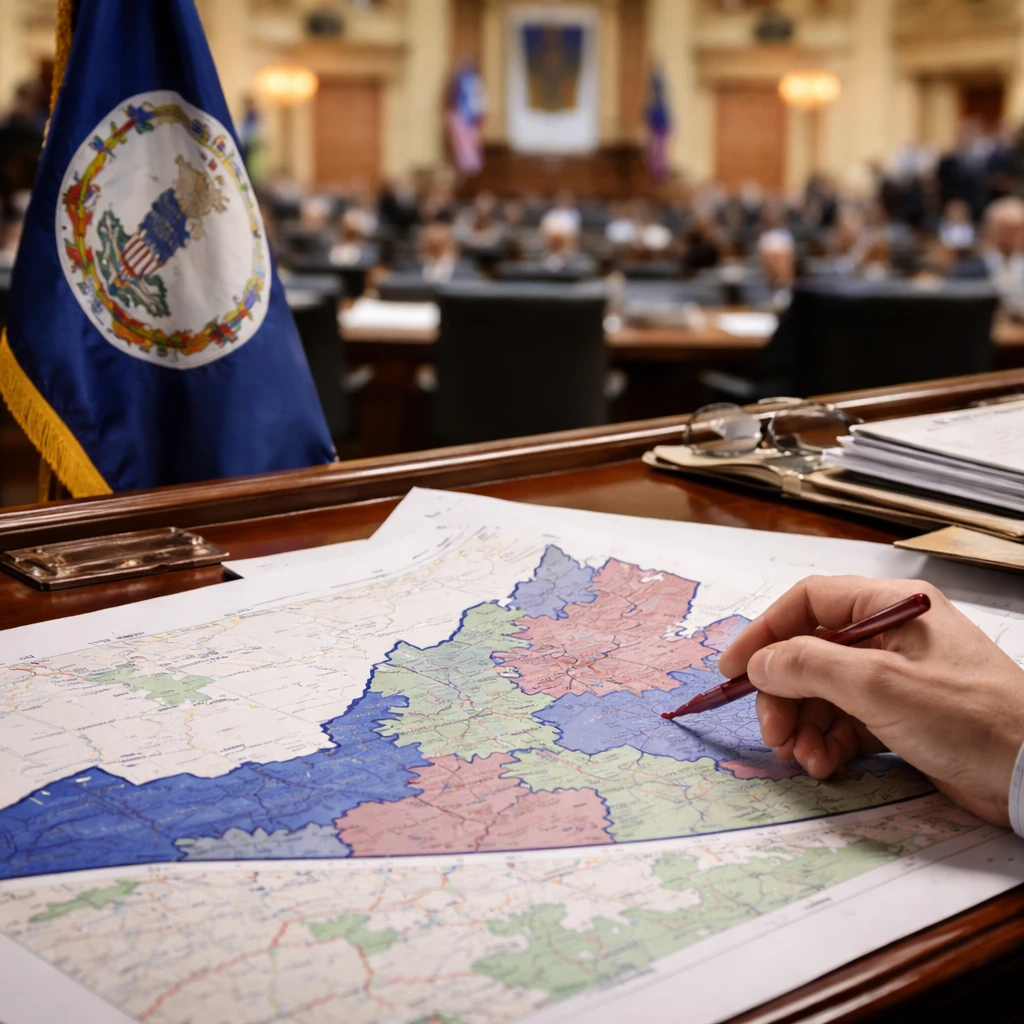

In Richmond, Virginia, the state Senate has endorsed a constitutional amendment permitting the redrawing of congressional districts before the standard decennial cycle. This measure is designed to enable a redraw that would potentially benefit Democratic candidates in the continuing contest over U.S. House representation.
The newly proposed congressional map has not yet been released to the public, but state officials have pledged to unveil it by the end of the month. Voters are expected to review the proposed boundaries before participating in an anticipated referendum, presumably scheduled for April.
Democratic Delegate Cia Price emphasized the democratic nature of the process, stating on Wednesday that because the endeavor is led by Virginians and seeks public approval, voters will have access to the proposed maps ahead of their vote.
The state Senate, narrowly controlled by Democrats, passed the amendment on a party-line vote Friday afternoon, following a similar endorsement by House Democrats earlier in the week.
This legislative push follows last year's initiative by former President Donald Trump, who encouraged Texas Republicans to craft congressional district boundaries that would be advantageous to their party. This prompted a nationwide debate over mid-decade redistricting, with multiple states following suit.
Since that time, states including Texas, Missouri, and North Carolina have enacted new congressional maps bolstering Republican prospects, with Ohio also adopting a map considered favorable to Republicans.
Conversely, Democrats have secured map revisions in California through voter approval, and a judicially adopted congressional map in Utah has similarly been seen to benefit the Democratic Party.
The national landscape of redistricting remains unsettled, as some Republican factions, exemplified by Kansas where plans for a special redistricting session were abandoned, and Indiana’s GOP-led Senate rejecting a proposal that might have secured full Republican control of its congressional delegation, showcase resistance to mid-cycle map changes.
Uncertainty persists regarding whether states with differing political compositions, such as Florida, Illinois, and Maryland, will pursue new map redraws.
Current estimates indicate that mid-decade redistricting efforts have created a net advantage of three seats for Republicans nationwide, with nine seats potentially gained by GOP candidates versus six predicted pickups for Democrats. However, ongoing legal challenges in various states render the final impact of these changes unresolved.
Within Virginia, the amendment proposal has sparked intense debate among legislators focused on the issue of gerrymandering in a politically competitive state that hosts a significant population of independent voters. This debate has intensified given the state's previous sustained efforts toward fair districting practices.
Senate Majority Leader Scott Surovell criticized Republican-led gerrymandering efforts in other states, asserting that such actions undermine commitments to electoral fairness upheld by Virginia voters. In contrast, Republican Senate Minority Leader Ryan McDougle has publicly opposed Virginia's redistricting plan, citing Indiana Republicans’ refusal to engage in similar partisan maneuvers as an example of principled governance.
Virginia's current congressional districts, represented by six Democrats and five Republicans, were drawn by a court after a bipartisan commission could not agree on a new map, a commission established following a 2020 referendum supporting constitutional measures to eliminate legislative gerrymandering.
The amendment before Virginia voters would authorize mid-decade congressional map adjustments only until 2030 and includes provisions that permit such actions only if analogous steps are undertaken by other states.
Governor-elect Abigail Spanberger, a Democrat, has voiced her support for the effort but has refrained from endorsing a specific redistricting plan, indicating that ultimate decisions rest with the electorate.