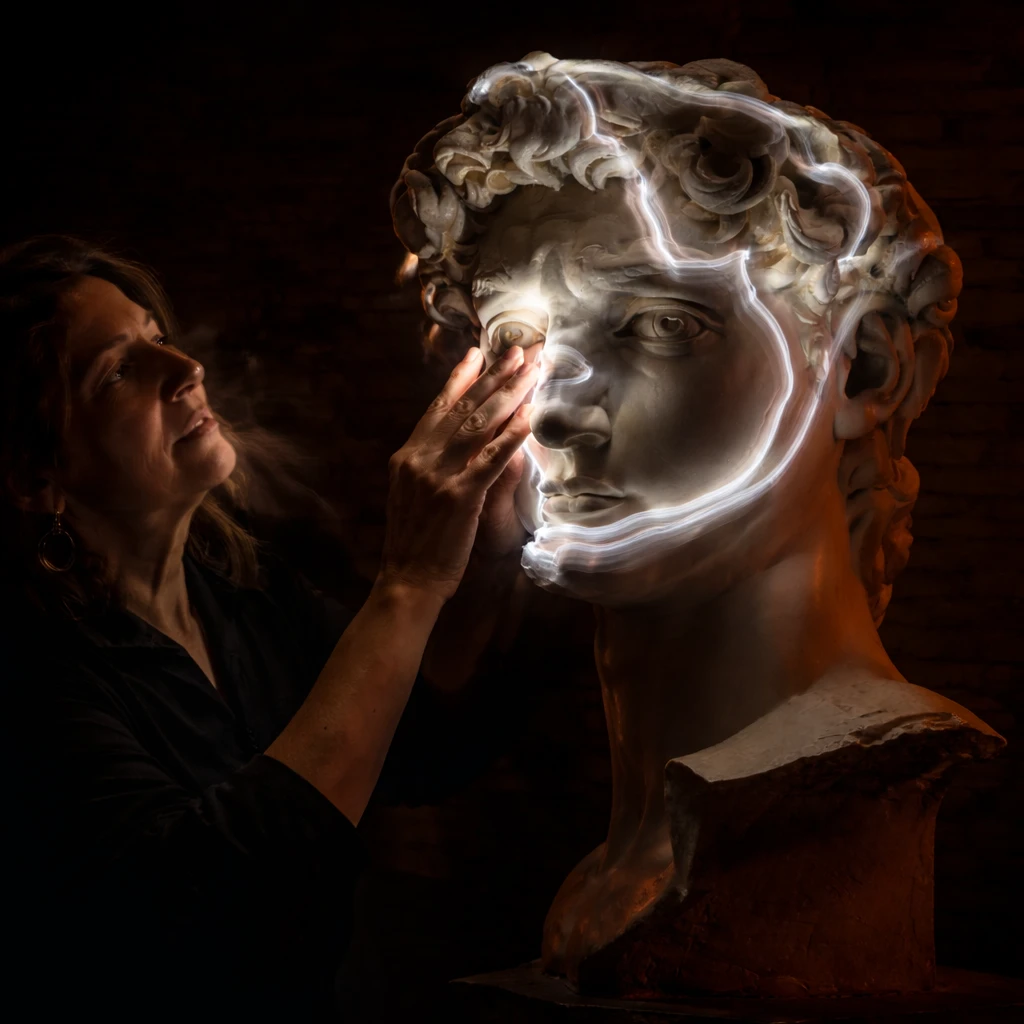

Since 2005, Alessandra Tarantino has contributed to The Associated Press from Italy, operating mainly out of Rome and focusing on the Vatican, sports, and political stories. Expressing her motivation behind a recent powerful photograph, she describes a long-held interest in telling stories related to blindness, though initially lacking an approach that felt authentic and impactful.
An opportunity arose through a reunion with Giorgio Guardi, a friend involved with Radici, an organization dedicated to inclusive tourism in Rome that arranges specialized tours for individuals with disabilities, including those who are blind and deaf. Tarantino participated in one such tour during a chilly November day, observing firsthand how blind participants engage with their surroundings by touching artworks, sensing textures, and relying on tour guides to guide their hands across art pieces. This experience revealed for her the multifaceted nature of the tactile perception—beyond mere physical touch, it encompasses the guide’s voice, ambient scents, and an intimate emotional connection that collectively contribute to what is termed the “tactile image.”
While pondering how to photographically represent this tactile perception, Tarantino recalled the pioneering work of Gjon Mili, who in the late 1940s created a memorable series of light trail portraits featuring Pablo Picasso sketching midair. This evocative imagery, which had graced LIFE magazine in 1949, offered a conceptual scaffold for expressing non-visual interaction with art.
The challenge lay in translating how a blind person “sees” through touch into a photographic expression. Given sighted persons' difficulty imagining this experience, Tarantino devised a plan to marry Mili’s light trail technique with the emotional and sensory exploration of a blind individual encountering a sculpture.
Consulting with the Museo Tattile Omero's communications head led her to Stefania Terre, a blind woman willing to collaborate on this artistic project. Tarantino shared with Stefania both the inspirations coming from Picasso’s image and the idea to transform her tactile encounter with art into a new form of visual art.
They convened at the Museo Omero following a tour where Stefania engaged with the tactile artwork. When the museum closed for the day, the staff switched off all illumination, creating near-total darkness. Stefania was given a small LED light affixed to a finger via an elastic band. As she gently explored the life-sized face of Michelangelo’s David, Tarantino used a camera mounted on a tripod to take a 24-second long exposure photograph.
The result was striking. Emerging from the encompassing darkness is the illuminated visage of David, subtly outlined by the movements of Stefania’s hand holding the LED light. Stefania’s own face faintly appears in the background, partially lit by ambient light filtering into the museum. This method captured the light trails of her tactile exploration, conveying not only the physical act of touching but symbolizing an alternate sensory pathway to experiencing art.
From a technical perspective, Tarantino details her photographic settings: ISO 50 for minimal grain, an aperture of f/16 for deep focus, and a shutter speed of 24 seconds to capture the entire gestural interaction. The tripod ensured stability during the prolonged exposure, preventing blur beyond the intended light movement.
She believes this image transcends traditional visual storytelling by challenging viewers to reconsider how art can be perceived and appreciated. The Museo Tattile Omero’s slogan, “Forbidden not to touch,” encapsulates the essence of this sentiment—highlighting touch as a vital and enriching experience in art that complements or even substitutes visual input.
The image remains unpredictable despite preliminary tests, its final manifestation depending on the real-time interplay of light, motion, and environment. This unpredictability lends the photo an authenticity that deepens its impact.
Key Points:
- The photograph creatively conveys how blind individuals experience art, emphasizing multiple senses beyond sight, such as touch and auditory cues.
- Employing a long-exposure technique inspired by mid-20th century photographs of Picasso, the image visualizes the tactile exploration of sculpture.
- Collaboration between the photographer, blindness advocates, and a specialized museum provided practical and conceptual frameworks for the project, underscoring inclusive engagement with art.
Risks and Uncertainties:
- The unpredictable nature of long-exposure photography in low-light, real-world conditions introduces variability in the final artistic output.
- Communicating the subjective tactile experience to primarily sighted audiences carries the challenge of accurately representing a fundamentally non-visual perception.
- Access to specialized institutions and willingness of participants with disabilities are essential factors influencing the feasibility of similar projects.
Impacted Sectors: This work intersects with cultural institutions, accessibility services, and the arts sector, highlighting the importance of inclusive programming and adaptive technologies. It may also influence public perceptions in fields related to disability advocacy and sensory studies.