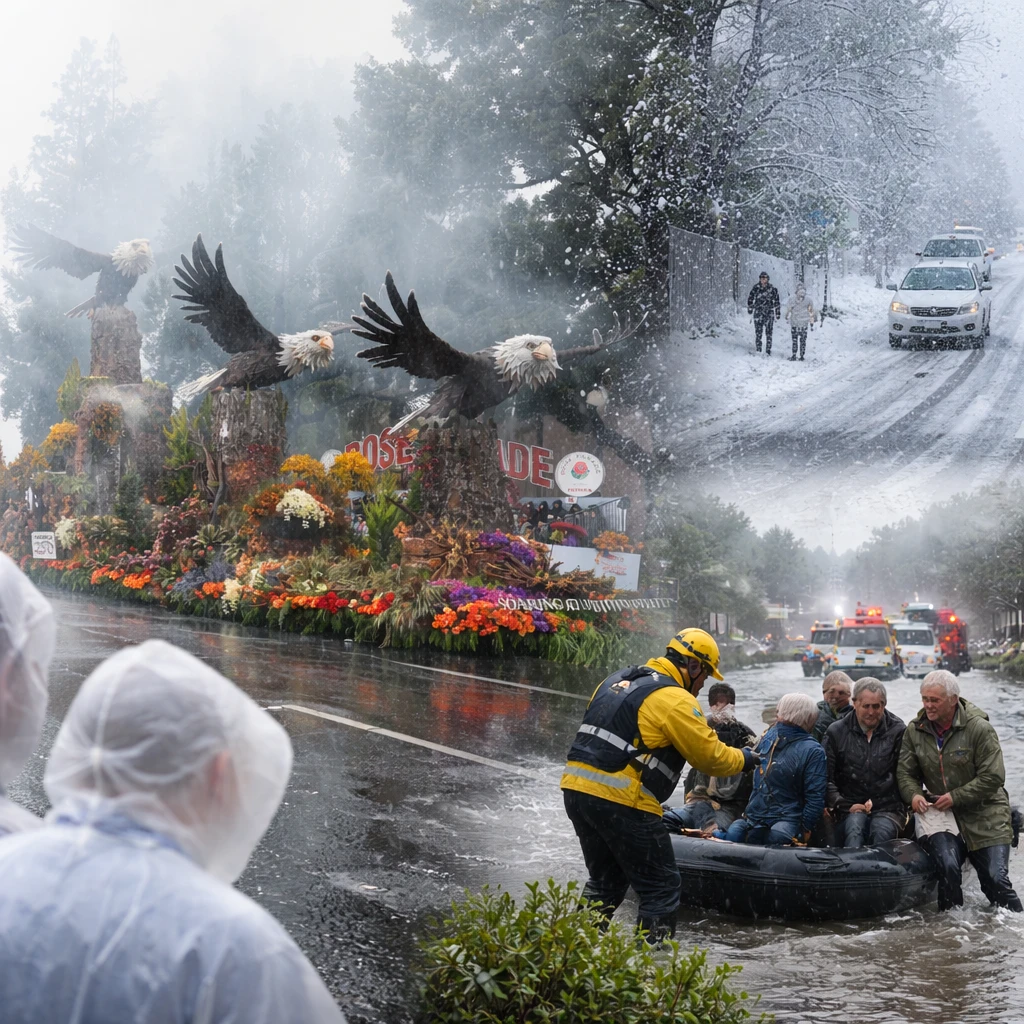

On New Year's Day, the Rose Parade in Pasadena, California, was met with rainfall for the first time in 20 years, marking a significant shift in the region's traditional New Year's weather. Marching bands, elaborate floats, and attendees along the six-mile parade route were subjected to persistent rain measuring between one to two inches (2.5 to 5 centimeters). The temperature at the parade's 8 a.m. commencement registered at a cool 58 degrees Fahrenheit (14.4 degrees Celsius), contributing to a damp and chilly atmosphere for participants and spectators.
Despite the weather, the event proceeded with few alterations. Organizers from the Pasadena Tournament of Roses implemented minor adjustments, such as covering the tops of convertibles carrying grand marshal Earvin "Magic" Johnson and other VIPs to shield them from the showers. The two-hour parade, which draws hundreds of thousands of attendees in person and millions more via national television broadcasts, had experienced no rain for two decades prior to this occurrence.
Throughout the preceding week, weather forecasts steadily predicted increased rainfall for the parade day. Subsequently, the National Weather Service issued a flood watch applicable to all counties in California, with a coastal flood advisory extended through Sunday afternoon for areas along the Pacific Coast near San Francisco. Concurrently, evacuation warnings were announced for residents in regions of Southern California severely impacted by the wildfires of the previous year, adding another layer of complexity to the area's weather-related challenges.
In the Northeast, New York City greeted the new year with clear skies as it prepared for Mayor Zohran Mamdani's inaugural celebration. However, harsher weather conditions affected other parts of the Northeast and the Midwest. An Alberta clipper storm combined with a trailing Arctic front generated a mix of snow squalls and strong winds, resulting in varying intensity of snow from light showers to more substantial squalls. These conditions extended from Wisconsin, through northern Illinois and Michigan, and reached into northern New Jersey, southeastern New York, and New England.
Travel disruptions were evident as approximately 25 percent of flights departing from San Diego International Airport and Boston Logan International Airport experienced delays, according to data from flight tracker FlightAware. These transport disturbances emphasize the broader impacts of the winter weather conditions plaguing both coastal and inland regions during this holiday period.