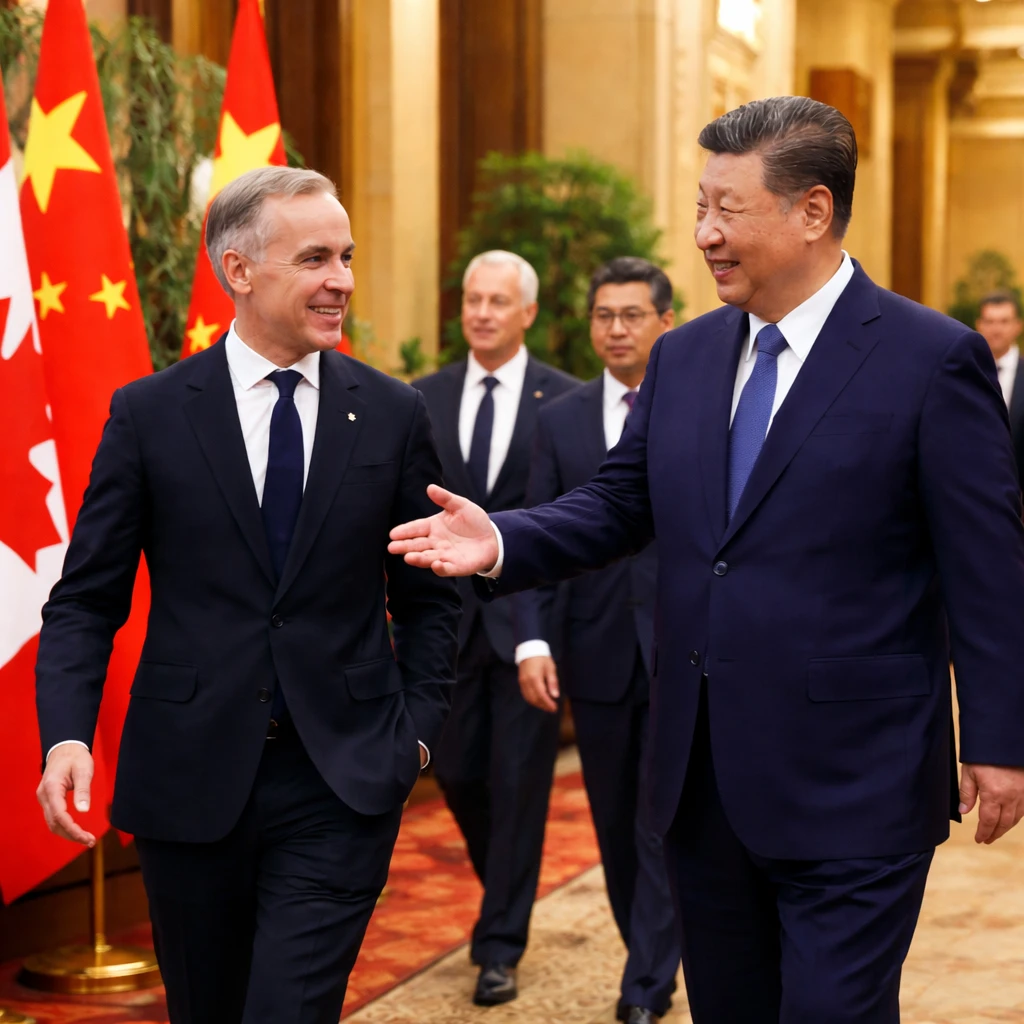

Chinese President Xi Jinping has recently hosted a series of high-profile visits from Western leaders aiming to enhance their economic and diplomatic connections with China, the world’s second-largest economy. Notably, Canadian Prime Minister Mark Carney concluded a trade agreement that significantly reduced tariffs on Chinese electric vehicles and Canadian canola oil. In the United Kingdom, Prime Minister Keir Starmer arrived in Beijing to mend relations strained over recent years. German Chancellor Friedrich Merz is also slated to visit China next month, while Finnish Prime Minister Petteri Orpo is among the latest European dignitaries to engage directly with Xi in Beijing.
This trend marks a departure from the international posture formed during the administration of former U.S. President Donald Trump. His tenure was characterized by confrontations over tariffs and controversial proposals such as acquiring Greenland from Denmark, a NATO ally. Despite the risk of displeasing Trump, several U.S. allies are actively exploring cooperation with China, historically perceived as an adversary and the foremost economic competitor to the United States.
Addressing the global economic forum in Davos following his return from Beijing, Carney portrayed the engagement with China as pragmatic and strategic. He emphasized partnering with the world as it exists, rather than aspiring toward an idealized geopolitical scenario: "We’re engaging broadly, strategically with open eyes," he said.
While some legislators and analysts view these renewed Chinese partnerships as a shift potentially advantageous for Beijing at the expense of U.S. influence, others argue that China and the U.S. present comparable challenges to their partners due to their assertive pursuit of national interests. This evolving alignment underscores changing interactions between global powers and their allies.
Senator Jeanne Shaheen, ranking Democrat on the Senate Foreign Relations Committee, critiqued the U.S. approach, stating, "Instead of creating a united front against China, we’re pushing our closest allies into their arms." In response to inquiries about Starmer's visit, former President Trump described such diplomatic outreach as "very dangerous for them to do that." He further cautioned against Canada's engagement with China, questioning its economic well-being and casting doubt on positioning China as a solution. Trump himself is anticipated to visit Beijing in April.
European Union's foreign policy chief, Kaja Kallas, acknowledged China's long-term challenges, especially regarding economic coercion, yet advocated diversifying partnerships globally. According to Una Aleksandra Bērziņa-Čerenkova from the Latvian Institute of International Affairs, Europe's strategy is not a pivot toward China but a move to fortify the continent as an independent bloc.
Analysts note Beijing's increasing efforts to engage individual European capitals directly, effectively bypassing Brussels' EU leadership. Alicia Gracia-Herrero, a specialist on Europe-China relations at the investment bank Natixis, explained that China seeks to maintain current dynamics—gaining access to wealthy European consumers without reciprocating market concessions. Tim Rühlig of the EU Institute for Security Studies highlighted incidents like the U.S.'s interest in Greenland and China's rare earth export controls as pivotal moments pushing Europe to recognize both powers as monopolistic bullies.
European leaders, similar to their American counterparts, visit Beijing acknowledging China's substantial economic stature and influence in global affairs, alongside the imperative to maintain effective communication channels. Joerg Wuttke, former president of the EU Chamber of Commerce in China, noted, "Everyone goes to Beijing, including the guy who doesn’t want us to go to China."
Canada, under Prime Minister Justin Trudeau, originally aligned with U.S. policy by imposing a 100% tariff on Chinese electric vehicles to guard American manufacturing interests. However, Carney's recent visit in 2024 resulted in a reduction of that tariff in exchange for reduced Chinese tariffs on Canadian agricultural goods. Carney described the renewed trade relationship as "more predictable," implicitly criticizing Trump's earlier tariff threats. Despite Trump threatening tariffs against Canada following this deal, Carney dismissed such threats as posturing. At Davos, Carney condemned coercion from great powers on smaller nations, emphasizing the need for middle powers to unify their voice to avoid being marginalized—a sentiment resonating strongly in Europe.
British Prime Minister Starmer's Beijing visit marks the first in eight years by a UK leader, aiming to overcome longstanding disagreements involving security concerns, technology, and Hong Kong's political situation. Both leaders advocated for a strategic partnership, with Starmer affirming collaboration on climate change and global stability challenges. The visit yielded various agreements, including reduced Chinese tariffs on Scotch whisky and a 30-day visa-free scheme for British tourists and business visitors.
Similarly, Finnish Prime Minister Orpo engaged with Chinese Premier Li Qiang to advance cooperation in sustainable construction, energy, and animal disease control. Orpo also called on China to contribute toward resolving the Ukraine conflict, addressed trade imbalances, and raised human rights concerns. Other recent visitors to Beijing include French President Emmanuel Macron, Irish Prime Minister Micheál Martin, and South Korean President Lee Jae Myung. Chancellor Merz’s upcoming visit is anticipated to balance Germany’s concerns over trade deficits and dependencies on China for critical minerals while maintaining a robust dialogue.
As European and other U.S. allies draw nearer to China in economic and diplomatic terms, analysts warn of potential fractures within Western alliances. Scott Kennedy, senior adviser at the Center for Strategic and International Studies, observed the difficulty for the U.S. and its partners to present a unified stance, whether in isolating China or establishing cooperative conditions.
These developments unfold against a backdrop of shifting international economic relations affecting sectors such as automotive manufacturing, agriculture, energy, and high-technology industries. The dynamics influence market access, trade policies, and supply chain considerations critical to these sectors' strategic planning and financial stability.