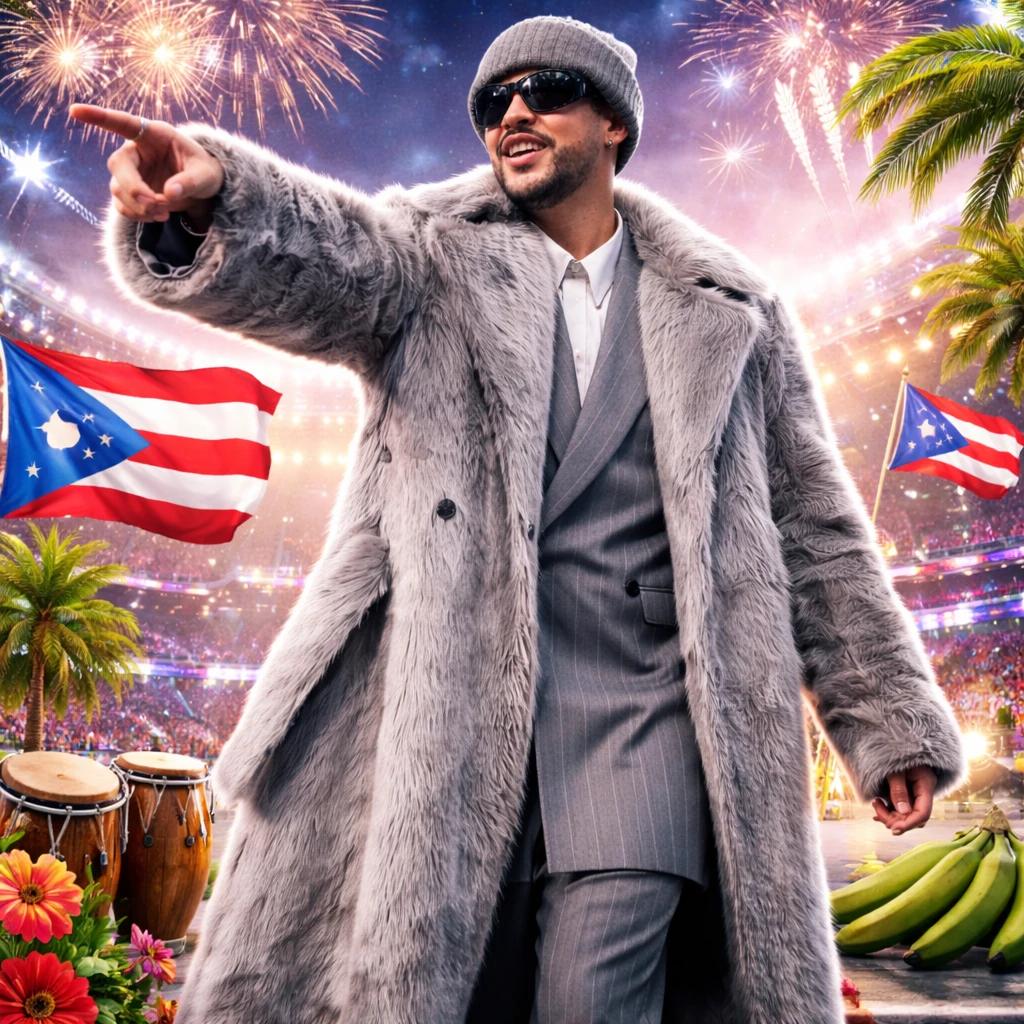
The Super Bowl halftime show represents one of the most anticipated entertainment moments in sports, and this year’s performance by Bad Bunny promises to be a landmark celebration of Latino heritage. Fresh off an unprecedented Grammy win for his album "Debí Tirar Más Fotos," a heartfelt homage to Puerto Rico, the artist is preparing to captivate audiences on Sunday with a dynamic set that is anticipated to run approximately 13 minutes, fitting within the historical range of 12 to 15 minutes for such shows.
During a recent interview, Apple Music’s Zane Lowe revealed the anticipated length of the performance, while Bad Bunny himself shared limited specifics, maintaining an air of mystery. He characterized the event as a "huge party," emphasizing his intent to infuse the stage with rich aspects of his cultural background, though he refrained from giving away details or confirming potential surprise guests.
A preview in the form of a 90-second trailer released last month set a festive and inviting tone. In it, Bad Bunny interacts with a flamboyan tree, symbolically pressing play on his track "Baile Inolvidable," a modern salsa number featuring collaborators from the Libre de Música San Juan, an educational institution. The song is a key component of "Debí Tirar Más Fotos," which artfully blends traditional Puerto Rican genres such as bomba, plena, salsa, and música jíbara with modern styles including reggaeton, trap, and pop.
The trailer spotlights a variety of dancers from diverse backgrounds and ages, including a salsa dancer clad in a red dress, a firefighter, a cowboy, and an elder known affectionately as a "viejito" wearing a traditional pava hat, illustrating the broad and cross-cultural appeal of the performance. Bad Bunny, recognized as the most-streamed artist globally on Spotify, continues to resonate with a worldwide audience.
Considering language, Bad Bunny’s repertoire is predominantly in Spanish, and no indication suggests a departure from this in the halftime show. At a prior "Saturday Night Live" hosting gig, he incorporated a minimal amount of Spanish with a humorous nod to non-Spanish speaking viewers, playfully encouraging them to learn the language before the Super Bowl. He has reiterated that while knowledge of Spanish isn't necessary to enjoy the show, attendees should certainly be prepared to dance.
Various symbols tied intimately to Puerto Rican identity and history are expected to feature prominently. The Puerto Rican flag is likely to be displayed, potentially in different color schemes that hold specific connotations: the current red, white, and blue for the official flag; light blue, which is associated with the independence movement; black and white, emblematic of struggle and resilience; and colors echoing the Dominican Republic’s flag representing the historical Lares revolution. These visual elements draw from lyrics such as those in "La Mudanza," where Bad Bunny references the outlawing of the Puerto Rican flag during the Gag Law era, reinforcing pride and remembrance.
Expressions unique to Puerto Rican culture, such as "Wepa!" a celebratory exclamation, and "Acho, PR es otra cosa," a phrase popularized during his residency performances, might be integrated to reflect the island’s vibrancy. The staging might include a casita, a symbolic small house typical in Puerto Rican and broader Caribbean culture, replicating a house party atmosphere. Another culturally significant item is the pava, a straw hat linked to the jíbaro rural farmers, which has become a proud emblem embraced by Bad Bunny, even appearing as a fashion statement in previous high-profile events.
The natural beauty of Puerto Rico may also be highlighted through imagery associated with the flamboyan tree, noted for its brilliant red, orange, and yellow blossoms, commonly depicted in Puerto Rican art. This imagery links to the island's identity alongside its famous nocturnal amphibian inhabitants, the coquí frogs, whose calls are distinctive and widely recognized symbols. Additionally, the endangered Puerto Rican crested toad, "el sapo concho," has been visually represented in Bad Bunny’s recent work and could be included symbolically in the show’s visuals.
Musical instrumentation is expected to feature traditional Puerto Rican elements, given Bad Bunny’s incorporation of bomba and plena styles in his recent project. Instruments like the cuatro, a small four-string guitar; güiro or güira, a hollow gourd percussion instrument; palitos, wooden sticks for rhythm; cencerro, a cowbell; maracas; as well as specialized instruments such as the barriel (barrel drum for bomba) and pandereta (tambourine for plena) may be on display or audible throughout the performance.
While specifics about guest appearances remain unknown, there is speculation that other influential Latin artists or Puerto Rican performers may join Bad Bunny on stage. Collaborators from his San Juan residency, like the band Chuwi, as well as musical luminaries including Marc Anthony, Ricky Martin, Jennifer Lopez, Young Miko, Wisin y Yandel, Gilberto Santa Rosa, and Alfonso Vélez could potentially be involved based on past associations.
Regarding political messaging, the nature of Bad Bunny’s show will ultimately be interpreted by viewers. Previous halftime shows have incorporated politically charged elements, such as Jennifer Lopez's inclusion of imagery related to U.S. immigration issues and Kendrick Lamar’s metaphorical commentary on racial dynamics. Bad Bunny himself has not shied from political expression, criticizing responses to hurricanes in Puerto Rico, immigration policies, and taking a stand with statements like "ICE out" during his recent Grammy acceptance. His past decisions around tour destinations have also hinted at considerations about immigration enforcement for fans. Notably, former President Donald Trump, who will not attend this year's game, disparaged Bad Bunny as a "terrible choice," contrasting with his attendance at last year’s Super Bowl, where Bad Bunny also performed to critical acclaim.