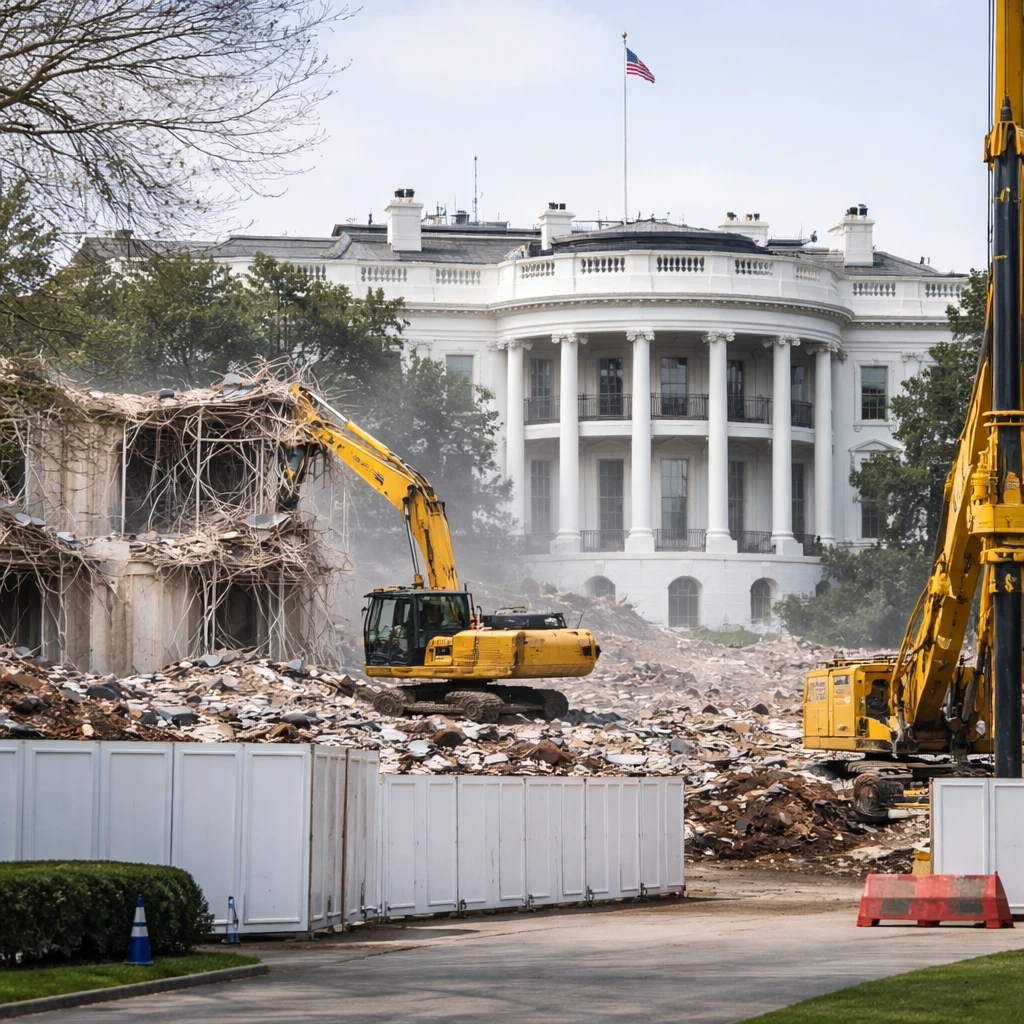

WASHINGTON — In a public session before the National Capital Planning Commission, officials from the White House elaborated on their decision to demolish the East Wing instead of renovating it, emphasizing structural deficiencies and cost-effectiveness as key drivers.
Josh Fisher, the director of the White House Office of Administration, outlined a range of severe problems afflicting the East Wing. These included an unstable colonnade, ongoing water intrusion, and extensive mold buildup, all of which contributed to an assessment that demolition followed by reconstruction would be the most financially prudent long-term strategy for accommodating the new ballroom project estimated at $400 million.
"Considering these and other complications, analyses determined that tearing down the existing structure and rebuilding was the lowest total cost solution and the most sustainable approach for the future," Fisher stated during the hearing.
Initiated without broad public announcement in October, the East Wing demolition generated notable public attention, prompting the detailed explanations presented on Thursday to elucidate the necessity of such drastic measures.
The ballroom's design includes an addition of a second floor to the colonnade adjoining the West Wing. Project architects and White House officials highlighted that this modification intends to visually harmonize the historic complex by mirroring the new ballroom situated on the opposite side. However, this alteration will also significantly transform the iconic space directly outside the Oval Office.
Additionally, the construction plans incorporate a new visitor entry complex. This facility is designed to facilitate smoother access for guests attending events in the new ballroom, eliminating the need for temporary, often inadequate, structures such as tents that have been utilized during larger occasions.
During the commission meeting, Commissioners raised several queries. Phil Mendelson, chairman of the D.C. Council and a commission member, sought clarity on the possibility of changes to the ballroom's size and location. Officials responded that while modifications remain conceivable, the current plans have undergone thorough study.
Mendelson also questioned whether the proposed ceiling height, projected between 38 and 40 feet (approximately 11.5 to 12 meters), could be reduced prior to finalization. Officials assured that the dimensions are not definitively fixed, though Mendelson expressed concerns about the ballroom's imposing scale relative to the existing structure.
Will Scharf, appointed by the President as commission chair, appeared receptive to these concerns. However, he noted that upon completion, the ballroom would indeed surpass the size of the existing White House footprint.
Mendelson further inquired about why the complete project had not been submitted for full review prior to the commencement of demolition. Fisher explained that aspects of the ballroom’s construction bear a "top secret" classification, limiting disclosure. Scharf reiterated that the commission traditionally lacks oversight over site preparation and demolition phases of White House projects, pointing out the precedent set by similar work at the Smithsonian's National Air and Space Museum, where demolition preceded full commission approval.
Scharf acknowledged the vocal reaction the ballroom project has elicited, noting "passionate comments on both sides," and clarified that the current session was limited to commissioner questions and feedback, reserving public commentary and formal approvals for an anticipated review in spring. The commission’s subsequent meeting is scheduled for February 5.
In defending the project, Scharf emphasized the need for an expanded and refined venue to host official events. Reflecting on a recent visit with President Trump to Windsor Castle, he underscored that hosting distinguished guests like King Charles III would necessitate a grander indoor space. "Currently, such guests are more likely than not to be accommodated outdoors under tents equipped with porta-potties," Scharf remarked.
Another Trump appointee to the commission, Deputy White House Chief of Staff James Blair, echoed the sentiment that the American public merits a venue capable of hosting significant and dignified gatherings.
Speaking with reporters after the meeting, Scharf contextualized the concerns, stating their main focus is not about the desirability of the ballroom itself but rather the anticipated impact on visitor experiences and the interaction of the new structure with the surrounding site and city environment.
Plans for the ballroom were only recently submitted to the commission, a federal panel that typically reviews such projects prior to initiation. This timing has drawn litigation from the National Trust for Historic Preservation, which alleges procedural violations including insufficient independent reviews, lack of congressional approval, and absence of public comment before construction began.
The commission’s website describes the ballroom project as a means to "establish a permanent, secure event space within the White House grounds," intended to increase capacity for official functions, supplant temporary event facilities, and maintain the historic and cultural integrity of the White House property. Past design assessments as far back as 2000 recognized the growing necessity for expanded event space suitable for significant gatherings.
The ballroom's scale has evolved since its initial announcement. Initially projected at 90,000 square feet with accommodation for 650 seated guests and a budget of $200 million, the project’s specifications have been increased to seat 999, with the price now estimated at $400 million. President Trump has asserted that private donations, including his own contributions, will finance the construction.
Demolition of the old East Wing to make way for the ballroom occurred last October. The White House aims to complete the construction before the conclusion of President Trump's term in January 2029. Features such as bulletproof glass and a capacity designed to host future presidential inaugurations are included in the plans. Recently, the President personally procured marble and onyx materials for the ballroom at his expense, though financial details remain undisclosed.