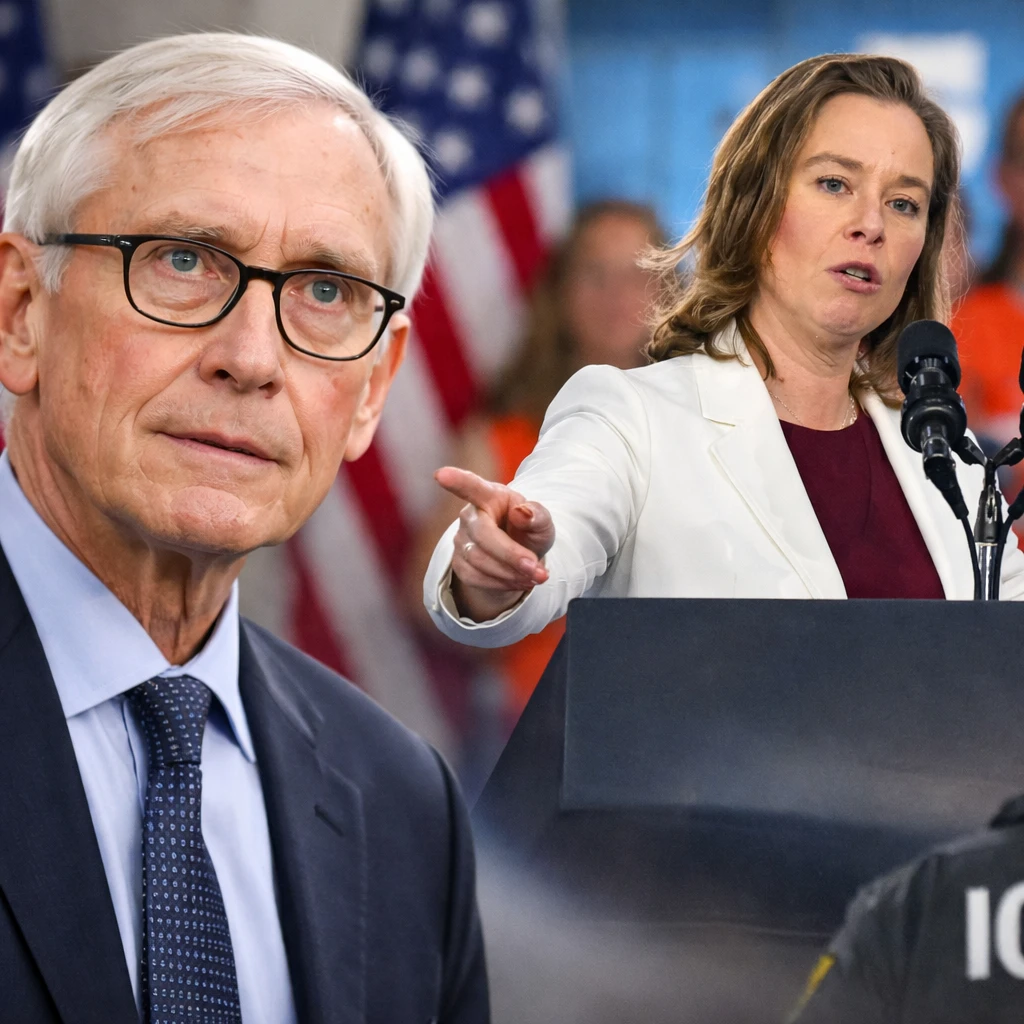
In the state capital of Madison, Wisconsin, Governor Tony Evers, a member of the Democratic Party, has publicly questioned the practicality and advisability of a proposal initiated by his lieutenant governor, Sara Rodriguez, aimed at limiting federal immigration enforcement in certain public spaces. The proposal suggests prohibiting civil immigration enforcement activities around critical community areas, including courthouses, health facilities, licensed child care centers, educational institutions, shelters for victims of domestic violence, and places of worship.
Rodriguez, also a Democrat and a candidate for governor in the forthcoming election to succeed Evers—who has chosen not to pursue a third term—set forth this initiative on a Monday following a contentious period marked by immigration-related incidents in the neighboring state of Minnesota. Rodriguez and Evers were elected on the same ticket in 2022 after she secured the lieutenant governor nomination.
The plan outlined by Rodriguez advocates that these designated locations be safeguarded from enforcement actions unless exceptions are warranted by a judicial warrant or if an immediate threat to public safety is identified. She emphasized the need for Wisconsin to join other states that are taking steps to regulate the scope and methods of federal immigration officers operating within their jurisdictions.
Governor Evers responded to queries about the proposal during a news briefing on Monday by expressing skepticism concerning the state’s capacity to enforce such a ban on federal immigration enforcement. He also voiced apprehension regarding the response it might provoke from the Trump administration, indicating that such a move could potentially escalate tensions and result in heightened federal actions.
"I’m not sure we have the ability to do that," Evers remarked. He further noted, "Banning things absolutely will ramp up the actions of our folks in Washington, D.C. They don't tend to approach those things appropriately."
Despite the governor's concerns, Rodriguez maintained her stance on Tuesday. She acknowledged the governor's perspective but insisted that the state should not withhold from implementing measures aimed at limiting immigration enforcement. "For too long Democrats have dialed back actions in hopes President Trump doesn’t escalate, and that’s not what happens," she stated in a formal release. "He always escalates."
Rodriguez's proposal follows the fatal shooting last week of Renee Good by an Immigration and Customs Enforcement (ICE) officer in Minnesota, an event that ignited protests nationwide, including in Wisconsin, denouncing the aggressive deportation tactics employed under the Trump administration.
In an effort to counter increased immigration enforcement, Minnesota, along with its cities Minneapolis and St. Paul, has initiated a lawsuit against the federal government seeking a temporary restraining order to halt the surge in enforcement activities. This legal challenge aims to curtail or limit the federal operation in the state.
The approach proposed by Rodriguez in Wisconsin draws significant influence from comparable initiatives being advanced in other Democratic-led states such as California, New York, Illinois, and New Jersey. Nonetheless, any such legislation introduced in Wisconsin faces slim prospects in light of the state’s Republican-controlled legislature, where these policies lack support.
Additionally, Rodriguez has called for all ICE agents operating in Wisconsin to be clearly identified by name, wear visible identification, and be equipped with body cameras. Her argument is centered on fostering transparency and accountability in immigration enforcement practices.
She remarked, "No one should be afraid to drop off their kids at school, seek medical care, go to court, or attend worship because enforcement actions are happening without clear rules or accountability."
When pressed on whether ICE officers are welcome in Wisconsin, Governor Evers deflected by emphasizing the state’s capacity to manage immigration-related matters independently, stating, "I think we can handle ourselves, frankly. I don’t see the need for the federal government to be coming into our state and making decisions that we can make in the state."