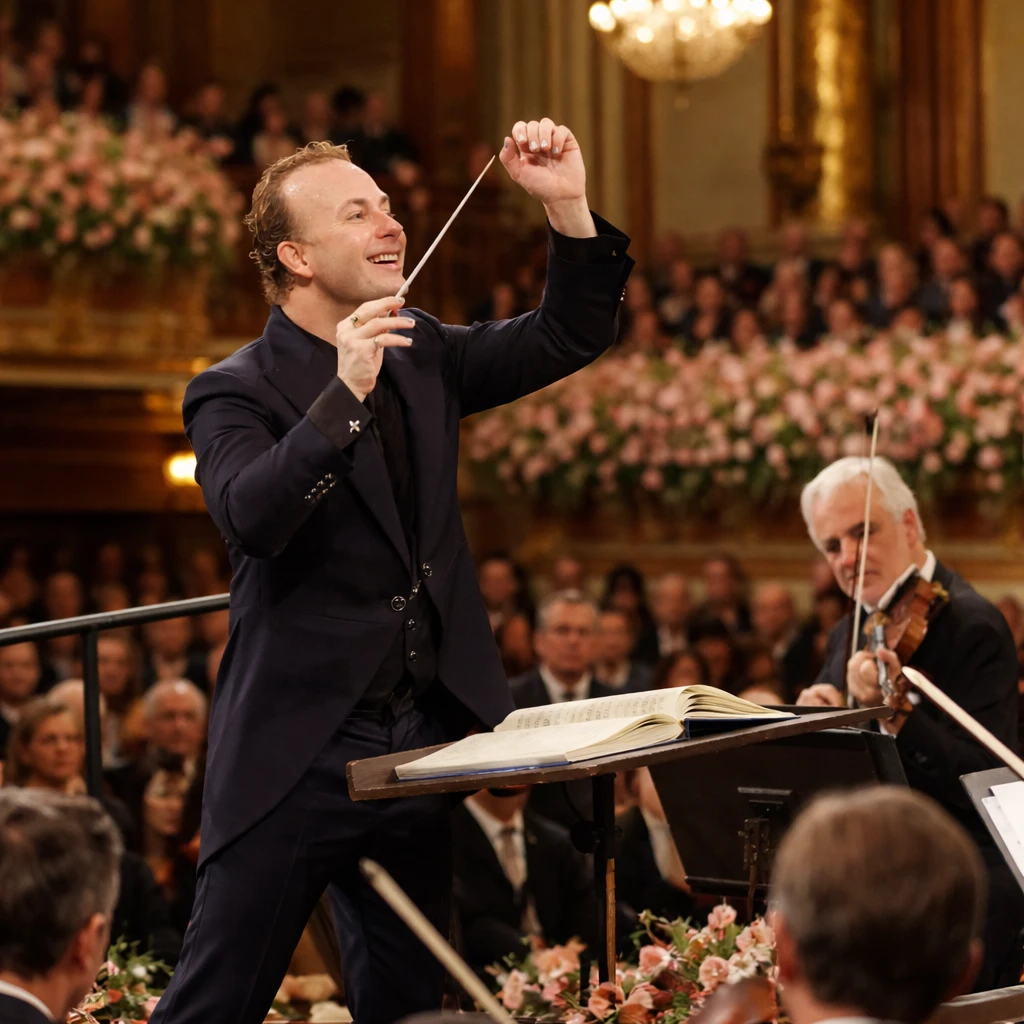
Yannick Nézet-Séguin’s unexpected elevation to conduct the Vienna Philharmonic's New Year's Day concert traces back to his swift intervention at New York’s Carnegie Hall in 2022. Just days before the Vienna Philharmonic was set to embark on a tour there with conductor Valery Gergiev, Nézet-Séguin, leading the Philadelphia Orchestra, noticed a promotional poster for the Vienna event. Reflecting on the moment, he thought, “This looks like a Yannick program.” This intuition would soon lead to a pivotal role in one of the world's most esteemed concert traditions.
The catalyst for the sudden change was Russia's invasion of Ukraine in February 2022, which compelled the Vienna Philharmonic to withdraw not only Gergiev, a known supporter of Vladimir Putin, but also pianist Denis Matsuev. Nézet-Séguin accepted the urgent invitation to lead their subsequent Carnegie Hall performances, a gesture the orchestra's chairman, violinist Daniel Froschauer, described as gratitude for his assistance in salvaging the tour. The replacement engagement culminated in Nézet-Séguin conducting the orchestra's celebrated waltz concert, broadcast globally to millions.
At the time, Nézet-Séguin was already an influential figure in classical music, holding posts as music director of the Philadelphia Orchestra, the Metropolitan Opera, and Montreal’s Orchestre Métropolitain. The Vienna Philharmonic had barely arrived in the United States for scheduled concerts when their leadership, led by Carnegie artistic director Clive Gillinson, decided Gergiev and Matsuev could no longer participate.
Gillinson reached out to Nézet-Séguin, who initially missed the call while exercising virtually. He promptly returned the call and accepted the demanding commitment despite a busy schedule including preparation for a Met Opera premiere. Nézet-Séguin agreed to maintain the original repertoire, which featured Rachmaninoff's Piano Concerto No. 2 and Symphony No. 2, despite a change in soloist from Matsuev to South Korean pianist Seong-Jin Cho. Cho had traveled overnight from Berlin after late-night rehearsals in a hotel bar, where he practiced amidst patrons who mistook him for performing, all while preparing for a 7 a.m. flight to New York.
Upon arrival, Cho had scant time to rehearse with Nézet-Séguin, who was concurrently conducting the dress rehearsal of Verdi’s “Don Carlos” at the Met. The compressed schedule and intense performances took a toll; Nézet-Séguin would later contract COVID-19, acknowledging the demanding program likely contributed to his illness. Despite these challenges, the concerts were met with success, and the collaboration forged a lasting bond between the conductor and the orchestra.
Although Nézet-Séguin had previously appeared with the Vienna Philharmonic, this 2022 engagement marked the end of a five-year interval devoid of collaboration. Following this, the orchestra extended several invitations including a Summer Night Concert, a California tour, a week-long Vienna residency, and a Paris performance. These engagements reflected the orchestra’s intent to embrace younger leadership amid an aging cohort of conductors, as noted by their managing director Michael Bladerer.
Nézet-Séguin joins the ranks of distinguished predecessors who have conducted Vienna’s New Year's concert, such as Herbert von Karajan, Carlos Kleiber, Claudio Abbado, Riccardo Muti, and Daniel Barenboim. For the 2026 concert, he will notably incorporate compositions by female composers Josefine Geiger and Florence Price alongside works by the Strauss family, following the inclusion of a female composer by Muti for the 2025 concert. This direction highlights a gradual diversification of the traditionally male-dominated program.
Reflecting on the honor, Nézet-Séguin remarked on the rarity and prestige of conducting the event, describing it as a long-held dream for conductors that often seems unattainable due to the nature of its selection process. In addition to his musical responsibilities, he plans to don a custom Louis Vuitton suit for the occasion, underscoring the event's ceremonious stature.