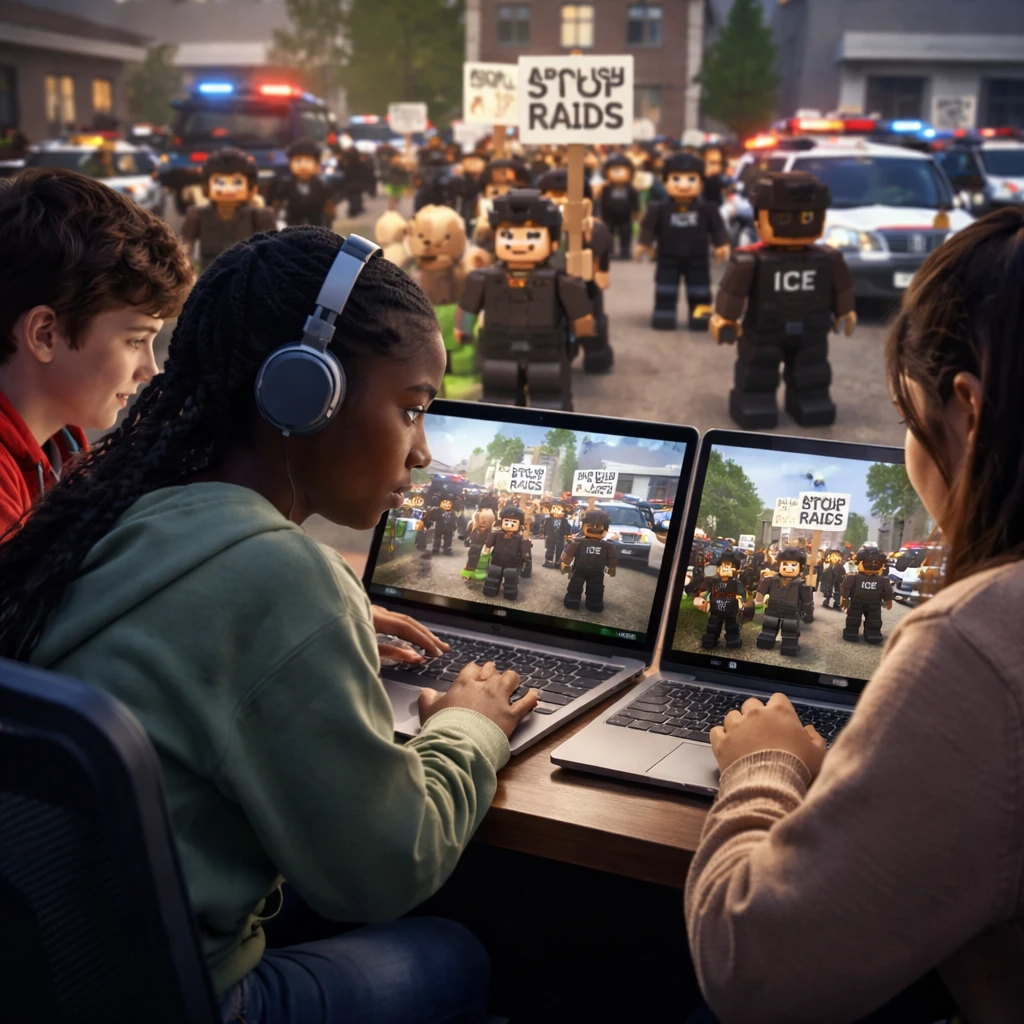

Roblox, a widely favored online game platform among children and adolescents, describes itself as the "ultimate virtual universe" where participants can "be anything you can imagine," according to its official website. Lately, some participants have assumed the roles of Immigration and Customs Enforcement (ICE) officers. Within certain Roblox roleplaying games, users have equipped themselves with virtual ICE uniforms and conducted mock "raids." Concurrently, other users have taken to virtual demonstrations, wielding signs held by their avatars with messages such as "We hate ICE." Notably, all signs comply with Roblox’s strict ban on profanity.
These scenes of protests and reenacted raids have recently gained traction on social media platforms such as TikTok, where videos showcasing these activities have attracted millions of views in recent weeks. Much of this engagement appears concentrated within a private server connected to the Brookhaven roleplaying game, one of Roblox's most popular and frequently accessed games.
Such oppositional displays and raid reenactments within Roblox are not entirely new phenomena. Previous footage exhibited similar behaviors emerging last summer, coinciding with the nationwide "No Kings" protests which primarily ecompassed reactions to escalated immigration enforcement. The renewed prevalence of such content in both the game world and social media channels suggests that young individuals are actively responding to the recent government immigration operations in Minnesota and the robust protests these actions have incited.
While virtual protests might provide a constructive outlet for children and teens to process distressing immigration news, according to Giovanni Ramos, assistant professor of clinical science at the University of California, Berkeley, the enactment of immigration raids could be more problematic. These reenactments conflict with Roblox’s established community guidelines.
A Roblox spokesperson stated on Friday that performing immigration raid reenactments contravenes the platform’s community standards. The company emphasized its commitment to taking immediate actions against those breaching such policies. Roblox’s user guidelines explicitly prohibit content that "recreates specific real-world sensitive events, mocks the victims of such events, supports, glorifies, or promotes the perpetrators or outcome of such events or capitalizes on these events for commercial purposes."
To enforce these standards, Roblox employs a multilayered strategy that integrates human moderators, user reports, and sophisticated artificial intelligence models. The platform encourages users to report any content or behaviors that violate its community standards to enable thorough investigation and prompt responses. The spokesperson acknowledged that, while no enforcement system is flawless, the company continuously works to enhance user protections daily.
Ramos noted that these virtual reenactments of raids may function to diminish the intense emotional impact immigrant youth suffer when repeatedly exposed to these chronic stressors. Nonetheless, there is concern that such roleplay might invalidate the feelings of those deeply affected if these raids are trivialized as amusement.
Additionally, Ramos suggested that many young users adopting the roles of immigration officers on Roblox could be motivated by curiosity rather than malice. He posited that such engagement might be a way for youth to explore and make sense of news reports and adult conversations they encounter regarding immigration enforcement. Furthermore, the protests orchestrated on Roblox might serve as a platform for children to find social support and build connections with others undergoing similar experiences, fostering community and emotional understanding. Ramos concluded that such virtual social bonds can be vital and should not be underestimated, potentially serving as a crucial lifeline for vulnerable youth.